
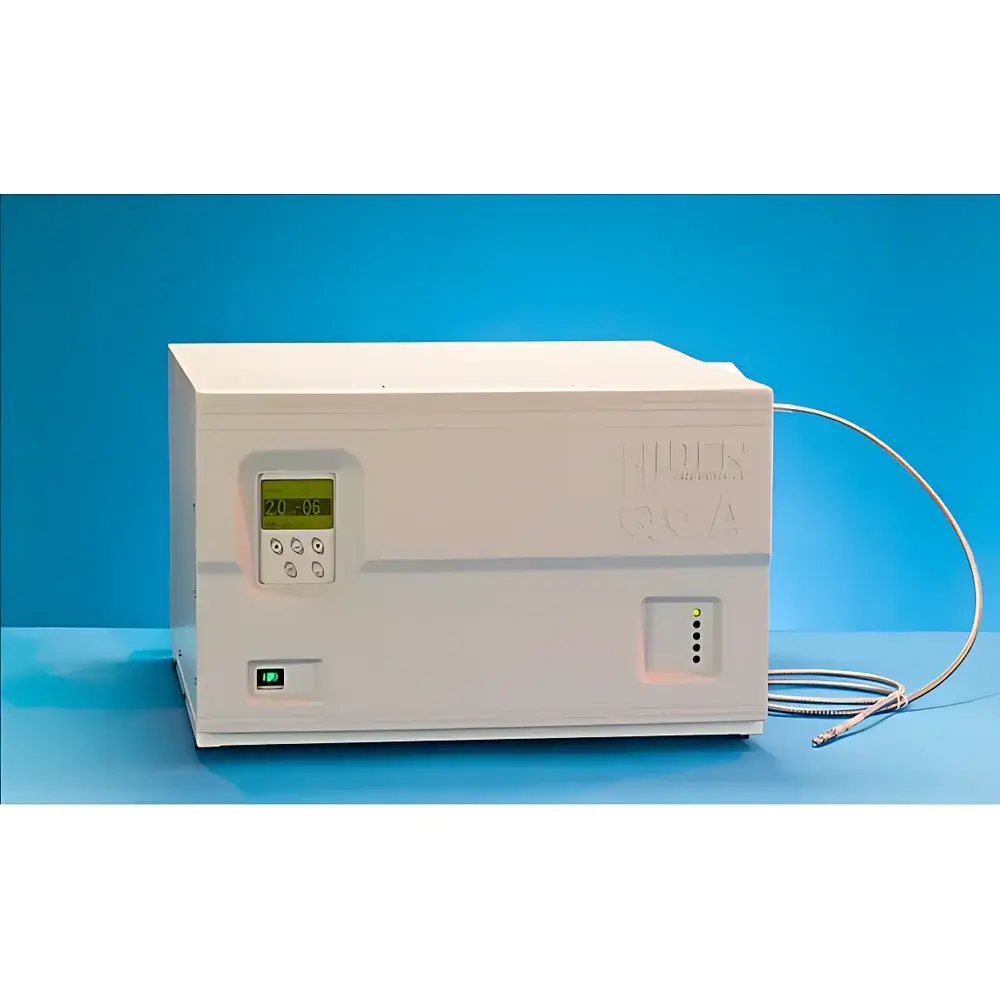
Hiden QGA Quantitative Gas Analysis Mass Spectrometer
| Brand | Hiden |
|---|---|
| Origin | United Kingdom |
| Model | QGA |
| Mass Range | 1–200 amu (standard) |
| Response Time | ≤300 ms |
| Sample Pressure Range | 100 mbar – 2 bar (standard) |
| Detection Range | 1 ppm – 100% |
| Software | QGA Professional Quantitative Analysis Suite |
| Multi-Channel Capability | Up to 80 gas streams (with optional multi-port sampling valve) |
| External Signal Triggering | Yes |
| Data Integration | Supports external sensor inputs (e.g., temperature, pressure, CO analyzers) |
| Spectral Processing | Automated library matching, overlap subtraction, dynamic spectral simulation |
Overview
The Hiden QGA Quantitative Gas Analysis Mass Spectrometer is a benchtop quadrupole mass spectrometer engineered for real-time, high-fidelity quantitative analysis of complex gas mixtures in dynamic process environments. Based on electron ionization (EI) and calibrated partial pressure measurement principles, the QGA delivers trace-to-bulk concentration data across a wide dynamic range—enabling rigorous stoichiometric tracking, reaction progress monitoring, and impurity profiling without offline sampling or chromatographic separation. Its compact vacuum architecture integrates a turbomolecular pump and heated capillary inlet, optimized for direct coupling to reactors, exhaust lines, fermentation vessels, and CVD chambers. Designed for continuous operation under variable pressure and composition conditions, the QGA meets the metrological demands of catalytic kinetics, thermal desorption studies, and regulatory-compliant gas purity verification.
Key Features
- Real-time quantification with ≤300 ms response time per mass channel—enabling sub-second tracking of transient gas events such as catalyst ignition or rapid exothermic decomposition.
- Standard mass range of 1–200 amu; extendable to 300 amu for detection of heavier organometallics, silanes, or fluorinated compounds common in MOCVD and etch processes.
- Robust pressure tolerance: operates stably from 100 mbar to 2 bar (standard), with optional configurations supporting ultra-low (1 mbar) and high-pressure (up to 30 bar) sampling—ideal for high-throughput reactor effluent analysis.
- Integrated QGA Professional software featuring automated spectral deconvolution, intelligent library scanning, and real-time overlap correction—critical for resolving isobaric interferences (e.g., CO/N₂ at m/z 28, NO/C₂H₄ at m/z 30).
- Hardware-triggered acquisition: accepts TTL or analog external signals (e.g., from thermocouples, pressure transducers, or laser pulse generators) to synchronize spectral acquisition with process events.
- Multi-sensor data fusion: accepts analog inputs for temperature, pressure, flow rate, and auxiliary gas analyzer outputs (e.g., NDIR CO, electrochemical O₂), enabling contextual normalization and cross-calibrated reporting.
- Scalable gas routing: supports sequential analysis of up to 80 independent sample streams via optional motorized multi-port sampling valves—eliminating manual line switching and ensuring reproducible dwell-time allocation.
Sample Compatibility & Compliance
The QGA accommodates gases and vapors across industrial, academic, and pharmaceutical domains—including corrosive species (HCl, HF, NH₃), reactive intermediates (radicals, carbonyls), and condensable organics (ethanol, acetone, siloxanes). All wetted surfaces are electropolished stainless steel or quartz-lined; optional heated transfer lines prevent condensation of high-boiling components. The system complies with IEC 61000-6-2/6-4 for electromagnetic compatibility and conforms to CE marking requirements. While not intrinsically safe, it may be deployed in Zone 2 hazardous areas when installed with appropriate barrier systems. Data integrity features—including audit-trail-enabled method logging, user-access controls, and timestamped raw-data archiving—support alignment with GLP, GMP, and FDA 21 CFR Part 11 documentation standards where electronic records are subject to regulatory review.
Software & Data Management
QGA Professional is a Windows-based application delivering turnkey quantitative workflows without scripting. It includes pre-loaded libraries for >500 gases and vapors (NIST-referenced), with customizable calibration tables for user-defined standards. Spectral simulation tools allow users to model expected fragment patterns under varying electron energy or source temperature—facilitating method development prior to physical experimentation. All quantitative results are traceable to primary calibration standards (e.g., certified gas mixtures, permeation tubes), with uncertainty propagation reported per ISO/IEC 17025 guidelines. Raw .qga files store full mass spectra, metadata, and auxiliary sensor timestamps; export formats include CSV, ASCII, and HDF5 for integration with MATLAB, Python (via h5py), or LIMS platforms.
Applications
- Catalysis: In situ monitoring of reactant consumption, intermediate formation, and product selectivity during TPD, TPR, and steady-state flow experiments.
- Thermal Analysis–MS coupling: Direct interface with TGA/DSC systems to identify evolved gases during decomposition, oxidation, or polymer degradation.
- Environmental Emissions: Continuous stack monitoring for NOₓ, SO₂, VOCs, and greenhouse gases under EN 15267-3 and EPA Method 25A compliance frameworks.
- Materials Processing: Real-time endpoint detection in plasma etching, ALD, and CVD reactors via precursor depletion and byproduct evolution signatures.
- Bioprocess Analytics: Fermentation off-gas profiling (O₂ uptake, CO₂ evolution, ethanol, acetaldehyde) for metabolic flux analysis and PAT implementation.
- Hydrogen Economy: Sub-ppm H₂ leak detection, purity certification per ISO 8573-8, and PEM electrolyzer gas crossover validation.
FAQ
Does the QGA require routine mass calibration?
Yes—mass axis calibration is recommended before each analytical campaign using perfluorotributylamine (PFTBA) or argon; automated routines are included in QGA Professional.
Can the QGA quantify isotopic ratios (e.g., D/H, ¹³C/¹²C)?
It provides relative abundance data at natural abundance levels; high-precision isotopic ratio quantification requires specialized magnetic sector or TOF instruments.
Is remote operation supported?
Yes—QGA Professional supports secure TCP/IP communication, enabling unattended overnight runs and integration into centralized process control networks (OPC UA compatible).
What maintenance intervals are recommended?
Filament replacement every 6–12 months depending on total ion current exposure; turbomolecular pump oil service every 2 years; annual full system performance verification is advised.
How is sensitivity affected by background water vapor?
The heated inlet and differential pumping reduce H₂O clustering artifacts; residual water interference is minimized via real-time background subtraction using the 18/19 amu ratio and user-defined blank spectra.
Related Products





