
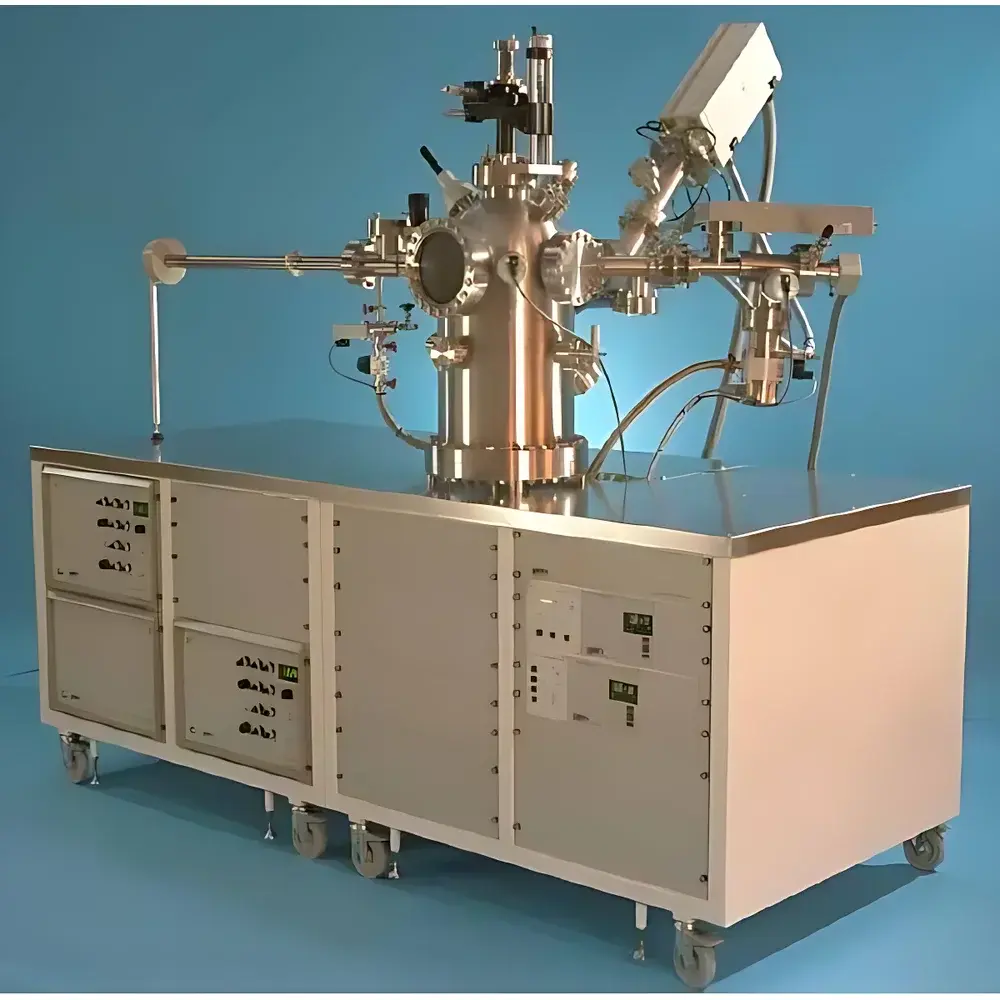
Hiden SIMS Workstation Secondary Ion Mass Spectrometer
| Brand | Hiden |
|---|---|
| Origin | United Kingdom |
| Model | SIMS Workstation |
| Mass Analyzer Type | Quadrupole |
| Primary Beam Energy | 25 keV Ga⁺ |
| Mass Range | 1000 amu |
| Mass Resolution | 0.5 amu (5% valley between adjacent equal-height peaks) |
| Detection Mode | Pulsed Ion Counting (positive/negative ions) |
| Dynamic Range | 7 decades |
| Spatial Resolution | 50 nm (Ga⁺ beam), 100–150 µm (O₂⁺/Cs⁺ beams) |
| Vacuum System | UHV-compatible, three-stage differential pumping |
| Control Interface | Ethernet LAN, RS232, RS485 |
| Software | MASsoft v6.x (GLP-compliant audit trail, method templating, automated sequence execution) |
Overview
The Hiden SIMS Workstation is a compact, high-performance quadrupole-based secondary ion mass spectrometer engineered for quantitative depth profiling, elemental imaging, and surface chemical mapping of solid materials under ultra-high vacuum (UHV) conditions. Operating on the principle of sputter-induced secondary ion emission, the instrument utilizes focused primary ion beams—including 25 keV Ga⁺ for nanoscale spatial resolution and 5 keV O₂⁺ or Cs⁺ for enhanced matrix-dependent ion yield—to eject characteristic secondary ions from the topmost atomic layers of a sample. These ejected ions are mass-analyzed by a robust 9 mm rod triple-filtered quadrupole mass analyzer, delivering high transmission efficiency and stable mass calibration across a full 1000 amu range. Designed for routine laboratory deployment rather than synchrotron-scale infrastructure, the SIMS Workstation maintains analytical rigor without requiring cryogenic pumping or complex beamline integration—making it suitable for semiconductor metrology labs, thin-film R&D facilities, and advanced materials characterization centers operating under ISO/IEC 17025 or GMP-aligned quality frameworks.
Key Features
- Triple-filtered 9 mm quadrupole mass analyzer with <0.5 amu mass resolution (5% valley definition), optimized for high signal-to-noise ratio and long-term mass stability
- Pulsed ion counting detection system offering 7-decade dynamic range and sub-part-per-trillion detection sensitivity for trace element quantification
- Dual-beam capability: Standard 5 keV O₂⁺/Cs⁺ source for enhanced positive/negative ion yield; optional 25 keV liquid metal Ga⁺ ion gun enabling ≤50 nm lateral resolution for nanostructured film analysis
- UHV-compatible chamber (<1×10⁻⁹ mbar base pressure) with three-stage differential pumping, compatible with co-located XPS, AES, or LEED systems
- Gridded raster scanning optics supporting simultaneous acquisition of positive, negative, and neutral species in mixed-mode operation
- Integrated Penning gauge and hardware interlocks ensuring overpressure protection during sample loading and vent cycles
- Modular sample stage with manual XYZ translation and tilt adjustment—no robotic autoloader required, minimizing maintenance overhead while preserving analytical flexibility
Sample Compatibility & Compliance
The SIMS Workstation accommodates conductive and insulating samples up to 25 mm in diameter, including Si wafers, oxide multilayers, perovskite thin films, metallic alloys, and polymer composites. For electrically non-conductive specimens, the optional low-energy electron flood gun mitigates surface charging during prolonged sputtering. All vacuum components comply with ISO 27427 (vacuum technology — terminology and definitions) and meet CE marking requirements for electromagnetic compatibility (EMC Directive 2014/30/EU) and low-voltage safety (LVD Directive 2014/35/EU). Data acquisition and method storage adhere to ALCOA+ principles via MASsoft’s built-in audit trail, electronic signatures, and 21 CFR Part 11–ready configuration—supporting FDA-regulated environments where traceability and data integrity are mandatory.
Software & Data Management
Control and data reduction are performed using MASsoft v6.x—a Windows-based platform developed exclusively for Hiden analytical instruments. The software provides real-time spectral visualization, automated depth calibration using known reference standards (e.g., NIST SRM 2137), batch processing of multi-sample sequences, and export of calibrated intensity vs. sputter time profiles in ASTM E1527-compliant formats. Imaging datasets are rendered as false-color elemental maps with pixel-level mass spectral deconvolution. Raw .dat files retain full metadata—including beam parameters, dwell times, detector gain settings, and vacuum history—for retrospective reprocessing. Backups and method libraries are managed through configurable network paths, with optional integration into LabArchives ELN or Thermo Fisher SampleManager LIMS via OPC UA gateway.
Applications
- Quantitative depth profiling of dopant distributions (e.g., B, P, As) in Si/SiGe heterostructures with sub-nanometer depth resolution
- Interface chemistry analysis of ALD-grown high-k dielectrics (HfO₂, Al₂O₃) on silicon substrates
- Elemental mapping of grain boundary segregation in Ni-based superalloys
- Organic layer stoichiometry verification in OLED stack architectures (e.g., Ir(ppy)₃ emissive layers)
- Contamination screening of photomask blanks for EUV lithography readiness
- Corrosion product identification on passivated stainless steel surfaces following ASTM G150 electrochemical testing
FAQ
What vacuum level is required for stable SIMS operation?
The system achieves and maintains a base pressure below 1×10⁻⁹ mbar using a combination of turbomolecular and ion pumps—essential for minimizing background hydrocarbon interference and ensuring secondary ion transmission fidelity.
Can the SIMS Workstation perform isotopic ratio measurements?
Yes—within its 1000 amu range and 0.5 amu resolution, the quadrupole enables baseline separation of key isotopes (e.g., ²⁸Si/²⁹Si, ⁵⁶Fe/⁵⁷Fe) when combined with energy filtering and pulse-counting statistics optimization.
Is external calibration required before each analysis?
No—MASsoft supports internal standardization using implanted reference layers or matrix-matched certified reference materials (CRMs), reducing reliance on daily external calibrants while maintaining ASTM E1421 traceability.
How is charge compensation handled for insulating samples?
A dedicated low-energy electron flood source (0–10 eV) is integrated into the column optics, automatically activated during analysis of oxides, nitrides, or polymers to neutralize surface potential buildup.
Does the system support automated batch analysis?
Yes—MASsoft allows scripting of multi-position raster scans, variable dwell time sequences, and conditional logic triggers (e.g., stop-on-signal-threshold), enabling unattended overnight runs across 20+ samples per session.



