
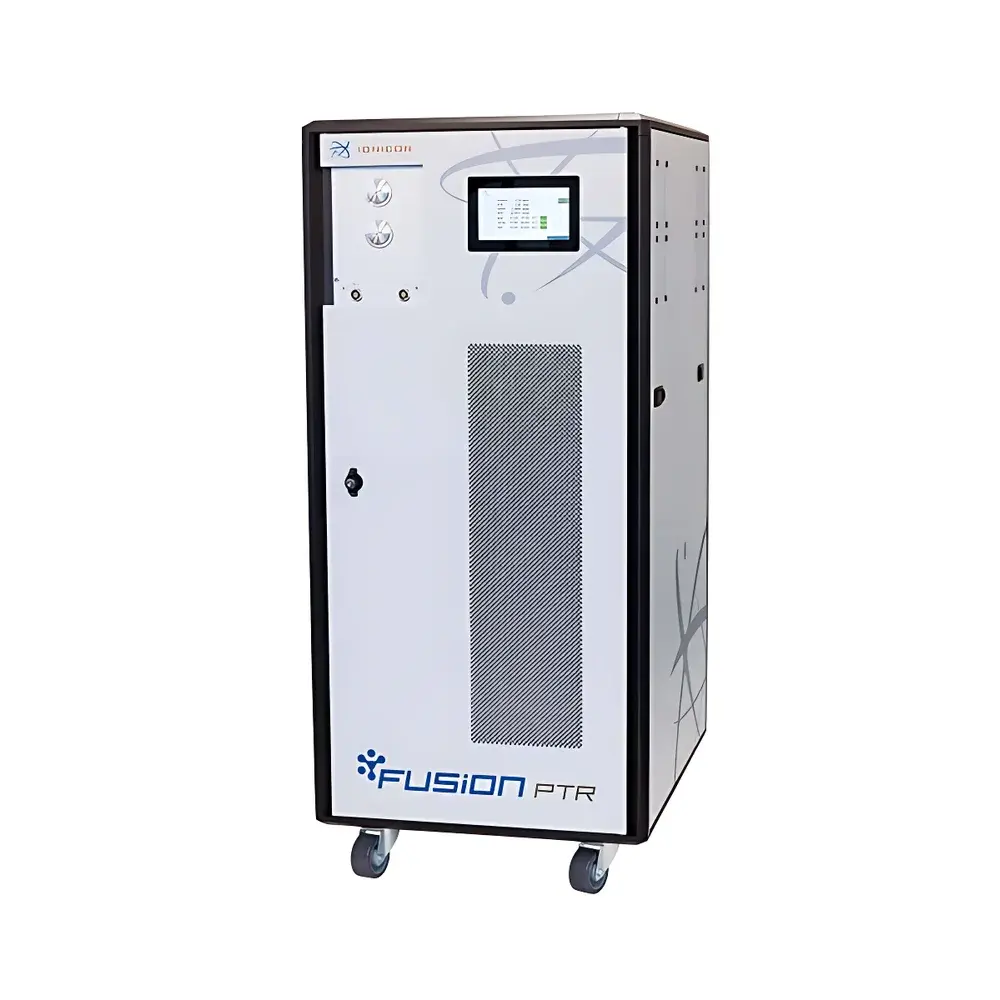
IONICON FUSION PTR-TOF 10k Proton Transfer Reaction Time-of-Flight Mass Spectrometer
| Brand | IONICON Analytik GmbH |
|---|---|
| Origin | Austria |
| Manufacturer | IONICON Analytik GmbH |
| Model | FUSION PTR-TOF 10k |
| Detection Principle | Proton Transfer Reaction (PTR) coupled with Time-of-Flight Mass Spectrometry |
| Instrument Type | Online Real-Time Gas Analyzer |
| Configuration | Single-Source VOC Monitoring System |
| Detection Range | 100 ppqv – 100 ppb |
| Mass Resolution | ≥10,000–15,000 m/Δm (FWHM) |
| Accuracy | ±0.001% of reading (mass axis calibration stability) |
| Response Time | ≤100 ms (90% signal rise time, T90) |
| Limit of Detection | <0.1 pptv (for selected VOCs, e.g., benzene, isoprene) |
| Sensitivity | up to 30,000 cps/ppbv (H₃O⁺ mode, for monoterpenes) |
Overview
The IONICON FUSION PTR-TOF 10k is a high-performance, online proton transfer reaction time-of-flight mass spectrometer engineered for real-time, quantitative trace gas analysis of volatile organic compounds (VOCs) in ambient air, industrial emissions, and controlled laboratory environments. It operates on the well-established PTR-MS principle: H₃O⁺ (or alternative reagent ions) react selectively with VOCs having a proton affinity higher than water via soft chemical ionization, minimizing fragmentation and enabling unambiguous compound identification based on exact mass (<5 ppm mass error). Coupled with a high-transmission orthogonal TOF analyzer, the system delivers sub-second temporal resolution, ultra-low detection limits, and high mass accuracy—making it suitable for dynamic atmospheric chemistry studies, emission source apportionment, breath analysis, and process monitoring under GLP-compliant workflows.
Key Features
- FUSION Reaction Chamber: Ultra-clean, low-background design with optimized ion optics and minimized surface interactions, achieving validated limits of detection below 0.1 pptv for key biogenic and anthropogenic VOCs.
- TRION Reagent Ion Source: Enables rapid, software-controlled switching among H₃O⁺, NH₄⁺, NO⁺, and O₂⁺ within 100–200 ms—critical for selective detection of compounds with overlapping masses or differing proton affinities (e.g., distinguishing isomeric ketones vs. aldehydes).
- Advanced Inlet System: Heated, laminar-flow sampling interface with minimal residence time (<50 ms), ensuring response times ≤100 ms (T90) and preserving fast transient signal integrity during eddy covariance or plume tracking applications.
- ioniTOF 10k Analyzer: High-resolution orthogonal time-of-flight mass spectrometer delivering typical mass resolving power of 10,000–15,000 m/Δm (FWHM at m/z 200), sufficient for baseline separation of isobaric species such as C₃H₆O⁺ (acetone/propanal) and C₆H₆⁺ (benzene) from interfering N₂H₄⁺ or CH₅N⁺ clusters.
- Robust Architecture: Fully integrated vacuum system with dual-stage turbomolecular pumping, temperature-stabilized ion optics, and field-deployable mechanical design compliant with EN 61326-1 for electromagnetic compatibility in laboratory and mobile platform installations.
Sample Compatibility & Compliance
The FUSION PTR-TOF 10k accepts gaseous samples directly from ambient air, stack ducts, or headspace vials without pre-concentration or chromatographic separation. It is compatible with standard ¼” Swagelok or PTFE-lined sampling lines and supports continuous operation at flow rates of 10–100 sccm. The instrument meets ISO/IEC 17025 requirements for analytical competence when operated with documented calibration protocols using certified gas standards (e.g., EPA TO-15 mixtures). Data acquisition and processing comply with FDA 21 CFR Part 11 requirements for electronic records and signatures when configured with audit-trail-enabled software (e.g., TOF-DAQ v4.x with user role management and secure log archiving). All hardware and firmware adhere to EU RoHS and CE directives.
Software & Data Management
Bundled TOF-DAQ software provides real-time spectral acquisition, automated mass calibration (using internal or external reference ions), peak integration, and time-series visualization. Quantitative analysis leverages linear response models validated per ASTM D6196–22 for VOC speciation. Export formats include mzML (Proteomics Standards Initiative), CSV, and NetCDF for interoperability with Python-based analysis pipelines (e.g., SIRIUS, MS-DIAL). Raw data files are timestamped, checksum-verified, and stored in hierarchical directories supporting long-term archival per GLP guidelines. Optional add-ons include automated drift correction, multivariate statistical modules (PCA, PLS-DA), and API integration for SCADA or LIMS connectivity.
Applications
- Ambient air quality monitoring: Real-time quantification of aromatic hydrocarbons, oxygenated VOCs, and biogenic emissions (isoprene, monoterpenes) at urban, rural, and forest sites.
- Industrial emission verification: Continuous stack monitoring for compliance with EU Industrial Emissions Directive (IED) and U.S. EPA Method TO-15 equivalents.
- Indoor air and building science: Identification of off-gassing sources (e.g., formaldehyde from adhesives, siloxanes from sealants) with sub-minute temporal resolution.
- Human exposure & breath research: Detection of disease biomarkers (e.g., acetone for diabetes, aldehydes for oxidative stress) in exhaled breath condensate or direct breath sampling.
- Laboratory reaction kinetics: Time-resolved monitoring of VOC formation/consumption in photochemical smog chambers or catalytic oxidation reactors.
FAQ
What reagent ions are supported, and how quickly can they be switched?
The TRION source supports H₃O⁺, NH₄⁺, NO⁺, and O₂⁺; switching between any two reagent ions is completed within 100–200 ms, with full signal stabilization achieved in ≤500 ms.
Is calibration required before each measurement campaign?
A single daily mass calibration using H₂O cluster series is sufficient for stable operation over 8–12 h; sensitivity calibration with certified VOC standards is recommended before critical quantitative campaigns or after major maintenance.
Can the system operate unattended for extended periods?
Yes—the FUSION PTR-TOF 10k supports remote monitoring, automated restart after power loss, and scheduled self-diagnostics; field deployments exceeding 30 days without intervention have been validated in European atmospheric observatories.
Does the instrument support isotope ratio analysis?
While not designed for high-precision isotopic ratio measurements (e.g., δ¹³C), the mass resolution and mass accuracy enable confident discrimination of ¹³C-substituted peaks (e.g., m/z 92.050 vs. 93.058) for semi-quantitative isotopic pattern assessment.
What vacuum level is maintained in the TOF region?
The orthogonal TOF analyzer operates at ≤5×10⁻⁷ mbar, sustained by a dual-stage turbomolecular pump system with active vibration damping to ensure flight path stability and mass resolution reproducibility.
Related Products







