
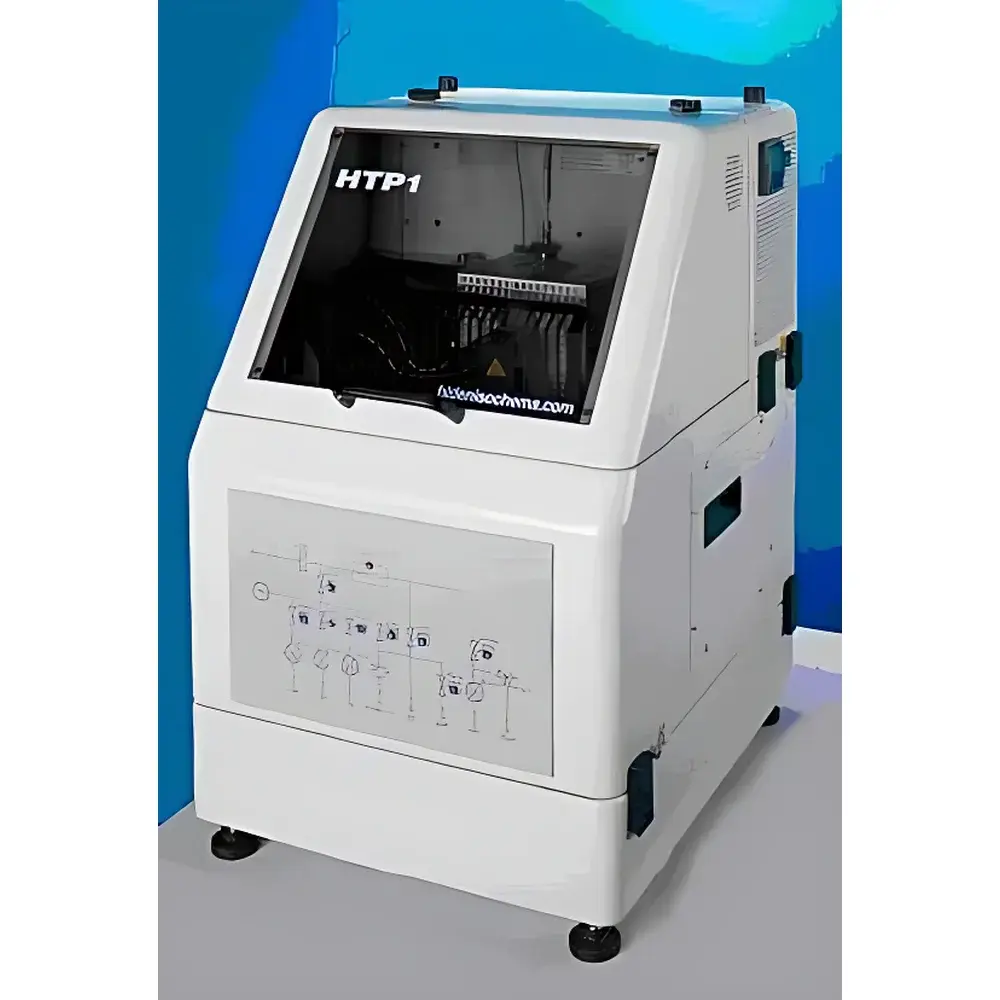
Hiden HTP1-V High-Pressure Hydrogen Storage Research Analyzer
| Brand | Hiden |
|---|---|
| Origin | United Kingdom |
| Model | HTP1-V |
| Instrument Type | Physical/Chemical Adsorption Analyzer |
| Measurement Principle | Volumetric (Pressure-Step) Method |
| Gas Inlet Ports | 8 |
| Temperature Range | LN₂ (–196 °C) to 500 °C |
| Isothermal Stability | ±0.1 °C |
| Heating Rate | 1–20 °C/min |
| Pressure Range | Ultra-High Vacuum (UHV, <1×10⁻⁹ mbar) to 200 bar (20 MPa) |
| Primary Function | High-Pressure Hydrogen Adsorption/Desorption Characterization |
| Optional Mass Spectrometer | m/z 1–200 amu (300 amu optional), response time <300 ms, quantitative output in ppm/ppb/%, scan speed up to 100 amu/s |
Overview
The Hiden HTP1-V High-Pressure Hydrogen Storage Research Analyzer is a rigorously engineered volumetric adsorption system designed for quantitative characterization of hydrogen uptake and release behavior in advanced solid-state storage materials under precisely controlled thermodynamic conditions. Operating on the pressure-step (manometric) principle, the instrument measures minute gas consumption or evolution by monitoring real-time pressure differentials within calibrated reference and sample volumes—enabling high-reproducibility PCT (Pressure–Composition–Temperature) isotherms, kinetic profiling, and thermodynamic parameter derivation (e.g., enthalpy and entropy of adsorption via van’t Hoff analysis). Its UHV-compatible architecture ensures baseline integrity for low-coverage measurements, while its dual-range pressure transducers (capable of stable operation from <1×10⁻⁹ mbar to 200 bar) support seamless transition across physisorption, chemisorption, and spillover-dominated regimes. The system is purpose-built for R&D laboratories engaged in DOE Hydrogen Program-aligned material screening, ISO 16111-compliant storage system validation, and fundamental studies of metal–organic frameworks (MOFs), complex hydrides, and nanoconfined carbon architectures.
Key Features
- Eight independently controlled gas inlet ports with automated valve sequencing—enabling multi-gas comparative studies (H₂, D₂, N₂, CO₂, CH₄) without manual reconfiguration
- Integrated cryogenic–high-temperature furnace with programmable ramp rates (1–20 °C/min) and isothermal stability of ±0.1 °C over full range (–196 °C to 500 °C), verified per ASTM E220 calibration protocol
- UHV-grade stainless-steel manifold and sample cell (all-metal seals, bakeable to 150 °C), certified to ≤1×10⁻¹⁰ mbar·L/s helium leak rate
- High-resolution pressure measurement using redundant capacitance manometers (10⁻⁴ mbar to 200 bar), traceable to NPL standards
- Modular mass spectrometer interface (optional Hiden EQP series) supporting real-time speciation, isotopic discrimination (e.g., H₂ vs. D₂), and transient desorption flux quantification with <300 ms temporal resolution
- Fully automated TPD (Temperature-Programmed Desorption) mode with derivative signal acquisition and peak deconvolution algorithms compliant with ISO 18254 data reporting conventions
Sample Compatibility & Compliance
The HTP1-V accommodates powdered, pelletized, or monolithic samples (max. 2 cm³ volume; max. 5 g mass) in standardized UHV-compatible quartz or stainless-steel sample holders. Its design conforms to key regulatory and methodological frameworks governing hydrogen storage research: it supports GLP-compliant audit trails (via timestamped raw data logging), meets FDA 21 CFR Part 11 requirements for electronic records when paired with Hiden’s validated software suite, and enables generation of datasets suitable for submission to the U.S. Department of Energy’s Hydrogen Materials Advanced Research Consortium (HyMARC) database. All thermal and pressure protocols adhere to ISO 15901-2 (physisorption) and ISO 20595 (chemisorption) guidelines, while high-pressure safety systems comply with PED 2014/68/EU and ASME BPVC Section VIII Division 2.
Software & Data Management
Hiden’s proprietary IGOR Pro-based acquisition and analysis platform provides fully scriptable experiment sequencing, real-time visualization of pressure/temperature/time traces, and automated PCT fitting using Langmuir, Dual-Site Langmuir, and Virial equation models. Raw data are stored in HDF5 format with embedded metadata (instrument configuration, calibration history, operator ID), ensuring FAIR (Findable, Accessible, Interoperable, Reusable) compliance. Batch processing tools enable statistical comparison across sample sets, while export modules generate publication-ready figures conforming to ACS, RSC, and Elsevier formatting standards. Audit logs record all parameter modifications, user logins, and data exports—fully satisfying ISO/IEC 17025 clause 7.5.2 for data integrity verification.
Applications
- Quantitative PCT isotherm generation at pressures up to 200 bar and temperatures from –196 °C to 500 °C for AB₅, AB₂, A₂B₇, and complex hydride systems
- Hydrogen desorption kinetics modeling via isoconversional methods (Friedman, Ozawa–Flynn–Wall) using high-fidelity TPD profiles
- Competitive co-adsorption studies (e.g., H₂/H₂O, H₂/CO) to assess poisoning resistance under realistic impurity conditions
- BET surface area and micropore volume determination using N₂ at 77 K or CO₂ at 273 K—validated against NIST SRM 1990 and 2970
- In-situ monitoring of catalytic hydrogenation/dehydrogenation cycles with mass spectrometric product identification and quantification
FAQ
What hydrogen purity levels are recommended for reliable PCT measurements?
High-purity H₂ (≥99.9995 %) is required; residual O₂ and H₂O must be <0.1 ppm to prevent irreversible surface oxidation or hydrolysis of reactive hydrides.
Can the HTP1-V perform gravimetric measurements?
No—it is a volumetric system; for simultaneous mass change detection, integration with a microbalance (e.g., Setaram TG-DSC) requires external synchronization via TTL triggers and shared temperature programming.
Is calibration traceable to national standards?
Yes—pressure sensors are calibrated annually against NPL-traceable deadweight testers; temperature calibration follows ITS-90 using Pt100 probes certified to Class A tolerance.
How is safety managed at 200 bar operating pressure?
The system incorporates triple redundant pressure relief (rupture discs + spring-loaded valves + electronic cut-off), real-time strain monitoring of pressure vessels, and interlocked access doors that halt pressurization upon opening.



