
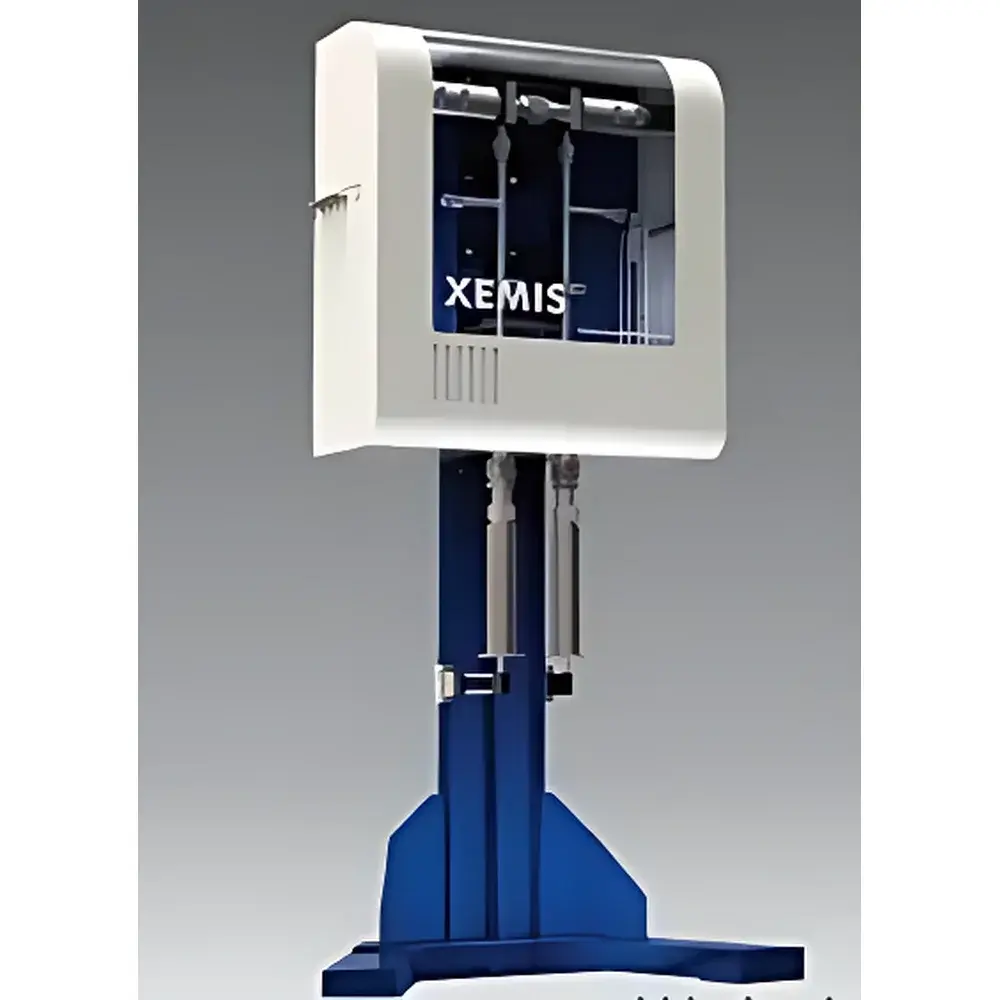
Hiden XEMIS Magnetic Levitation Microbalance for High-Pressure Adsorption Analysis
| Origin | UK |
|---|---|
| Manufacturer Type | Authorized Distributor |
| Origin Category | Imported |
| Model | XEMIS |
| Pricing Range | USD 130,000–260,000 (FOB) |
| Measurement Principle | Gravimetric Method |
| Temperature Range | 77 K to 773 K (–196 °C to 500 °C) |
| Pressure Range | Ultra-High Vacuum (UHV) to 200 bar |
| Ultimate Vacuum | 1 × 10⁻⁸ Torr |
| Sensitivity | 0.2 µg |
| Long-Term Stability | ±5 µg |
| Maximum Sample Capacity | 5 g |
| Dynamic Weighing Range | 0–200 mg |
| Construction | All-Metal VCR-Sealed Architecture |
| Calibration | Zero-Drift-Free Operation, No In-Situ Re-Zero Required |
Overview
The Hiden XEMIS Magnetic Levitation Microbalance is a high-precision gravimetric adsorption analyzer engineered for quantitative gas-solid interaction studies under extreme thermodynamic conditions. Unlike conventional quartz spring or electromagnetic compensation balances, the XEMIS employs a proprietary external sensing architecture—where the force transduction elements are physically isolated from the sample chamber—enabling stable, drift-free mass measurement in corrosive, pyrophoric, or ultra-high-pressure environments. This design eliminates thermal and mechanical coupling between the sensor and reaction zone, ensuring metrological integrity across the full operational envelope: from cryogenic temperatures (77 K) to 773 K and pressures spanning UHV (1 × 10⁻⁸ Torr) to 200 bar. The system operates on the fundamental principle of magnetic suspension force equilibrium, where sample mass change is inferred via real-time feedback control of levitation current, delivering sub-microgram resolution without mechanical contact or hysteresis.
Key Features
- External-sensing architecture isolates transducers from the process chamber, enabling safe handling of H₂, NH₃, Cl₂, HF, and other reactive gases without sensor degradation
- Geometrically symmetric microbalance with minimized internal volume (<5 cm³), reducing dead volume effects and improving pressure equilibration kinetics
- Full-metal construction using electropolished 316L stainless steel and VCR face-seal fittings, compliant with ASME B31.3 and ISO 2852 standards for high-integrity gas handling
- Wide dynamic weighing range (0–200 mg) with 0.2 µg resolution and long-term stability of ±5 µg over 72-hour continuous operation
- Modular reactor design supports interchangeable sample holders—including Hastelloy C-276, Inconel 625, and alumina crucibles—for temperature-programmed experiments up to 773 K
- IGA’s proprietary endpoint prediction algorithm dynamically adjusts gas dosing based on real-time mass derivative, minimizing overshoot and accelerating isotherm acquisition
- No in-situ recalibration or zero-reset required; baseline stability maintained across thermal cycling and pressure ramping sequences
Sample Compatibility & Compliance
The XEMIS accommodates heterogeneous solid samples including metal–organic frameworks (MOFs), covalent organic frameworks (COFs), activated carbons, zeolites, silica aerogels, carbon nanotubes, and catalytically active metal oxides. Its inert, all-metal flow path meets ASTM D4292 (for carbon adsorbents), ISO 15901-2 (physisorption), and ISO 20816-1 (vibration-sensitive instrumentation). For regulated environments, the system supports audit-trail-enabled operation per FDA 21 CFR Part 11 when integrated with Hiden’s IGAware software suite, fulfilling GLP/GMP data integrity requirements for CO₂ sequestration validation, hydrogen storage certification (SAE J2718), and pharmaceutical excipient characterization.
Software & Data Management
Controlled via IGAware v5.3, the XEMIS provides fully scriptable experiment sequencing, real-time derivative analysis (dm/dt), and automated isotherm fitting using non-linear regression against Langmuir, BET, D-R, and Toth models. Raw mass–time–pressure–temperature datasets are stored in HDF5 format with embedded metadata (sample ID, operator, calibration certificate traceability, environmental logs). Export options include ASTM E1447-compliant CSV, NIST-compatible JSON-LD, and direct integration with MATLAB, Python (via h5py), and LabArchives ELN. All user actions—including method edits, parameter changes, and data exports—are time-stamped and digitally signed for regulatory compliance.
Applications
- High-pressure gas adsorption isotherms (CO₂, CH₄, H₂, N₂, Ar) for geological sequestration modeling and porous material benchmarking
- Kinetic uptake profiling of hydrogen in MOF-5, UiO-66, and Mg-based hydrides under realistic refueling conditions (up to 100 bar, 298–373 K)
- Thermodynamic analysis of heat of adsorption via van’t Hoff plots derived from multi-temperature isotherms
- Chemisorption studies involving oxidative/reductive pretreatment (e.g., NiO reduction, Pt oxidation) monitored gravimetrically under controlled gas mixtures
- Supercritical fluid adsorption in ionic liquids and deep eutectic solvents at subcritical and supercritical states
- Shale gas and coalbed methane sorption hysteresis quantification under geologically relevant stress–strain conditions
- Stability assessment of porous polymers under cyclic adsorption–desorption loading (≥1000 cycles)
FAQ
Does the XEMIS require periodic recalibration during long-term isotherm measurements?
No. The external sensing architecture and closed-loop magnetic levitation control eliminate thermal drift and mechanical creep, enabling uninterrupted 96-hour isotherm acquisition without re-zeroing or recalibration.
Can the XEMIS be integrated with mass spectrometry or FTIR for coupled gas-phase analysis?
Yes. The system features dual UHV-compatible differential pumping ports (CF-35) for seamless coupling to quadrupole mass spectrometers (QMS) or transmission-mode FTIR cells, supporting simultaneous gravimetric and evolved-gas analysis.
Is the instrument compatible with automated sample changers for high-throughput screening?
The XEMIS platform supports third-party robotic sample loaders via RS-485 and Ethernet/IP interfaces; Hiden offers OEM integration kits for compatibility with Brooks AutoMate and Anton Paar RoboLander systems.
What vacuum performance is achievable during low-pressure physisorption measurements?
With optional turbomolecular pumping (800 L/s), the system achieves 1 × 10⁻⁸ Torr base pressure within 90 minutes, meeting ISO 9001:2015 vacuum integrity verification protocols.
How is data traceability ensured for ISO/IEC 17025-accredited laboratories?
IGAware generates electronic records with SHA-256 hash signatures, immutable timestamps, and role-based access controls—fully aligned with ILAC P14:2021 requirements for digital data management in accredited testing facilities.



