
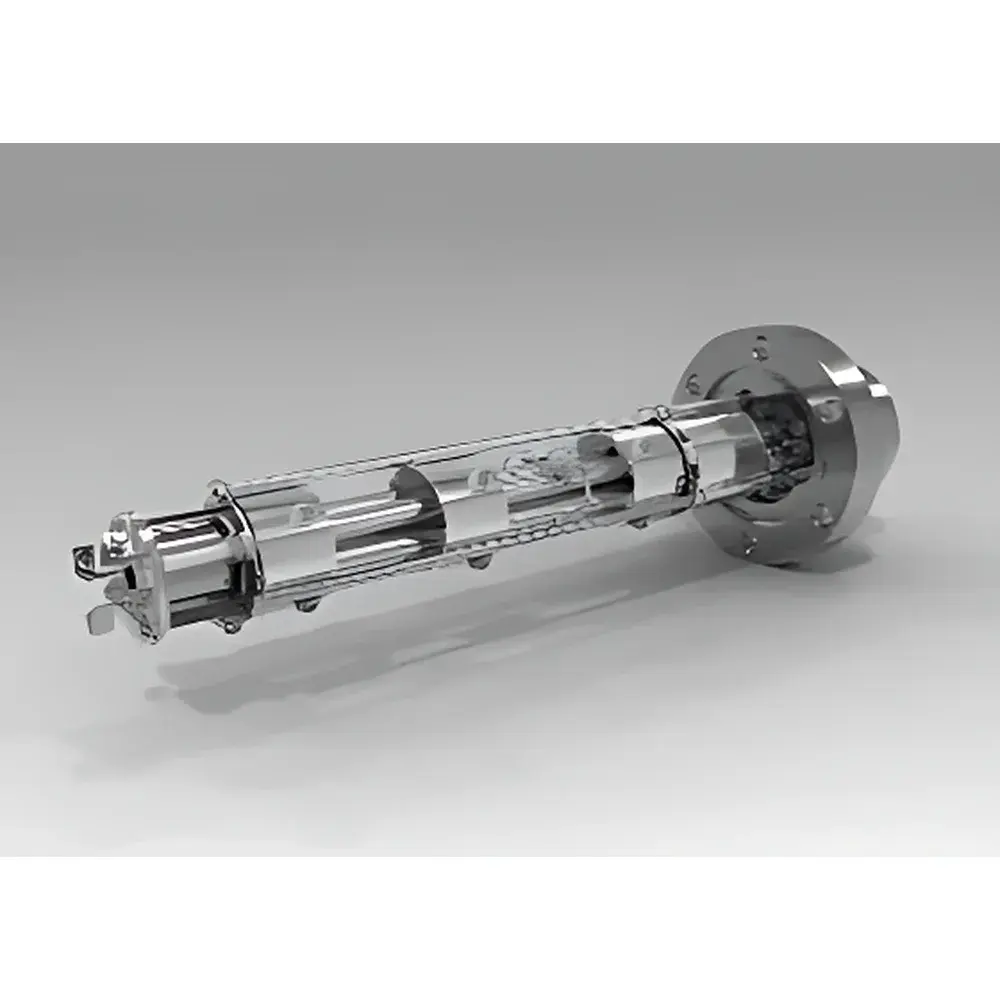
Hiden HALO 201 MBE Quadrupole Mass Spectrometer for Molecular Beam Epitaxy Residual Gas Analysis
| Brand | Hiden |
|---|---|
| Origin | United Kingdom |
| Model | HALO 201 MBE |
| Mass Range | 1–300 amu |
| Scan Speed | 100 amu/s |
| Minimum Scan Step | 0.01 amu |
| Sensitivity | 0.1–1 ppm |
| Long-Term Stability | < ±0.5% peak height drift over 24 h |
| Minimum Detectable Partial Pressure | 2 × 10⁻¹³ mbar |
| Maximum Operating Pressure | 1 × 10⁻⁴ mbar |
| Detector | Dual Faraday/Channelplate Electron Multiplier |
| Ion Source Shield | Contamination-Resistant |
| Filament Wiring | Molybdenum-Copper Alloy |
Overview
The Hiden HALO 201 MBE is a purpose-engineered quadrupole mass spectrometer (QMS) designed specifically for real-time residual gas analysis (RGA) in ultra-high vacuum (UHV) molecular beam epitaxy (MBE) systems. Operating on the principle of mass-selective ion filtering via radiofrequency (RF) and direct current (DC) voltages applied to hyperbolic rod electrodes, the instrument delivers high-fidelity identification and quantification of trace gaseous species—ranging from hydrogen (H₂), water (H₂O), nitrogen (N₂), oxygen (O₂), carbon monoxide (CO), and hydrocarbons to reactive precursors such as arsine (AsH₃), phosphine (PH₃), and trimethylgallium (TMGa). Its UHV-rated construction, including all-metal seals and bakeable components rated to 400 °C, ensures compatibility with MBE chamber conditioning protocols while maintaining long-term calibration integrity under continuous thermal cycling.
Key Features
- UHV-optimized quadrupole analyzer with 1–300 amu mass range and 0.01 amu minimum scan resolution—enabling discrimination between isotopic peaks (e.g., ⁴⁰Ar vs. ⁴⁰Ca⁺) and closely spaced fragments (e.g., CO⁺ at 28.006 amu vs. N₂⁺ at 28.013 amu).
- Molybdenum-copper filament wiring architecture minimizes thermal expansion mismatch and outgassing under sustained 1000 °C filament operation—critical for stable electron emission and extended source lifetime in MBE environments.
- Contamination-resistant ion source shield reduces carbonaceous buildup from cracked organometallics, preserving ion transmission efficiency and reducing recalibration frequency.
- Dual-detector configuration: switchable Faraday cup for quantitative, high-dynamic-range measurement (10⁶ linear range) and channelplate electron multiplier for sub-picoampere signal amplification—supporting both process trending and ultra-trace leak detection down to 2 × 10⁻¹³ mbar partial pressure.
- Real-time scan speed of 100 amu/s enables full-spectrum acquisition in <3 s—facilitating rapid response to transient events such as shutter opening, effusion cell activation, or unintended air ingress.
Sample Compatibility & Compliance
The HALO 201 MBE interfaces directly with standard ConFlat (CF) 63 or CF 100 flanges and supports differential pumping configurations for integration into load-lock, growth, and buffer chambers. All wetted materials—including ion source housing, quadrupole rods, and detector assemblies—are constructed from low-outgassing, non-magnetic stainless steel (316L) and oxygen-free high-conductivity (OFHC) copper. The system conforms to ISO 20483 (vacuum technology — terminology), ASTM E1940 (standard guide for residual gas analysis), and meets mechanical and electrical safety requirements per IEC 61010-1. Its analog and digital I/O architecture supports synchronization with MBE control systems (e.g., via TTL triggers or Modbus TCP), enabling time-stamped correlation of RGA data with substrate temperature, shutter state, and flux measurements.
Software & Data Management
Control and analysis are performed using Hiden’s QGA (Quantitative Gas Analysis) software suite, which provides real-time spectral display, automated peak identification against NIST/EPA mass spectral libraries, and customizable trend logging. The software supports audit-trail-enabled operation compliant with GLP and GMP frameworks, including user access levels, electronic signatures, and 21 CFR Part 11–ready data export (CSV, XML, HDF5). Batch-mode scripting allows scheduled multi-point scans across predefined mass windows (e.g., monitoring only 2–100 amu during growth, then expanding to 100–300 amu during venting), minimizing data storage overhead without sacrificing diagnostic coverage.
Applications
- Real-time monitoring of background contaminants (H₂O, CO, CO₂, O₂, N₂) during MBE chamber bakeout and base-pressure stabilization.
- Quantitative tracking of precursor cracking efficiency and decomposition byproducts (e.g., CH₄ from TMGa, AsHₓ fragments from As₂ or As₄ beams).
- Leak localization via helium sniffer testing with sub-10⁻¹⁰ mbar sensitivity and spatial mapping through sequential valve isolation.
- Process endpoint detection during in-situ etching or cleaning steps (e.g., Cl₂ or HBr plasma residue evolution).
- Long-term vacuum health assessment via 24-hour stability metrics—peak height reproducibility < ±0.5% confirms system readiness for epitaxial layer growth.
FAQ
What vacuum compatibility does the HALO 201 MBE support?
It operates continuously from 1 × 10⁻¹⁰ mbar to 1 × 10⁻⁴ mbar, with bakeout capability up to 400 °C and all-metal sealing suitable for UHV MBE systems.
Can the instrument distinguish between isobaric interferences in MBE precursor analysis?
Yes—its 0.01 amu step resolution and mass calibration stability (<10 ppm over 24 h) enable separation of key isobars such as ⁷⁵As⁺ (74.9216 amu) from ⁷⁵Br⁺ (74.9219 amu) and ⁷⁴Ge⁺ (73.9212 amu) from ⁷⁴Se⁺ (73.9225 amu).
Is the system compatible with automated MBE process control platforms?
Yes—it provides programmable analog outputs (0–10 V), digital I/O (TTL), and Ethernet-based Modbus TCP communication for integration with LabVIEW, EPICS, or proprietary MBE controllers.
How often is recalibration required under typical MBE usage?
With proper maintenance and periodic verification using known gas standards (e.g., Ar/N₂ mixtures), mass and sensitivity calibration remain valid for ≥6 months; stability monitoring is recommended daily prior to growth runs.
Does the dual-detector design require manual switching during operation?
No—QGA software automatically selects optimal detector based on signal amplitude, enabling seamless transition from Faraday-level quantitation to channelplate-amplified trace detection within a single scan sequence.





