
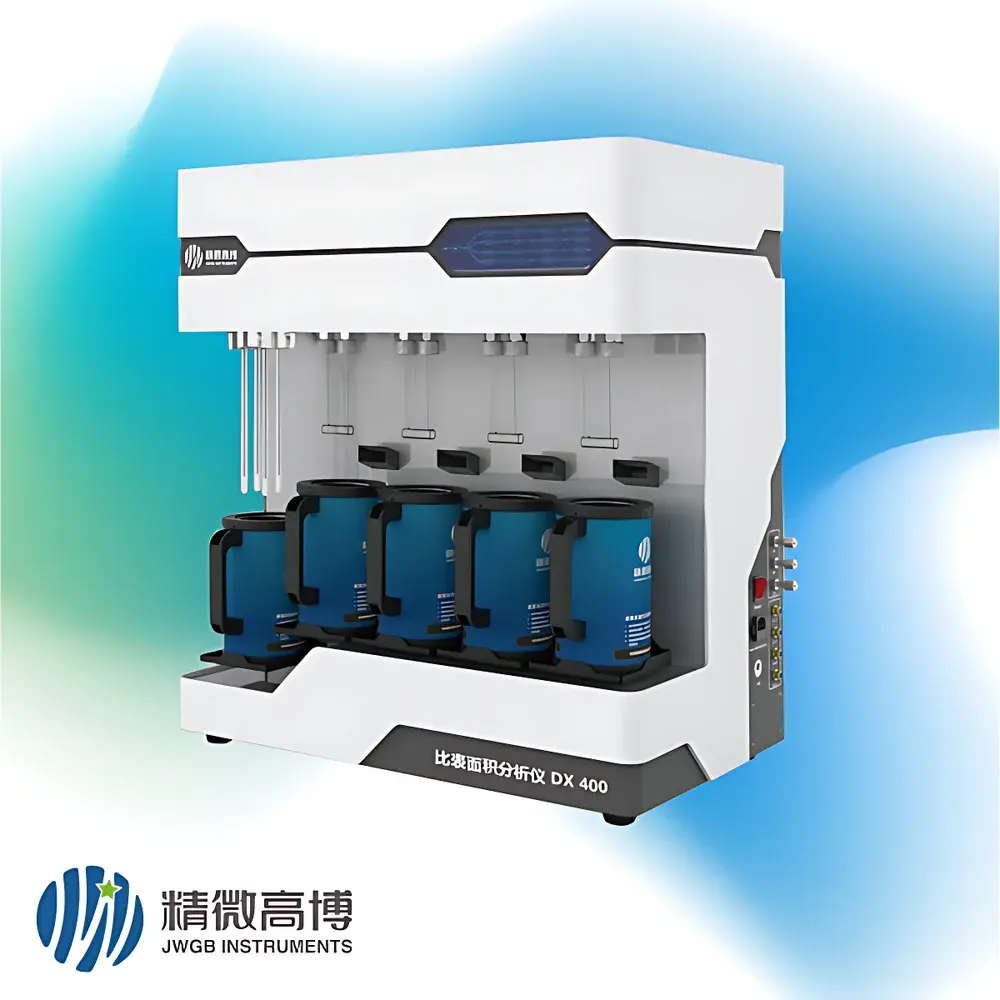
JWGB DX Series Metal Powder-Specific Specific Surface Area Analyzer (28 Samples per Hour)
| Brand | JWGB |
|---|---|
| Origin | Beijing, China |
| Manufacturer Type | Direct Manufacturer |
| Product Category | Domestic Instrument |
| Model | DX Series Metal Powder-Specific Specific Surface Area Analyzer (28 Samples per Hour) |
| Instrument Type | Specific Surface Area Analyzer |
| Operating Principle | Dynamic Flow Method (Gas Chromatography-Based) |
| Number of Analysis Stations | 4 |
| Measurement Range | 0.01 m²/g to Unlimited |
| Pressure Condition | Ambient Pressure |
| Theoretical Basis | Dynamic Chromatographic Adsorption Theory |
| Calibration Standard | Direct Comparison Method and BET Theory (for optional extended analysis) |
Overview
The JWGB DX Series Metal Powder-Specific Specific Surface Area Analyzer is an engineered solution for high-throughput, ambient-pressure surface area characterization of metallic and inorganic powders used in battery electrode manufacturing, pharmaceutical excipients, catalyst supports, and advanced metallurgical applications. Unlike conventional static volumetric or gravimetric analyzers requiring cryogenic liquid nitrogen immersion and vacuum evacuation, the DX Series implements a robust dynamic flow method—also known as the carrier-gas chromatographic technique—operating at ambient pressure and temperature-controlled conditions. In this configuration, a precisely regulated mixture of nitrogen and helium flows continuously over the sample bed while thermal conductivity detection (TCD) monitors real-time concentration shifts caused by nitrogen adsorption/desorption events. The integrated peak area from the TCD signal is directly proportional to the quantity of adsorbed nitrogen, enabling rapid quantification without time-intensive degassing cycles or ultra-high vacuum infrastructure. This architecture delivers exceptional repeatability (RSD < 2.5% for replicate metal powder analyses) and eliminates condensation-related artifacts common in low-temperature systems—particularly critical for hydrophobic or oxidation-sensitive metal powders.
Key Features
- Four independent analysis stations with fully automated sequential operation—enabling true parallel throughput of up to 28 standardized samples per hour under routine QC conditions.
- Ambient-pressure operation eliminates reliance on vacuum pumps, liquid nitrogen dewars, and complex pressure regulation hardware—reducing both capital cost and operational overhead.
- Proprietary thermal conductivity detector with drift-compensated electronics ensures stable baseline performance across multi-hour continuous runs.
- Integrated sample heating module (up to 300 °C) supports controlled in-situ degassing of metal oxides and passivated alloys without external furnaces.
- Pre-calibrated gas mixing manifold delivering precise N₂/He ratios (10–30% N₂ v/v) with certified mass flow controllers traceable to NIST standards.
- Ruggedized stainless-steel sample holders designed for abrasive metal powders, featuring reproducible packing geometry and minimized dead volume.
Sample Compatibility & Compliance
The DX Series is optimized for low-to-moderate surface area materials (0.01–50 m²/g), including Ni-Co-Mn ternary cathode powders, synthetic graphite anodes, atomized stainless steel and aluminum alloys, sintered tungsten carbide, and spray-dried pharmaceutical carriers. Its dynamic methodology avoids pore-filling assumptions inherent in BET modeling for non-porous or macroporous metals, making it especially suitable for quality control where absolute comparability—not micropore distribution—is the primary objective. The system complies with ASTM D3037 (Standard Test Method for Specific Surface Area of Carbon Black by Nitrogen Adsorption), ISO 9277 (Characterization of Powders—Determination of Specific Surface Area by Gas Adsorption Using the BET Method), and supports GLP-compliant data recording per FDA 21 CFR Part 11 when deployed with validated software modules.
Software & Data Management
JWGB’s proprietary DX-Control Suite provides intuitive workflow management, real-time chromatogram visualization, and automated peak integration using adaptive baseline algorithms. All raw TCD signals, calibration logs, environmental metadata (ambient temperature/pressure), and operator audit trails are stored in encrypted SQLite databases compliant with ALCOA+ principles. Batch reports export to PDF and CSV formats with embedded digital signatures; optional LIMS integration supports direct data push to enterprise QA systems. Software validation documentation—including IQ/OQ protocols and electronic signature implementation—meets ICH GCP and ISO/IEC 17025 laboratory accreditation requirements.
Applications
- Routine release testing of battery-grade cathode and anode powders in ISO 13485-certified production facilities.
- Process monitoring during mechanical alloying or gas atomization—tracking surface oxidation kinetics via surface area drift trends.
- Stability assessment of pyrophoric metal powders (e.g., nano-aluminum) under inert purge conditions.
- Comparative evaluation of milling efficiency across different attritor configurations using specific surface area as a proxy metric.
- Pharmaceutical excipient qualification per USP (Specific Surface Area) for tablet binder functionality prediction.
FAQ
Does the DX Series require liquid nitrogen or vacuum pumps?
No. It operates exclusively at ambient pressure using helium as a carrier gas and nitrogen as the adsorbate—eliminating cryogens and vacuum infrastructure.
Can it measure samples with surface areas below 0.01 m²/g?
The validated lower detection limit is 0.01 m²/g. For ultra-low-area metals (e.g., dense sintered tungsten), signal-to-noise optimization via extended integration time or higher N₂ partial pressure may extend practical usability.
Is BET analysis supported?
Yes—optional software modules enable single-point BET calculation using preloaded reference standards. However, the primary output uses direct comparison against certified silica gel or carbon black references per ASTM D3037.
How is instrument calibration maintained?
Daily automated zero/span checks using certified gas standards; full system calibration performed quarterly using NIST-traceable surface area reference materials (e.g., SRM 1988).



