
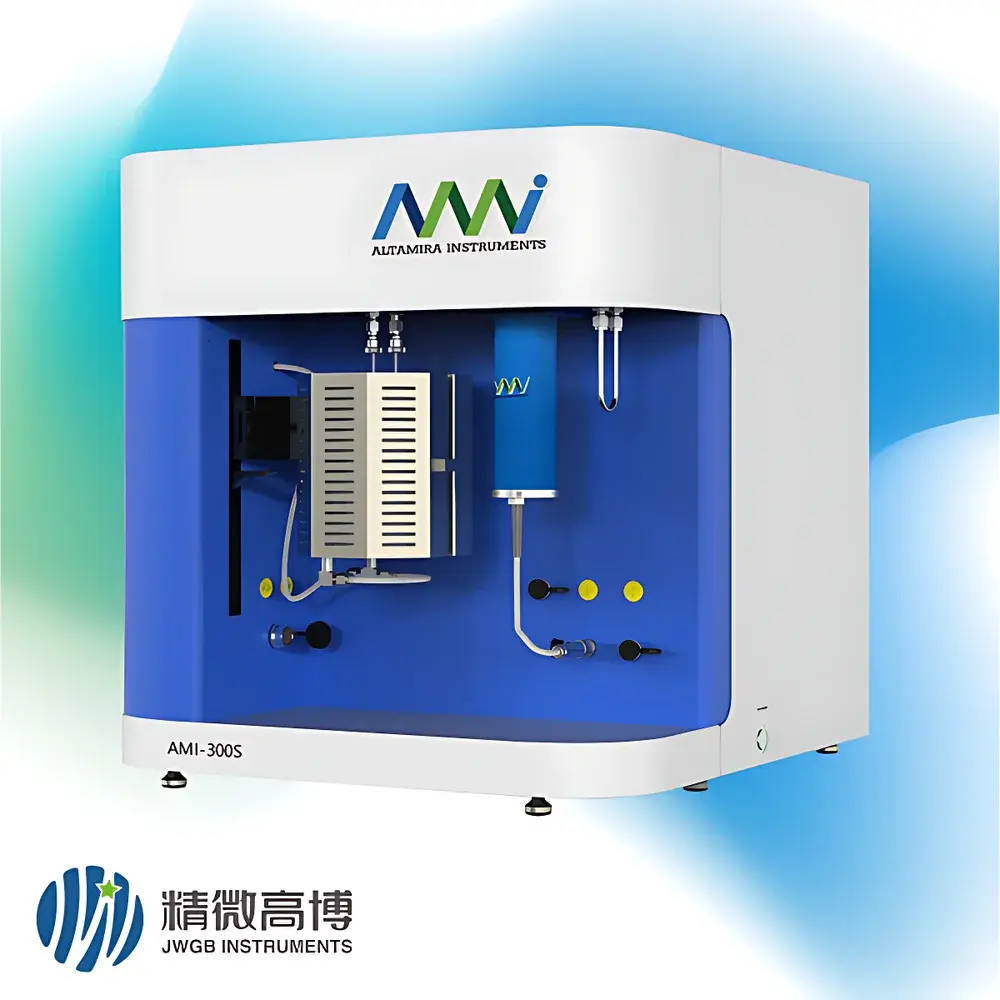
Altamira AMI-300S Corrosion-Resistant Chemisorption Analyzer
| Brand | Altamira |
|---|---|
| Origin | USA |
| Model | AMI-300S Corrosion-Resistant Chemisorption Analyzer |
| Testing Principle | Continuous Flow Method |
| Gas Inlet Ports | Expandable to 12 |
| Temperature Range | Ambient to 1200 °C |
| Isothermal Stability | ±0.01 °C |
| Heating Rate | 1–50 °C/min |
| Pressure Range | Atmospheric to 30 bar (optional 100 bar) |
| Analytical Capabilities | TPR, TPO, TPD, TPS, Pulse Chemisorption, Pulse Calibration |
Overview
The Altamira AMI-300S Corrosion-Resistant Chemisorption Analyzer is a high-performance, fully automated dynamic chemisorption system engineered for rigorous catalyst surface characterization under aggressive chemical environments. It operates on the continuous flow principle—where reactive gases are precisely metered over a temperature-programmed catalyst bed while effluent composition is monitored in real time. This methodology enables quantitative determination of active metal dispersion, adsorption enthalpy distribution, surface acidity/basicity strength profiles, and kinetic parameters associated with reduction, oxidation, desorption, and surface reaction pathways. Unlike static volumetric systems, the AMI-300S delivers accelerated analysis cycles—typically completing full TPR/TPO/TPD sequences in one-third the time—without compromising data fidelity or reproducibility. Its corrosion-resistant architecture—featuring Kalrez-sealed high-temperature valves, 316 stainless steel fluidic paths (1/16″ OD), and chemically inert internal surfaces—ensures long-term operational integrity when handling halogenated compounds, sulfur-containing reagents, ammonia, hydrogen sulfide, or acidic vapors commonly encountered in hydrotreating, FCC, and emission control catalyst development.
Key Features
- Expandable gas manifold supporting up to 12 independently controlled inlet ports—configurable as carrier, reactant, purge, or calibration streams—with optional mass flow controllers (MFCs) for trace-level precision (5–50 cm³/min, NTP).
- High-temperature furnace with programmable ramp rates from 1 to 50 °C/min across the full 25–1200 °C range; optional cryogenic module extends low-end capability to −130 °C for low-temperature adsorption studies.
- Dual-zone temperature control: independent regulation of furnace zone and sample-bed thermocouple enables accurate distinction between external heating profile and actual catalyst thermal response—critical for kinetic deconvolution.
- Integrated saturated vapor generator with digitally stabilized temperature control (±0.1 °C), enabling reproducible introduction of water, alcohols, or organic vapors without condensation artifacts.
- Modular detection interface supporting TCD (dual-filament tungsten or Au/W configuration), MS, FTIR, FID, or GC–MS in either serial or parallel configuration; all detector signals synchronized and time-aligned within the same acquisition file.
- Active cooling assembly with forced-air heat exchangers reduces cooldown time between runs by >60%, enhancing throughput for high-volume screening labs.
- Full-temperature traceability: all fluidic lines, valves, and connectors are actively heated (up to 200 °C) to prevent vapor condensation, adsorptive滞留, or cold-spot-induced memory effects.
- Built-in gas blending module eliminates need for external mixers—enabling on-demand generation of precise binary or ternary gas mixtures for BET, pulse titration, or co-adsorption experiments.
Sample Compatibility & Compliance
The AMI-300S accommodates diverse solid catalyst forms—including powders, extrudates, pellets, and monolith fragments—using interchangeable quartz U-tube, bubble, or straight-wall sample holders (low-pressure mode) or 316 stainless steel reactor tubes (high-pressure mode). Its corrosion-resilient design meets ASTM D7214 (catalyst sulfidation testing), ISO 18387 (TPR methodology), and USP guidelines for catalytic impurity profiling. All firmware and software modules comply with FDA 21 CFR Part 11 requirements for electronic records and signatures, including full audit trail logging, user role-based access control, and secure data encryption. Instrument operation adheres to GLP/GMP environmental monitoring standards, with redundant thermal safety interlocks: dual independent overtemperature cutoffs, real-time MFC flow verification, TCD filament current monitoring, and front-panel emergency power disconnect.
Software & Data Management
Control and analysis are executed via Altamira’s Windows-native ChemiSoft™ platform—a modular, scriptable environment supporting both guided workflow templates and advanced user-defined scripting (Python API integration available). Experimental protocols—including multi-step TPR/TPO sequences with conditional logic, isothermal holds, and pressure-switched modes—are configured graphically or via text-based method files. Raw signal acquisition (TCD voltage, MS m/z traces, temperature, pressure) is timestamped at 100 Hz resolution and stored in HDF5 format for long-term archival stability. Post-run processing includes baseline correction, peak deconvolution using Gaussian/Lorentzian fitting algorithms, stoichiometric quantification (e.g., H₂ uptake → metal dispersion), and Arrhenius/Eyring parameter extraction. Export options include CSV, Excel, and XML formats compatible with LIMS and ELN systems; raw data packages include full metadata (instrument ID, operator, calibration history, environmental logs).
Applications
The AMI-300S serves as a core analytical tool in heterogeneous catalysis R&D across petrochemical refining (hydrodesulfurization, hydrocracking, reforming), fine chemical synthesis (asymmetric hydrogenation, selective oxidation), environmental catalysis (three-way catalysts, SCR formulations), and emerging energy materials (PEM fuel cell anodes/cathodes, battery electrode interfaces, CO₂ hydrogenation catalysts). Specific use cases include: quantifying Pt dispersion in automotive exhaust catalysts via H₂ chemisorption; mapping acid site strength distribution in zeolites using NH₃-TPD; evaluating NiMoS phase evolution during sulfidation (H₂S + H₂ TPR); determining oxygen mobility in perovskite oxides via O₂-TPD; and assessing coke resistance in Fischer–Tropsch catalysts through sequential CO-TPD and CO₂-TPD cycles. Its robustness under corrosive feedstocks makes it uniquely suited for sulfur-, chlorine-, or nitrogen-rich process stream simulation.
FAQ
What materials are used in the fluidic path to ensure corrosion resistance?
All wetted surfaces—including valves, reactors, tubing, and fittings—are constructed from electropolished 316 stainless steel, with optional Hastelloy C-276 components for extreme halogen exposure. Sealing elements utilize Kalrez® 6375 or Chemraz® 585 where elevated temperature and chemical compatibility are required.
Can the AMI-300S perform simultaneous TCD and MS detection during a single experiment?
Yes—the system supports hardware-synchronized dual detection via a vacuum-compatible splitter manifold. Both TCD analog output and MS digital stream are acquired, time-aligned, and saved within a single project file, enabling direct cross-validation of speciation and quantitation.
Is the instrument compliant with regulatory data integrity requirements?
Yes—ChemiSoft™ implements full 21 CFR Part 11 compliance: electronic signatures, immutable audit trails, role-based permissions, data encryption at rest and in transit, and automated backup to network storage with SHA-256 hash verification.
How is temperature uniformity maintained across the catalyst bed during rapid heating?
The furnace employs a multi-zone resistive heating coil with distributed thermocouple feedback and PID tuning optimized for minimal axial gradient (<±2 °C over 50 mm bed length) even at 50 °C/min ramp rates.
Does the system support automated calibration routines for pulse injection accuracy?
Yes—integrated quantitative loop calibration uses certified standard gases (e.g., 1% H₂ in Ar) and auto-calculates injection volume based on measured TCD response, compensating for ambient temperature and pressure drift in real time.



