
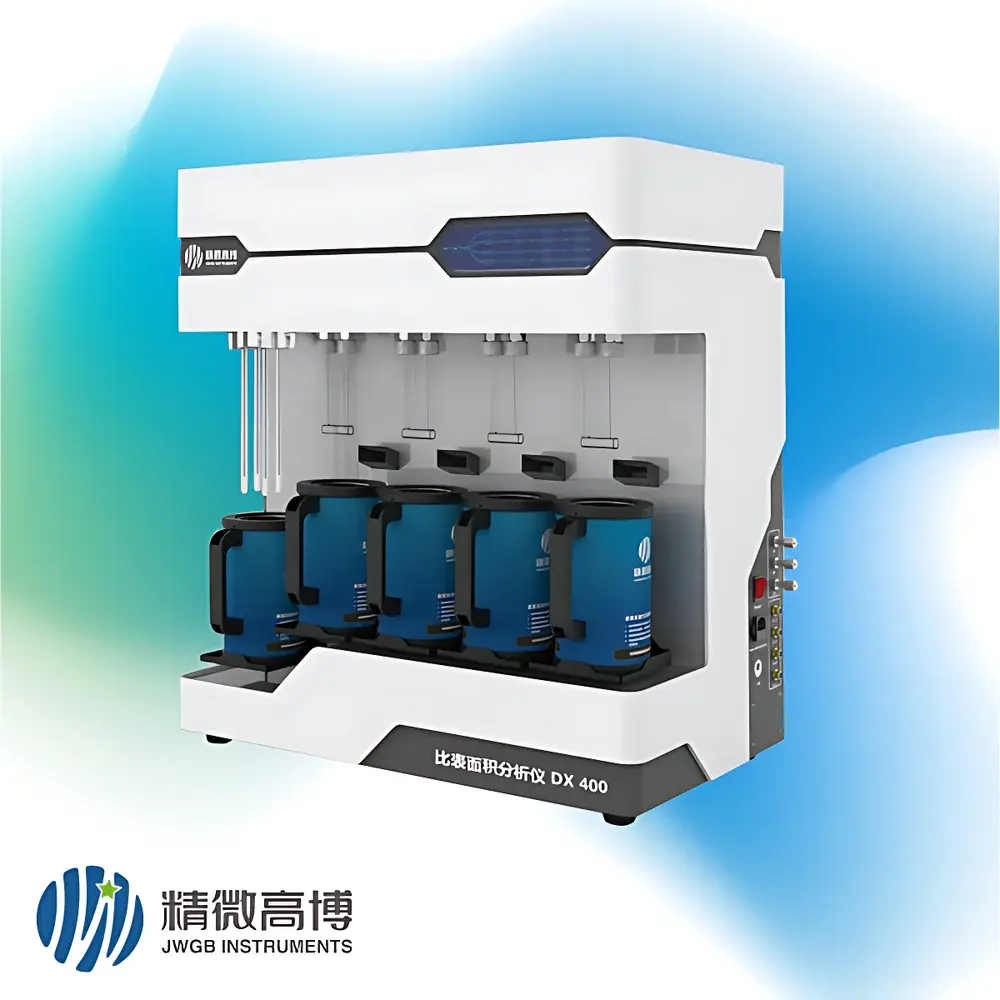
JWGB DX Series Lithium Iron Phosphate-Specific Dynamic Specific Surface Area Analyzer
| Brand | JWGB |
|---|---|
| Origin | Beijing, China |
| Manufacturer Type | Direct Manufacturer |
| Instrument Type | Dynamic Specific Surface Area Analyzer |
| Model | JWGB DX Series (28 Samples per Hour) |
| Analysis Stations | 4 |
| Measurement Principle | Dynamic Chromatographic Method (Flow Method) |
| Pressure Range | Atmospheric Pressure |
| Theoretical Basis | Direct Comparison Method & BET Theory |
| Specific Surface Area Range | 0.01 m²/g to Unlimited |
| Operating Condition | Liquid Nitrogen Temperature (−196 °C), N₂/He Carrier Gas Mixture |
| Detection System | High-Precision Thermal Conductivity Detector (TCD) |
Overview
The JWGB DX Series Lithium Iron Phosphate-Specific Dynamic Specific Surface Area Analyzer is an engineered solution for high-throughput, routine-specific surface characterization of cathode and anode materials in lithium-ion battery manufacturing. Unlike static volumetric gas adsorption systems, this instrument implements a dynamic chromatographic (flow) method—where a precisely controlled mixture of nitrogen and helium flows continuously over the sample at cryogenic temperature (−196 °C). Adsorbed nitrogen alters the thermal conductivity of the carrier gas stream; changes are quantified in real time by a high-stability thermal conductivity detector (TCD). The resulting adsorption or desorption peak area is directly proportional to the quantity of nitrogen adsorbed, enabling rapid calculation of specific surface area using either the direct comparison method (for relative consistency checks) or the Brunauer–Emmett–Teller (BET) theory (for absolute, standardized reporting). Designed explicitly for LiFePO₄, NMC, graphite, and other low-to-moderate surface area battery materials (0.01–100 m²/g range), the system prioritizes repeatability, operational robustness, and integration into QC/QA workflows under GLP-aligned laboratory conditions.
Key Features
- Four independent analysis stations enable parallel processing—up to 28 standardized samples per hour under routine operating conditions.
- Dedicated hardware and calibration protocols optimized for lithium iron phosphate and related battery-grade powders, minimizing inter-sample carryover and baseline drift.
- Atmospheric-pressure operation eliminates need for vacuum pumps, reducing maintenance overhead and increasing system uptime.
- Cryogenic measurement environment maintained via standard liquid nitrogen dewar with automated level monitoring and refill interface.
- Thermal conductivity detection provides high signal-to-noise ratio for low-surface-area materials where monolayer coverage is sparse and peak resolution is critical.
- Integrated mass flow controllers ensure precise, reproducible N₂/He mixing ratios (e.g., 10–30% N₂ in He), essential for method transferability across instruments and labs.
- Rugged mechanical architecture supports continuous operation in production support laboratories with minimal operator intervention.
Sample Compatibility & Compliance
The DX Series accommodates standard 6–8 mm glass sample tubes compatible with ASTM D3663 and ISO 9277 test protocols for dynamic BET surface area determination. It accepts dry, free-flowing powders—including air-sensitive cathode active materials—when handled under inert atmosphere gloveboxes prior to loading. Sample preparation follows standard degassing procedures (typically 2–4 h at 120 °C under vacuum or inert purge), with optional integrated pre-treatment modules available upon configuration. Data output complies with FDA 21 CFR Part 11 requirements when deployed with validated software versions, including full audit trail, electronic signatures, and user-access controls. Instrument design aligns with ICH Q5C stability testing guidance for pharmaceutical excipients and supports GMP-relevant documentation packages for battery material suppliers undergoing third-party quality audits.
Software & Data Management
JWGB’s proprietary analysis software (v4.2+) provides guided workflow execution—from method selection and instrument conditioning to peak integration and report generation. All raw TCD voltage-time traces are archived with metadata (sample ID, operator, date/time, gas flow rates, temperature log). Batch processing mode allows simultaneous evaluation of up to 32 samples with automatic outlier detection based on R² deviation from linear BET region. Export formats include CSV, PDF (with embedded calibration certificates), and XML for LIMS integration. Software validation documentation (IQ/OQ/PQ protocols) is provided for regulated environments. Audit trail records all parameter modifications, result recalculations, and user logins—fully traceable to individual analysts and timestamps.
Applications
- Routine QC screening of LiFePO₄ cathode batches for consistency in surface reactivity and coating uniformity.
- Comparative assessment of carbon-coated vs. uncoated graphite anodes during process development.
- Stability monitoring of nickel-rich NMC materials after thermal aging or moisture exposure.
- Pharmaceutical excipient qualification (e.g., microcrystalline cellulose, lactose) per USP guidelines.
- Quality gate testing in electrode slurry formulation lines—correlating surface area with dispersion efficiency and binder demand.
- Supporting DOE studies on calcination temperature, milling duration, or dopant concentration effects on surface energetics.
FAQ
Is the DX Series compliant with ISO 9277 or ASTM D3663?
Yes—the instrument implements the dynamic flow method as described in Annex B of ISO 9277:2010 and meets the procedural requirements of ASTM D3663-16 for comparative surface area analysis.
Can it measure microporous materials?
The DX Series is optimized for mesoporous and non-porous materials with surface areas ≥0.01 m²/g. It does not perform full pore size distribution analysis; for micropore characterization, volumetric low-pressure adsorption (e.g., t-plot or DFT) is recommended.
What gas purity is required for reliable results?
Helium carrier gas must be ≥99.999% pure; nitrogen should be ≥99.995% pure, with total hydrocarbon content <0.1 ppm to prevent TCD contamination and baseline instability.
Does the system support automated sample loading?
Standard configuration includes manual tube insertion; robotic autosamplers (up to 120-position) are available as factory-installed options with synchronized software control.
How is calibration verified between runs?
Each analysis sequence includes a reference standard (e.g., certified silica gel or alumina) measured every 8 samples; software flags deviations exceeding ±2% from historical mean and prompts recalibration.



