
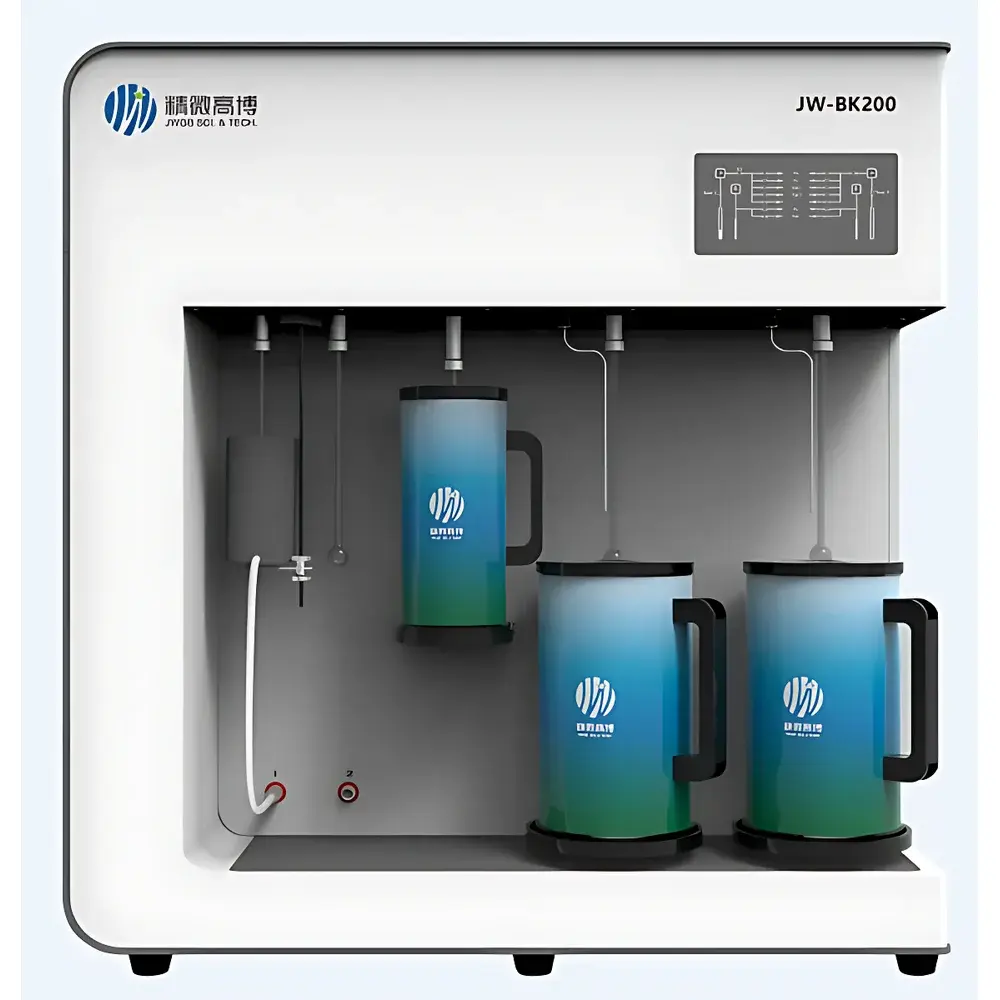
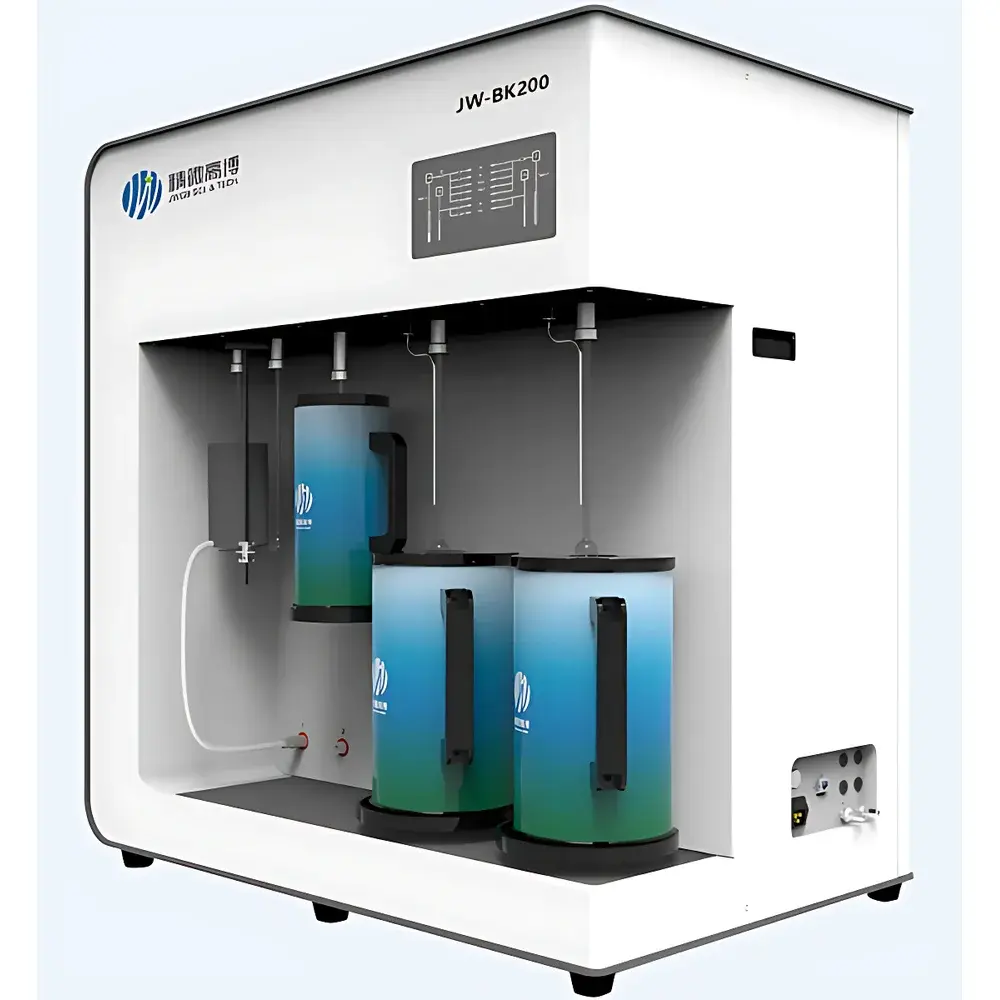
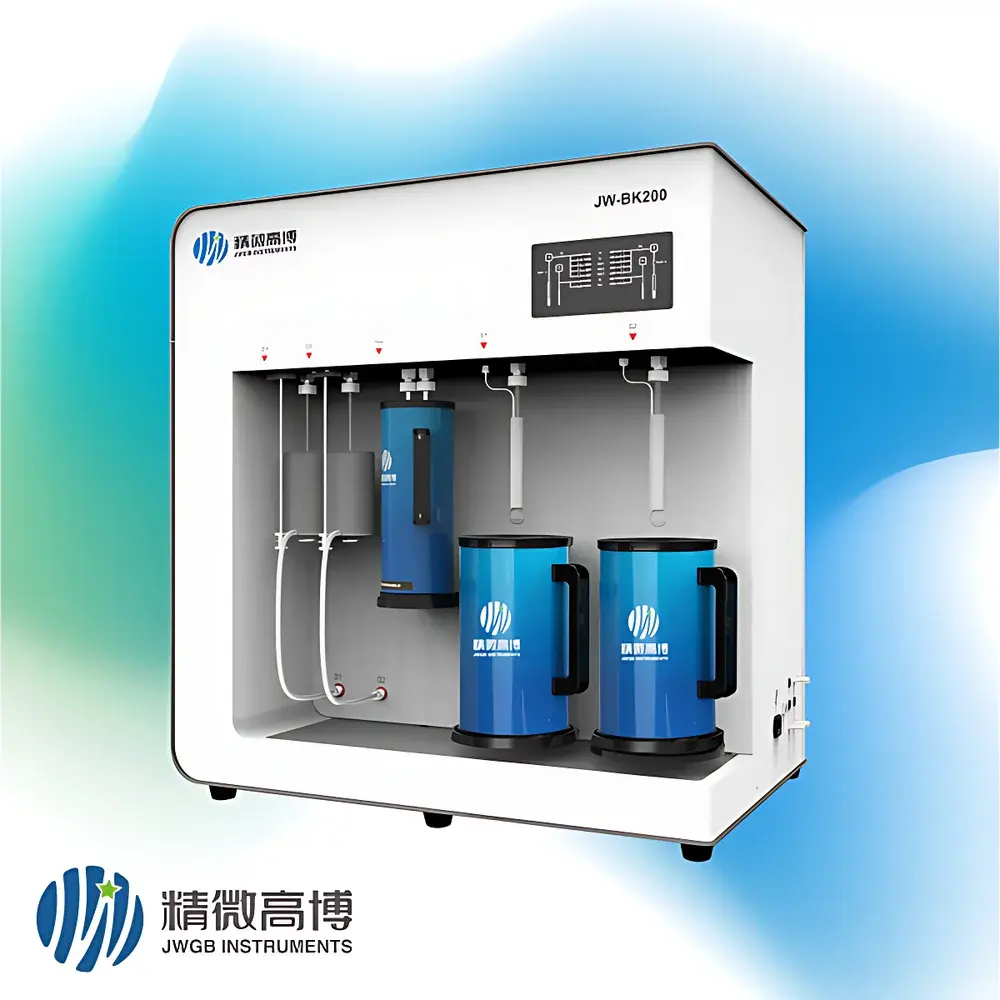
JWGB JW-BK200C MOFs/COFs-Specific Surface Area and Pore Size Analyzer
| Brand | JWGB |
|---|---|
| Origin | Beijing, China |
| Manufacturer Type | Direct Manufacturer |
| Instrument Type | Specific Surface Area and Pore Size Analyzer |
| Principle | Static Volumetric Method (Low-Temperature Gas Adsorption) |
| Analysis Stations | 2 Independent Micro/Meso-Pore Stations |
| BET Surface Area Range | Down to 0.0001 m²/g |
| Relative Pressure Range | p/p₀ = 1×10⁻⁸ to 0.998 |
| Theoretical Models | BET, Langmuir, BJH, t-plot, αs-plot, DR, MP, HK, SF, NLDFT |
| Pressure Sensors | Triple-range (1000 torr / 10 torr / 1 torr), accuracy ≤ ±0.15% of reading |
| Ultimate Vacuum | ≤1×10⁻⁶ Pa (analysis station) |
| Micropore Resolution Limit | 0.35 nm (N₂ at 77 K) |
| Degassing Temperature | RT–400 °C, ±1 °C control |
| Data Acquisition | Ethernet-based, Windows 7/10 (32/64-bit) compatible |
Overview
The JWGB JW-BK200C MOFs/COFs-Specific Surface Area and Pore Size Analyzer is a research-grade dual-station instrument engineered for high-precision characterization of ultramicroporous and hierarchical porous materials. It operates on the static volumetric gas adsorption principle—specifically, cryogenic nitrogen (77 K), argon (87 K), or krypton (119 K) adsorption—to quantify specific surface area, pore volume distribution, and pore geometry across micropores (0.35–2 nm), mesopores (2–50 nm), and macropores (50–5000 nm). Designed explicitly for metal–organic frameworks (MOFs), covalent organic frameworks (COFs), zeolites, activated carbons, and other nanoporous solids with high surface energy and low thermal stability, the system integrates ultra-high vacuum capability (1×10⁻⁶ Pa base pressure; 1×10⁻⁸ Pa under turbomolecular pumping), sub-torr pressure resolution, and thermally stabilized sample dewar architecture to ensure reproducible physisorption isotherm acquisition. Its hardware configuration—including imported turbo-molecular and dual-stage rotary vane vacuum pumps, triple-range capacitance manometers, and in-situ liquid nitrogen level regulation—enables rigorous adherence to ISO 9277, ASTM D3663, and IUPAC 2015 guidelines for physisorption analysis.
Key Features
- Dual independent analysis stations with fully autonomous operation: simultaneous measurement of two samples, including concurrent BET surface area, pore size distribution, and isotherm acquisition.
- Integrated dual degassing stations with programmable 10-step temperature ramping (RT–400 °C, ±1 °C), individual PID controllers, and cold-trap protection—enabling in-situ or ex-situ thermal pretreatment without cross-contamination.
- Triple-range pressure sensing system (1000 torr / 10 torr / 1 torr) with <±0.15% full-scale accuracy ensures high-fidelity data capture across the full p/p₀ range (10⁻⁸–0.998), critical for accurate micropore filling assessment and monolayer capacity determination.
- Patented multi-channel parallel vacuum manifold with adjustable pumping speed (2–200 mL/s) and “stepwise” anti-sputter protocols prevents fine-powder entrainment and maintains long-term system integrity during ultra-low-pressure measurements.
- 3-L vacuum-insulated Dewar with auto-refill compensation and liquid nitrogen level stabilization sustains stable 77 K bath conditions for >72 hours—eliminating manual refilling and thermal drift artifacts.
- Standard NLDFT (Non-Local Density Functional Theory) kernel library preloaded for carbon, silica, and alumina-based models; optional HK and SF kernel modules validated for slit-shaped and cylindrical micropores per IUPAC recommendations.
- Ethernet-based real-time data acquisition with GLP-compliant audit trail logging, supporting FDA 21 CFR Part 11–ready software configuration when deployed in regulated QC environments.
Sample Compatibility & Compliance
The JW-BK200C accommodates powdered, granular, and pelletized specimens up to 2 g per analysis port, with compatibility spanning MOFs (e.g., MOF-5, UiO-66, MIL-101), COFs (e.g., COF-1, TpPa-1), activated carbons, molecular sieves (13X, 5A), metal oxides (γ-Al₂O₃, TiO₂), and porous polymers. All hardware components comply with CE electromagnetic compatibility (EMC) directives and RoHS material restrictions. The instrument supports method validation per ISO/IEC 17025:2017 requirements, and its pressure calibration traceability is certified against NIST-standard reference manometers. For GMP-regulated labs, optional 21 CFR Part 11 compliance packages include electronic signature enforcement, role-based access control, and immutable raw data archiving.
Software & Data Management
JWGB’s proprietary JW-DATA v5.2 software provides guided workflow navigation—from sample loading and degas protocol selection to isotherm fitting and report generation. It supports batch processing of up to 16 samples, automated outlier detection using robust regression algorithms, and export of ASCII, CSV, and CDF formats compatible with third-party modeling tools (e.g., MATLAB, OriginLab, Zeo++). The software embeds built-in uncertainty propagation engines for BET surface area (Type I error estimation), pore volume (gravimetric correction), and NLDFT-derived pore size distributions. Audit trails record all parameter modifications, user logins, and calibration events with timestamped digital signatures. Remote monitoring and control via secure HTTPS interface enable centralized fleet management across multi-site laboratories.
Applications
- Catalysis R&D: Quantification of active site accessibility in supported catalysts (e.g., Pt/Al₂O₃), acidity mapping via NH₃-TPD correlation, and diffusion-limited reaction modeling using tortuosity-corrected pore network simulations.
- Gas Storage & Separation: High-pressure CH₄/CO₂/H₂ adsorption isotherms (up to 100 bar optional) for evaluating MOF performance in hydrogen storage tanks or post-combustion carbon capture systems.
- Battery Materials: Anode/cathode porosity profiling of silicon-carbon composites and solid-state electrolyte scaffolds to correlate ionic conductivity with interfacial surface area.
- Pharmaceutical Excipients: Regulatory-compliant surface area verification of amorphous silica carriers (e.g., Aerosil®) per USP and Ph. Eur. 2.9.34.
- Environmental Sorbents: Kinetic and equilibrium capacity benchmarking of biochar and activated clay derivatives for heavy metal sequestration and VOC abatement.
FAQ
What gases can be used for adsorption analysis on the JW-BK200C?
Nitrogen (77 K), argon (87 K), krypton (119 K), carbon dioxide (273 K), hydrogen (77 K), and methane (112 K) are supported. Gas selection is model-dependent: N₂ for mesoporous materials; Ar for sub-0.7 nm micropores; CO₂ for 0–1 nm ultramicropores at 273 K.
Is the instrument compliant with ISO 9277 and ASTM D3663?
Yes—the hardware architecture, pressure transducer calibration, temperature control stability, and data reduction algorithms are aligned with ISO 9277:2010 and ASTM D3663-20 specifications for BET surface area determination.
Can the system perform true density measurements?
Yes—via helium pycnometry mode using the same sample tube and pressure manifold, enabling skeletal density input for total pore volume calculation (Vtotal = VHe – Vskeletal).
How does the instrument handle moisture-sensitive MOF samples during degassing?
The integrated cold trap (−100 °C) between the degas line and vacuum manifold captures evolved H₂O and volatile organics, preventing backstreaming into the analysis chamber and preserving sensor longevity.
What validation documentation is provided for regulatory use?
Factory calibration certificates (pressure, temperature), NIST-traceable manometer reports, IQ/OQ documentation templates, and 21 CFR Part 11 readiness assessment reports are included with each delivery.



