
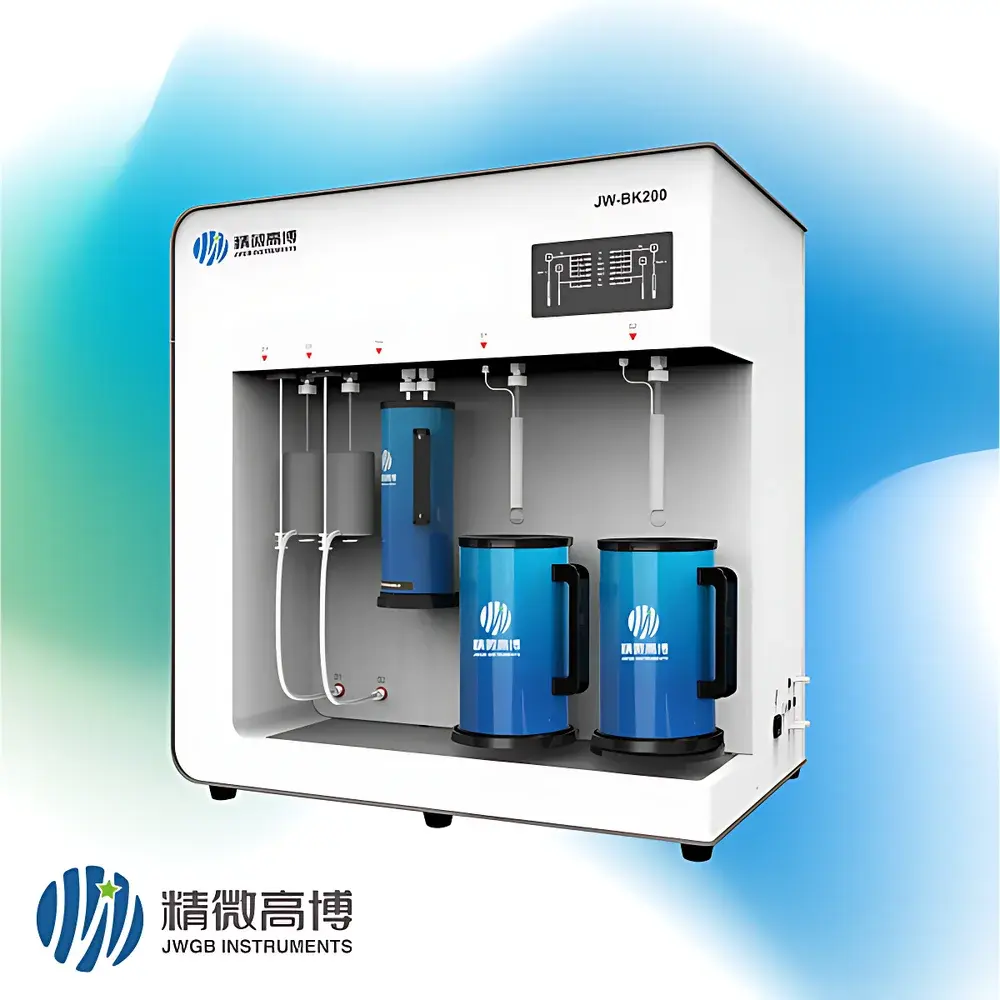
JWGB JW-BK200C Catalyst-Specific Micropore Size Analyzer
| Brand | JWGB |
|---|---|
| Origin | Beijing, China |
| Manufacturer Type | Direct Manufacturer |
| Instrument Category | Domestic |
| Model | JW-BK200C Catalyst-Specific Micropore Size Analyzer |
| Pricing | Upon Request |
| Instrument Type | Specific Surface Area and Pore Size Analyzer |
| Measurement Principle | Static Volumetric Method (Gas Adsorption) |
| Number of Analysis Stations | 2 |
| Specific Surface Area Range | Down to 0.0001 m²/g |
| Relative Pressure Range | p/p₀ down to 10⁻⁸ |
| Theoretical Framework | BET Multilayer Adsorption Theory, BJH Mesopore Analysis, HK/SF/NLDFT Micropore Modeling |
Overview
The JWGB JW-BK200C Catalyst-Specific Micropore Size Analyzer is a research-grade, dual-station static volumetric gas adsorption instrument engineered for high-precision characterization of microporous and ultramicroporous materials. It operates on the fundamental principle of physical gas adsorption at cryogenic temperatures—primarily using nitrogen at 77 K, with optional support for argon (87 K), krypton, CO₂ (273 K), and other probe gases—to quantify specific surface area, pore volume, and pore size distribution across the full range from 0.35 nm to 5000 nm. Its design integrates ultra-high vacuum capability (≤10⁻⁶ Pa), multi-range pressure transduction (1000 torr / 10 torr / 1 torr, ±0.15% reading accuracy), and intelligent equilibrium pressure control to ensure reproducible isotherm acquisition under strict thermodynamic equilibrium conditions. The system is optimized for catalyst-relevant materials—including zeolites, alumina-based supports, MOFs, COFs, activated carbons, and molecular sieves—where accurate quantification of sub-nanometer porosity directly correlates with catalytic activity, diffusion kinetics, and active site accessibility.
Key Features
- Dual independent analysis stations with fully parallel operation: simultaneous adsorption analysis of two samples and concurrent degassing of two additional samples
- Integrated dual-stage vacuum architecture: external oil-free rotary vane pump + internal turbo-molecular pump enabling ultimate pressure ≤10⁻⁸ p/p₀ during micropore equilibration
- Triple-range pressure sensing system (1000 torr / 10 torr / 1 torr) with auto-ranging and <0.1 kPa pressure control resolution for precise low-pressure data capture
- In-situ liquid nitrogen level regulation with thermal compensation algorithms and 3-L vacuum-insulated Dewar flask supporting uninterrupted 72-hour operation
- Programmable degassing module: two independent heating zones (RT–400 °C, ±1 °C stability), 10-step temperature ramping, and cold-trap protection to prevent condensable contamination of vacuum lines
- Real-time, station-specific p₀ measurement via dedicated reference manometers—no reliance on literature values or atmospheric input methods
- Standard NLDFT (Non-Local Density Functional Theory) kernel library with HK, SF, t-plot, αs-plot, DR, MP, and BJH models pre-installed and validated per IUPAC recommendations
- Ethernet-based acquisition architecture compatible with Windows 7/10/11 (32/64-bit); remote monitoring and multi-instrument control supported
Sample Compatibility & Compliance
The JW-BK200C accommodates powdered, granular, and pelletized solid catalysts and sorbents with minimal mass requirements (typically 50–500 mg depending on expected surface area). It complies with internationally recognized standards for gas adsorption analysis, including ISO 9277 (BET surface area), ISO 15901-1/-2 (pore size distribution), ASTM D3663 (catalyst surface area), and USP (pharmaceutical excipient characterization). All raw isotherm data, parameter inputs, and model selections are timestamped and logged with full audit trail functionality—enabling alignment with GLP and GMP documentation requirements. The system supports 21 CFR Part 11-compliant user access controls when deployed in regulated environments, with electronic signatures and change history tracking available through optional software modules.
Software & Data Management
Control and analysis are executed via JWGB’s proprietary AdsorptionPro™ software suite—a modular, wizard-driven platform that guides users through degassing protocol definition, isotherm acquisition scheduling, and model-based interpretation. Raw pressure–volume data are stored in vendor-neutral ASCII format with embedded metadata (sample ID, date/time, operator, instrument configuration). Batch processing enables comparative analysis across multiple samples; statistical reporting includes relative standard deviation (RSD) for BET surface area (≤±1.0%) and pore diameter (≤±0.2 nm). Export options include CSV, PDF reports, and direct integration with MATLAB, OriginLab, and Python-based analysis pipelines via API interface. All calibration records, maintenance logs, and sensor drift corrections are retained within the database for traceability.
Applications
- Catalysis R&D: Quantitative evaluation of support porosity in Pt/Al₂O₃, Ni/zeolite, Cu-MOF, and Co-Fe spinel systems for structure–activity correlation
- Petrochemical refining: Characterization of FCC catalysts, hydrodesulfurization supports, and shape-selective zeolitic frameworks
- Environmental engineering: Performance benchmarking of activated carbon, biochar, and metal–organic frameworks for VOC capture and heavy metal sequestration
- Energy materials: Pore confinement effects in battery electrode coatings, hydrogen storage MOFs, and CO₂ capture sorbents
- Academic surface science: Validation of synthetic protocols for COF crystallinity, templated mesoporous silica, and hierarchical carbons
FAQ
What probe gases are supported, and when should I use alternatives to nitrogen?
Nitrogen (77 K) is standard for materials with pores >0.7 nm. For ultramicroporous systems (<0.7 nm), argon (87 K) or CO₂ (273 K) is recommended to avoid kinetic limitations and enhance resolution below 0.4 nm.
Does the instrument meet ISO/ASTM accreditation requirements for lab certification?
Yes—the hardware architecture, pressure calibration traceability, and software audit trail capabilities align with ISO/IEC 17025 implementation guidelines for testing laboratories.
Can I perform t-plot or αs-plot analysis without purchasing additional licenses?
All IUPAC-recommended linear plot methods (t-plot, αs-plot, DR, MP) are included in the base software package.
How is sample degassing monitored independently from analysis stations?
Each degassing port features a dedicated pressure transducer and temperature controller, with real-time vacuum level logging synchronized to the main acquisition timeline.
Is NLDFT modeling validated against certified reference materials?
Yes—NLDFT kernel selection is cross-validated using NIST SRM 2973 (graphitized carbon black) and SIBATA CMS-100, with uncertainty budgets documented per ISO 5725.



