
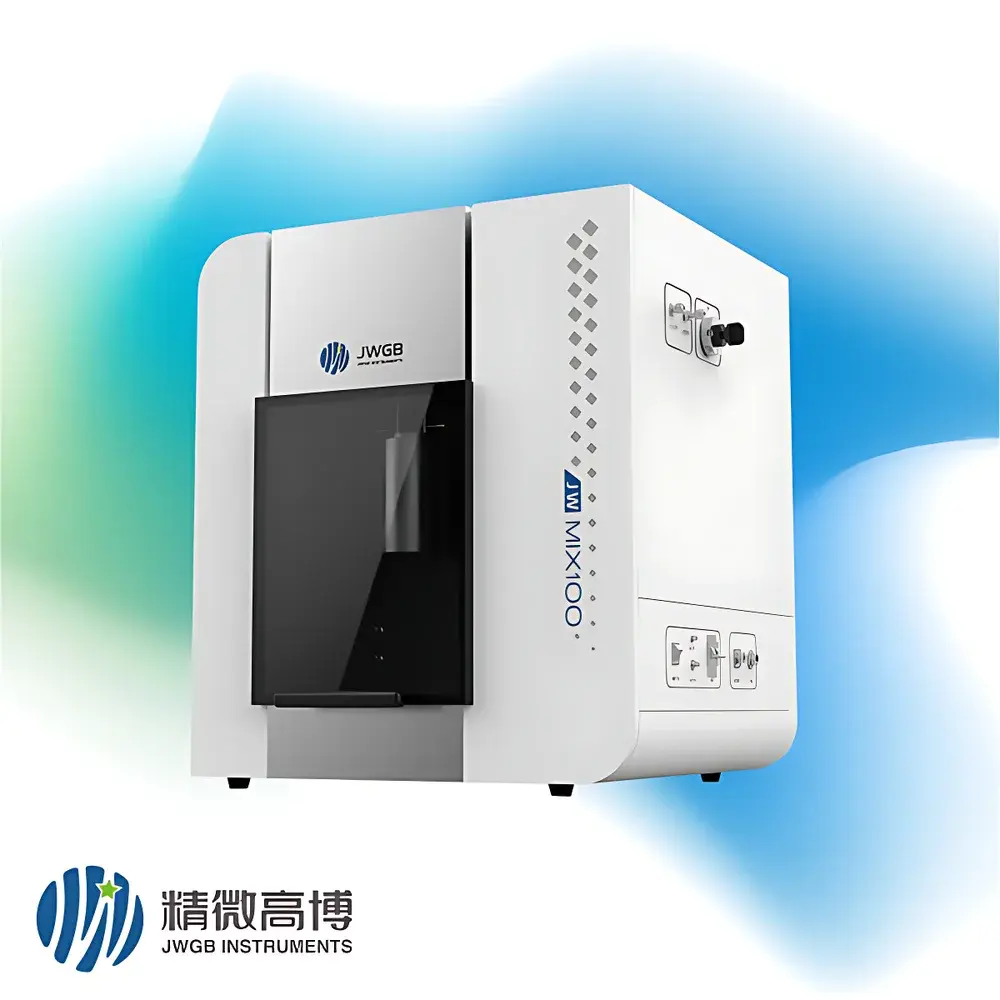
JWGB JW-MIX100 SHP Breakthrough Curve and Mass Transfer Analyzer (100 bar High-Pressure)
| Brand | JWGB |
|---|---|
| Origin | Beijing, China |
| Manufacturer Type | Original Equipment Manufacturer (OEM) |
| Product Category | Domestic |
| Model | JW-MIX100 SHP Breakthrough Curve and Mass Transfer Analyzer (100 bar High-Pressure) |
| Pricing | Upon Request |
Overview
The JWGB JW-MIX100 SHP Breakthrough Curve and Mass Transfer Analyzer is a high-precision, fully automated instrumentation platform engineered for quantitative characterization of dynamic adsorption behavior under elevated pressure conditions up to 100 bar. It operates on the fundamental principles of gas-phase chromatographic breakthrough analysis and zero-length column (ZLC) methodology—two complementary techniques widely recognized in porous materials science for determining intracrystalline diffusion coefficients, surface residence times, and mass transfer resistances. Unlike static volumetric or gravimetric systems, the JW-MIX100 SHP enables real-time monitoring of concentration fronts as multicomponent gas mixtures flow through a fixed-bed adsorbent sample under controlled temperature, pressure, and flow rate. This allows direct experimental derivation of breakthrough curves, which serve as primary inputs for modeling transport-limited adsorption processes in pressure swing adsorption (PSA), hydrogen purification, CO₂ capture, and hydrocarbon separation applications.
Key Features
- High-pressure operation up to 100 bar with integrated safety interlocks, pressure transducers (±0.1% FS accuracy), and dual-stage back-pressure regulation for stable flow control across wide pressure ranges.
- Dual-mode mass transfer quantification: simultaneous support for classical breakthrough curve analysis and zero-length column (ZLC) technique—enabling independent determination of effective diffusivity (Deff) and surface diffusion coefficient (Ds) in microporous materials such as zeolites, MOFs, and activated carbons.
- Modular gas delivery system with up to four independently controlled mass flow controllers (MFCs), supporting binary to quaternary gas mixtures with ppm-level composition accuracy and fast switching (<500 ms) for step-change experiments.
- Integrated thermal management with ±0.1 °C temperature stability over the range of 25–200 °C, ensuring reproducible isothermal adsorption/desorption kinetics.
- Real-time detection via configurable downstream analyzers—including TCD (thermal conductivity detector), IR gas sensors, or optional coupling to quadrupole mass spectrometry (QMS)—for species-resolved effluent concentration profiling.
- Robust stainless-steel microreactor architecture compliant with ASME B31.3 process piping standards; all wetted parts electropolished and passivated for inertness toward corrosive or reactive gases (e.g., H₂S, NH₃, Cl₂).
Sample Compatibility & Compliance
The JW-MIX100 SHP accommodates powdered, pelletized, or extruded adsorbent samples (typically 0.1–2.0 g, particle size 20–200 µm) within a standardized quartz or Hastelloy reactor cartridge. It supports both single-component and competitive multicomponent adsorption studies under industrially relevant conditions—fully aligned with ASTM D6877 (Standard Test Method for Determining Diffusion Coefficients of Gases in Porous Solids), ISO 15901-2 (Pore size distribution by gas adsorption), and IUPAC recommendations for kinetic adsorption measurements. System design adheres to GLP-compliant data integrity requirements, including electronic audit trails, user access levels, and 21 CFR Part 11–ready software architecture for regulated environments.
Software & Data Management
The proprietary JW-AdsorpKinetics™ software provides an integrated environment for instrument control, real-time visualization, model fitting, and report generation. It includes built-in solvers for linear driving force (LDF), pore diffusion (PDM), and surface diffusion models; supports non-linear regression against analytical solutions of Fickian and Langmuir-type diffusion equations; and exports time-stamped datasets in HDF5 and CSV formats. All raw signals are timestamped with microsecond resolution and linked to metadata (temperature setpoint, pressure history, MFC calibration logs). Software validation documentation (IQ/OQ/PQ protocols) and electronic signature capability are available upon request for pharmaceutical or energy-sector QA/QC deployment.
Applications
- Quantitative evaluation of diffusion limitations in next-generation adsorbents for carbon capture (e.g., amine-functionalized MOFs under flue gas conditions).
- Dynamic selectivity assessment of mixed-gas H₂/CH₄ or CO₂/N₂ separations in PSA cycle design.
- Validation of molecular simulation predictions (e.g., GCMC + MD) against experimental breakthrough times and slope-derived effective diffusivities.
- Thermal effects analysis during rapid adsorption/desorption cycles—via synchronized thermocouple readings and enthalpy-of-adsorption estimation from transient heat flux profiles.
- Accelerated aging studies of adsorbent performance degradation under cyclic high-pressure exposure.
FAQ
What types of adsorbent materials can be tested on the JW-MIX100 SHP?
Powdered zeolites, metal–organic frameworks (MOFs), activated carbons, silica gels, and functionalized polymers—provided they are mechanically stable under 100 bar and compatible with selected carrier gases.
Can the system perform both breakthrough and ZLC measurements without hardware reconfiguration?
Yes. The reactor manifold and valve sequencing are software-configurable to switch between breakthrough mode (fixed bed, continuous flow) and ZLC mode (short bed, pulse injection) within the same experimental session.
Is the instrument compatible with external gas analyzers such as FTIR or GC-MS?
Yes. Standard 6-mm Swagelok ports and analog/digital I/O interfaces allow seamless integration with third-party detectors for advanced speciation.
Does the system meet regulatory requirements for use in pharmaceutical process development?
It supports 21 CFR Part 11 compliance when deployed with validated software configuration, electronic signatures, and full audit trail functionality—subject to site-specific IQ/OQ execution.
What level of technical support and method development assistance is provided?
JWGB offers application engineering support—including custom kinetic model implementation, reference material testing, and comparative benchmarking against literature datasets—for academic and industrial users.



