
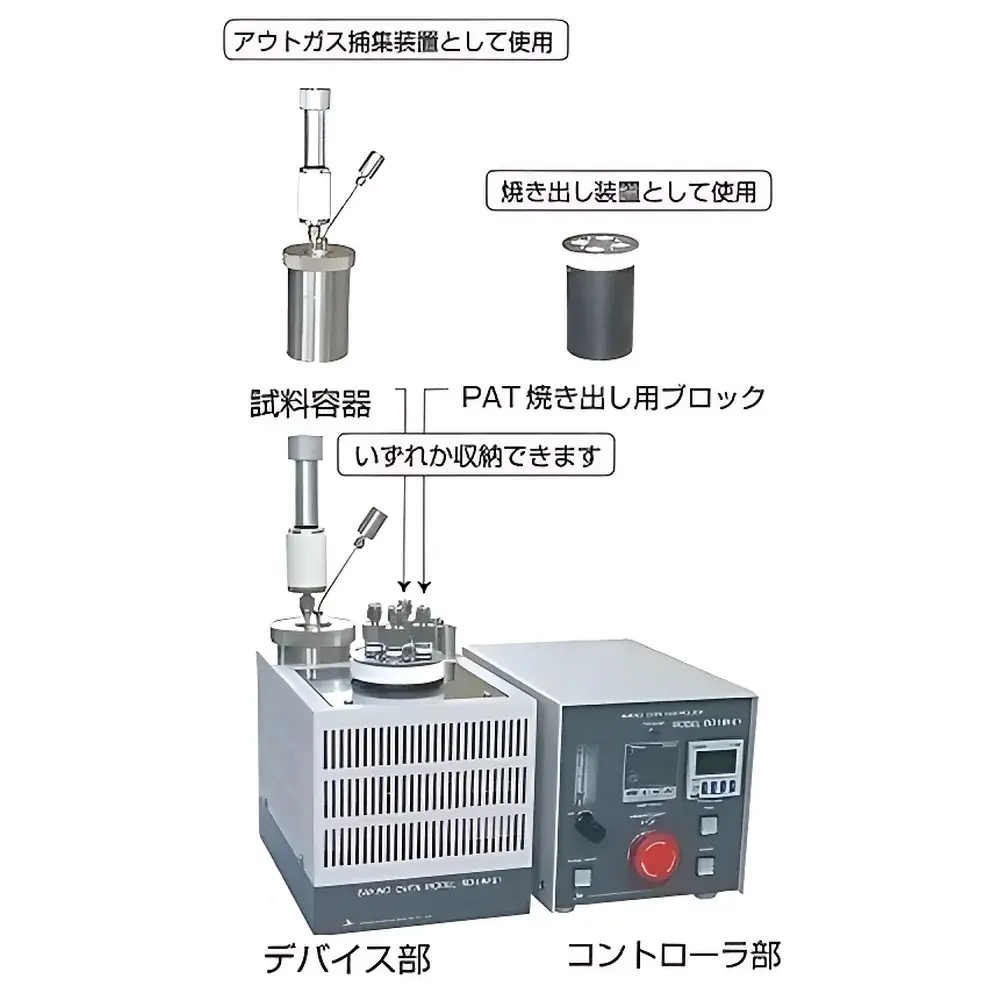
BO-HM-01 PAT-Enabled Gas Trapping and Thermal Desorption Unit
| Origin | Japan |
|---|---|
| Manufacturer Type | Authorized Distributor |
| Origin Category | Imported |
| Model | BO-HM-01 |
| Pricing | Upon Request |
Overview
The BO-HM-01 PAT-Enabled Gas Trapping and Thermal Desorption Unit is a dual-function laboratory instrument engineered for precise volatile organic compound (VOC) sampling and preparatory thermal conditioning of passive adsorbent tubes. It integrates two distinct operational modes—gas trapping (dynamic headspace sampling) and programmed adsorbent tube (PAT) thermal desorption preparation—within a single compact platform. The system operates on the principle of controlled inert-gas purging coupled with resistive heating to achieve quantitative analyte transfer from liquid or solid matrices into stainless-steel sample tubes, followed by high-fidelity thermal conditioning of Tenax GR-packed adsorbent tubes prior to subsequent thermal desorption–gas chromatography (TD-GC) analysis. Designed for compliance-driven laboratories, the BO-HM-01 supports method development and routine execution aligned with ASTM D6196, ISO 16017-1, and EPA TO-17 protocols for ambient air and workplace monitoring.
Key Features
- Dual-mode architecture: Independent switching between 250 mL stainless-steel gas trapping mode and multi-tube PAT thermal conditioning mode without hardware reconfiguration.
- High-purity sample pathway: 250 mL sample tube fabricated from electropolished stainless steel with gold-plated internal surface to minimize analyte adsorption and catalytic degradation of reactive VOCs.
- Precise thermal control: Resistively heated sample chamber (ambient to 200 °C) and separate aluminum-based PAT furnace (ambient to 300 °C), each with independent PID temperature regulation and real-time digital display.
- Programmable operation: Capture duration adjustable up to 99 hours 59 minutes; inert gas flow rate tunable from 200 to 2,000 mL/min via calibrated mass flow control.
- Scalable PAT conditioning: Simultaneous thermal treatment of up to four standard 6 mm OD adsorbent tubes (e.g., Tenax GR, Carbopack B, or custom-packed variants).
- Modular cooling option: Optional recirculating chiller interface enables active condensate management during extended trapping cycles involving high-volatility or moisture-rich samples.
- Compact benchtop footprint: Main unit (175 × 185 × 250 mm) and controller (175 × 180 × 250 mm) designed for space-constrained analytical labs; total system weight under 12 kg for mobility and installation flexibility.
Sample Compatibility & Compliance
The BO-HM-01 accommodates aqueous, solvent-based, and semi-solid matrices—including environmental water, soil slurries, polymer extracts, and pharmaceutical excipients—provided sample volume and volatility fall within defined operational envelopes. Its gold-coated stainless-steel sample tube ensures compatibility with oxygen-sensitive compounds (e.g., aldehydes, terpenes) and acidic/basic VOCs that may interact with untreated metal surfaces. For regulatory applications, the instrument supports GLP-compliant workflows when paired with validated SOPs and audit-trail-capable data loggers (external). While the BO-HM-01 itself does not embed 21 CFR Part 11 functionality, its analog control signals and time-stamped operational parameters are fully compatible with third-party LIMS integration for traceable record retention.
Software & Data Management
The BO-HM-01 utilizes an embedded microcontroller-based interface with dedicated front-panel keys and LED indicators for setpoint entry, status monitoring, and alarm signaling (e.g., overtemperature, flow interruption). Temperature and timer values are displayed in real time with ±1 °C and ±1 minute resolution, respectively. All operational parameters—including start time, target temperature, gas flow rate, and elapsed duration—are logged internally to non-volatile memory and exportable via RS-232 serial output (cable included) for post-acquisition analysis in Excel or laboratory informatics platforms. No proprietary software installation is required; raw ASCII logs conform to ASTM E1447-22 metadata conventions for instrument-generated data.
Applications
- Pre-concentration of trace-level VOCs from environmental water samples prior to TD-GC/MS analysis.
- Method validation studies requiring reproducible spiking and recovery assessment across multiple adsorbent tube lots.
- Thermal cleaning and outgassing of Tenax GR tubes to eliminate background artifacts in low-level odor profiling (e.g., food packaging, automotive interiors).
- Stability testing of volatile impurities in pharmaceutical intermediates per ICH Q3C guidelines.
- Calibration standard generation for dynamic dilution systems used in olfactometry or sensor array development.
FAQ
Can the BO-HM-01 be used with adsorbent tubes other than Tenax GR?
Yes—the PAT furnace accepts any standard 6 mm OD, 90 mm length adsorbent tube with compatible end fittings; users must validate breakthrough volumes and thermal desorption efficiency for alternative sorbents.
Is the gold plating on the sample tube resistant to repeated cleaning with organic solvents?
The electroless gold coating (≥0.5 µm thickness) exhibits excellent chemical inertness toward acetone, methanol, dichloromethane, and toluene; however, abrasive scrubbing or ultrasonic immersion in strong acids is not recommended.
Does the instrument support automatic sequence programming for unattended overnight operation?
While the BO-HM-01 lacks built-in multi-step sequencing, its programmable timer and stable thermal performance enable reliable 12–24 hour trapping cycles; external PLC integration is feasible via dry-contact relay outputs (optional accessory).
What safety certifications does the BO-HM-01 carry?
The unit complies with JIS C 61010-1:2013 (equivalent to IEC 61010-1) for electrical safety and includes overtemperature cutoff, current-limiting fusing, and grounded chassis construction.
Is calibration documentation provided with shipment?
A factory-issued calibration certificate for temperature sensors (NIST-traceable reference) and flow meter (at 1,000 mL/min N₂) is included; annual recalibration is recommended per ISO/IEC 17025 laboratory requirements.
Related Products



