
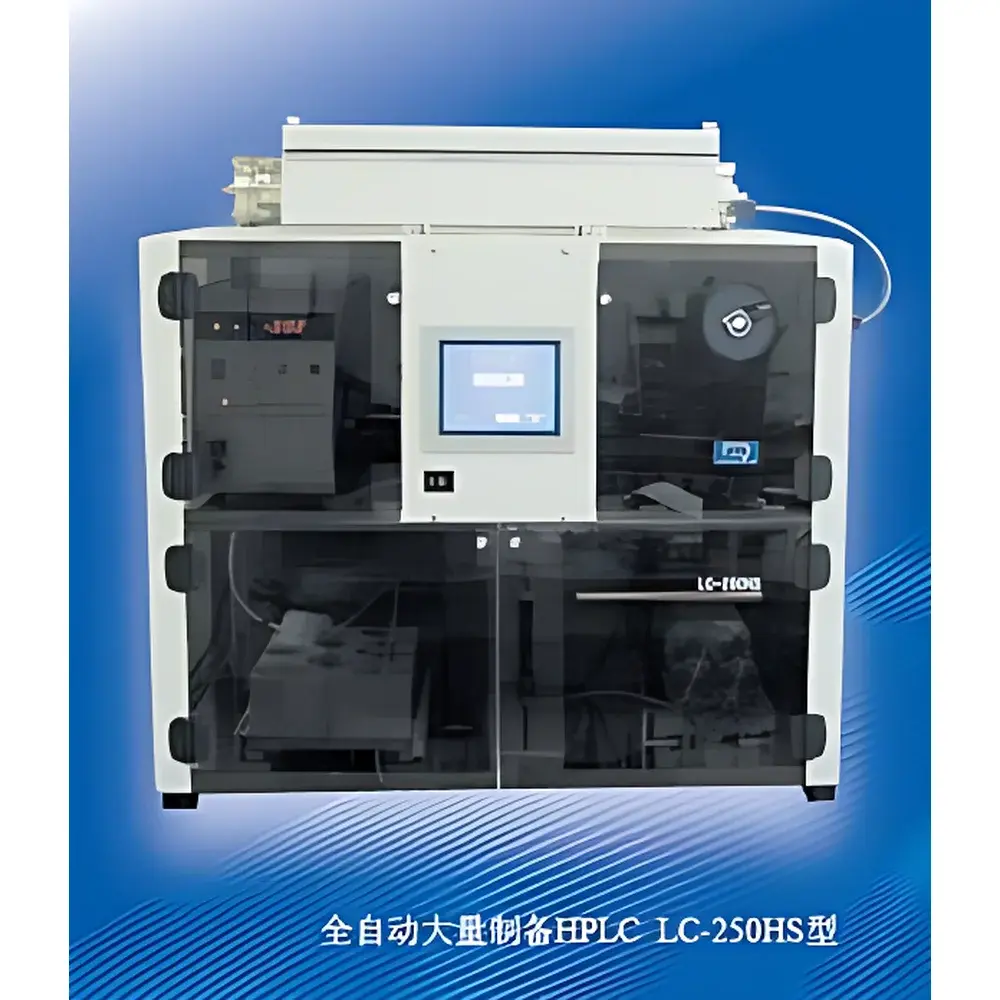
JAI LC-250HS Automated High-Capacity Recirculating Preparative Liquid Chromatography System
| Brand | JAI |
|---|---|
| Origin | Japan |
| Instrument Type | High-Pressure Preparative HPLC |
| Model | LC-250HS |
| Pump | K-200 Dual-Piston Reciprocating Pump |
| Max Pressure | 10 MPa |
| Flow Rate Range | 2–199 mL/min |
| Flow Accuracy | ±2% |
| Injector | Syringe Pump with 1–160 mL Loop Selection |
| Column Oven | Electric Heating, 5–80 °C |
| Detector | UV-310B Variable-Wavelength UV Detector (195–370 nm, 0.5 mm Pathlength, 20 µL Cell, Noise: 5×10⁻⁵ AU) |
| Fraction Collector | JHF-122 (90 Fractions, Time/Peak/Programmed Collection) |
| Control System | Touchscreen PLC Interface |
| Dimensions (W×H×D) | 760×750×690 mm |
| Weight | 98 kg |
| Wetted Materials | SUS316, Sapphire, Ruby, Ceramic, PTFE, Fluororesin, Fused Silica |
Overview
The JAI LC-250HS is an automated high-capacity recirculating preparative liquid chromatography system engineered for rigorous isolation and purification of milligram-to-gram quantities of complex organic compounds—particularly those exhibiting low abundance, structural similarity, or inherent instability. Unlike conventional analytical or semi-preparative HPLC platforms, the LC-250HS implements a true closed-loop recirculation architecture grounded in classical chromatographic theory: when resolution between adjacent peaks falls below baseline separation on a single pass, the eluent containing unresolved components is redirected back to the column inlet via a high-pressure switching valve, enabling repeated passage through the stationary phase without solvent replenishment. This approach leverages kinetic resolution enhancement rather than relying solely on column selectivity or gradient optimization—making it especially effective for chiral separations, natural product purification, and post-synthetic mixture cleanup where conventional methods fail. Designed and manufactured in Japan, the system integrates a robust dual-piston reciprocating pump (K-200), a high-sensitivity variable-wavelength UV detector (UV-310B), and a programmable fraction collector (JHF-122), all coordinated through an industrial-grade touchscreen PLC controller.
Key Features
- True recirculation capability with zero solvent consumption during loop cycles—enabling extended residence time without dilution or reconstitution.
- High-flow, high-pressure pump (up to 10 MPa, 2–199 mL/min) compatible with large-bore preparative columns (up to 50 mm ID), supporting loading capacities up to 1 g per injection.
- Dedicated polymer-based preparative columns (e.g., styrene-divinylbenzene copolymers) offering superior chemical inertness, minimal sample degradation (no silanol-induced deamidation, epimerization, or hydrolysis), and extended service life (>6 years under routine use).
- Integrated column oven (5–80 °C) with precise thermal stability (±0.5 °C), essential for reproducible retention time control during multi-hour recirculation runs.
- Full automation from sample injection to fraction collection—including programmable loop initiation/termination timing (0–999 min), cycle count (1–99), and injection volume (1–160 mL in 1 mL increments).
- PLC-based control architecture compliant with IEC 61131-3 standards; supports audit trail logging, parameter locking, and user-level access control for GLP/GMP-aligned workflows.
Sample Compatibility & Compliance
The LC-250HS accommodates a broad range of compound classes—including small-molecule APIs, synthetic intermediates, natural products, peptides, and labile chiral compounds—without requiring derivatization or stabilization. Its inert wetted path (SUS316 stainless steel, sapphire/ruby check valves, ceramic pump heads, PTFE/fluororesin seals, and fused silica flow cells) ensures compatibility with aggressive solvents (e.g., THF, DCM, TFA-containing mobile phases) and acidic/basic modifiers. The system meets mechanical and electrical safety requirements per JIS B 7981 and conforms to electromagnetic compatibility (EMC) standards IEC 61326-1. While not certified as 21 CFR Part 11–compliant out-of-the-box, its PLC controller supports optional electronic signature modules and timestamped event logs required for FDA-regulated environments. Method validation documentation aligns with ICH Q2(R2) principles for preparative chromatography.
Software & Data Management
Operation is managed via an intuitive 7-inch resistive touchscreen interface running embedded firmware compliant with IEC 62443-3-3 cybersecurity guidelines. All method parameters—including flow profile, UV wavelength setpoints, fraction trigger thresholds (absorbance or time-based), recirculation logic (fixed cycles vs. real-time peak monitoring), and temperature ramping—are stored in encrypted non-volatile memory. Raw detector signals (20-bit ADC resolution, 10 Hz sampling) are streamed to internal storage and exportable via USB 2.0 in CSV or ASCII format for third-party integration (e.g., Empower, Chromeleon, or custom Python-based analysis pipelines). Audit trails record operator ID, timestamp, parameter changes, and system alarms—retained for ≥12 months and exportable for regulatory review.
Applications
- Purification of synthetic intermediates for structure elucidation (e.g., 13C-NMR requires ≥100 mg of homogenous material; LC-250HS routinely delivers this in one recirculation run).
- Chiral resolution of enantiomers where baseline separation is unattainable by standard gradient elution—leveraging differential interaction kinetics over multiple column passes.
- Isolation of thermally sensitive or oxidation-prone compounds (e.g., polyphenols, alkaloids) using ambient-temperature recirculation and oxygen-free solvent handling options.
- Process development support for pharmaceutical candidates: rapid scouting of purification conditions prior to scale-up to SMB or simulated moving bed systems.
- Recovery of high-value catalysts or ligands from reaction mixtures—minimizing loss due to irreversible adsorption on silica-based media.
FAQ
What distinguishes recirculating preparative HPLC from conventional gradient-based purification?
Recirculation improves resolution by increasing theoretical plate count via repeated column exposure—not by altering mobile phase composition. It is particularly advantageous when selectivity (α) is marginal but efficiency (N) can be enhanced kinetically.
Can the LC-250HS operate without a dedicated analytical column?
Yes. Its high-efficiency polymer-packed preparative columns (≥20,000 plates/m) and sub-50 nAU noise floor enable direct μg-level analytical monitoring during prep runs—eliminating the need for separate analytical verification steps.
How does solvent consumption compare to linear-gradient preparative systems?
Recirculation reduces total solvent volume by up to 67% versus equivalent-resolution linear gradients, as only initial equilibration and final column flushing require fresh mobile phase.
Is method transfer from analytical to preparative scale supported?
Retention time scaling follows standard van Deemter and Knox relationships; JAI provides column geometry conversion tools and retention prediction algorithms based on k’ and φ values derived from analytical screening.
What maintenance intervals are recommended for the K-200 pump and UV-310B detector?
Pump seal replacement every 12 months under continuous operation; detector lamp recalibration every 6 months or after 2,000 hours—both documented in the included PM checklist aligned with ISO/IEC 17025 preventive maintenance protocols.






