
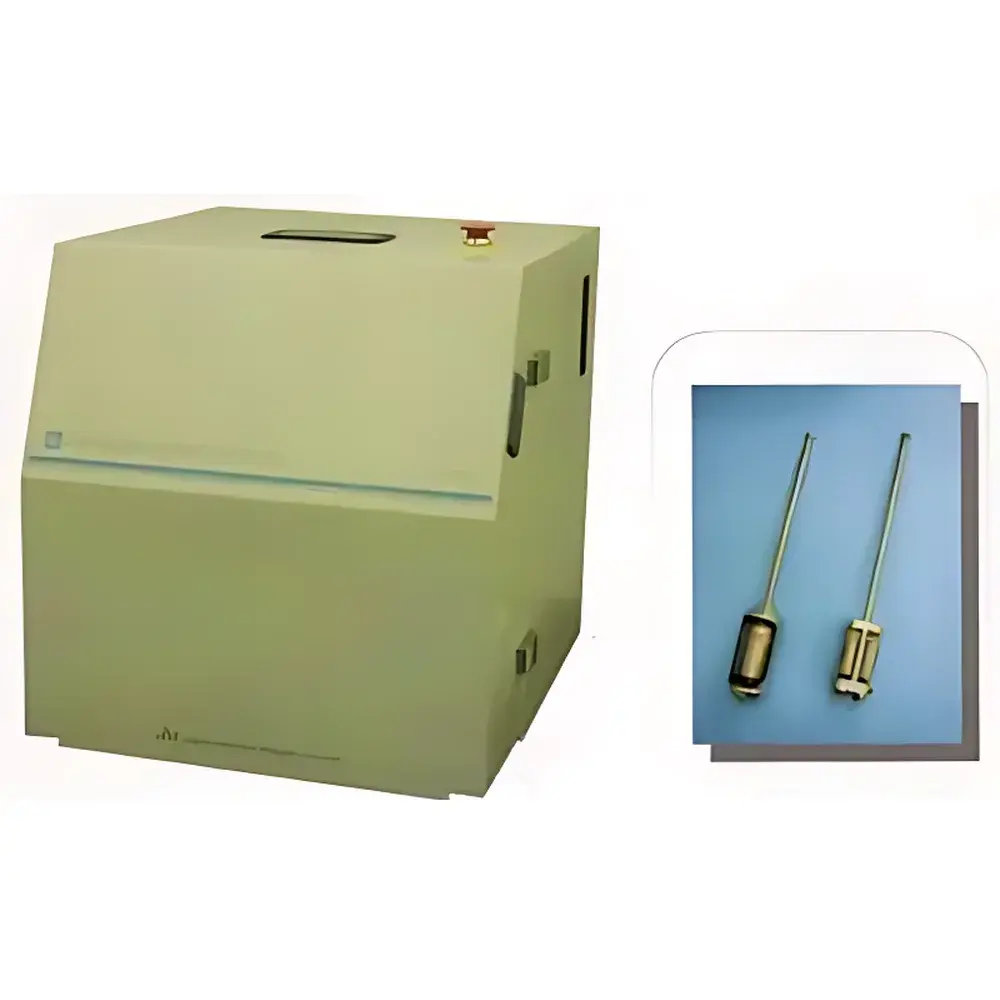
JAI JFC-2000 Cryogenic Ball Mill
| Brand | JAI |
|---|---|
| Origin | Japan |
| Model | JFC-2000 |
| Instrument Type | Cryogenic Ball Mill |
| Sample Applicability | Frozen Samples |
| Final Particle Size | < 0.01 mm |
| Maximum Feed Size | < 2 cm |
| Batch Capacity | 40 mL (standard single-chamber operation) |
| Grinding Chamber Volume | 75 mL (SUS316 or Ti grade 2) |
| Vibration Frequency Range | 500–1,400 cycles/min (load-dependent) |
| Precooling & Grinding Timer | Programmable |
| Dimensions (W×H×D) | 540 × 575 × 620 mm |
| Weight | ~100 kg |
| Power Supply | AC 100 V / 3 A |
| Safety Features | Emergency Stop Button, Lid-Interlocked Status Monitoring |
| Standard Accessories | 75 mL SUS316 grinding chamber (1 set), tungsten carbide grinding ball (1 pc), 75 mL-compatible impact rod (1 pc), 2,000 mL liquid nitrogen dewar (1 pc), maintenance toolkit (1 set) |
| Optional Accessories | 75 mL titanium chamber, four-position parallel grinding module (4 × 12 mL chambers) |
Overview
The JAI JFC-2000 Cryogenic Ball Mill is an engineered solution for the controlled, low-temperature comminution of thermally sensitive and tough materials. Designed and manufactured in Japan, this instrument employs vertical reciprocating vibration mechanics combined with liquid nitrogen cooling to achieve brittle fracture of samples that would otherwise deform, melt, or degrade under ambient grinding conditions. Unlike conventional planetary or rotary mills, the JFC-2000 utilizes a high-inertia impact rod system actuated at variable frequencies (500–1,400 cycles/min), delivering reproducible mechanical energy directly into the cryogenically embrittled sample matrix. Its primary application domain lies in preparatory sample homogenization for downstream analytical techniques—including FTIR spectroscopy, solid-state NMR, X-ray diffraction (XRD), solvent extraction, and polymer characterization—where preservation of molecular integrity, crystallinity, and chemical functionality is essential.
Key Features
- Programmable dual-timer control for independent precooling and grinding duration, enabling precise thermal management prior to and during milling.
- 75 mL standard grinding chamber constructed from electropolished SUS316 stainless steel or optional grade-2 titanium—resistant to LN₂ embrittlement and compatible with trace-metal-sensitive applications.
- Four-position parallel grinding module (optional) allows simultaneous processing of up to four discrete 12 mL samples under identical cryogenic and mechanical conditions—ideal for comparative studies or high-throughput screening.
- Integrated lid-interlock safety circuit halts all motion immediately upon chamber opening; emergency stop button meets IEC 60204-1 machinery safety standards.
- Acoustic and vibrational damping architecture reduces operational noise to ≤72 dB(A) at 1 m distance and minimizes floor-transmitted resonance—critical for shared laboratory environments.
- User-defined protocols (up to 99 presets) are stored in non-volatile memory, supporting GLP-compliant method reproducibility and audit-ready workflow documentation.
Sample Compatibility & Compliance
The JFC-2000 accommodates a broad spectrum of challenging matrices: elastomers (e.g., silicone, EPDM), thermoplastics (e.g., PEEK, polyimide), composite circuit boards (PCB), lignocellulosic biomass (wood chips, filter paper), synthetic fibers, and biological tissues (frozen muscle, plant roots, microbial pellets). All samples must be pre-frozen in liquid nitrogen prior to loading. The system complies with ISO 17025 requirements for equipment qualification and supports IQ/OQ documentation packages. When operated with titanium chambers and certified tungsten carbide media, it meets ASTM D3418 and USP criteria for materials used in pharmaceutical excipient grinding validation. Routine maintenance logs and parameter change histories satisfy FDA 21 CFR Part 11 data integrity expectations when paired with compliant LIMS integration.
Software & Data Management
The JFC-2000 operates via an embedded microcontroller interface with tactile membrane keypad and LED status display—no external PC required for basic operation. All protocol parameters (frequency, precool time, grind time, pause intervals) are timestamped and logged internally with cycle count tracking. Optional RS-232/USB interface enables export of raw operation logs (.csv) for traceability and trend analysis. Data files include operator ID (manually entered), chamber ID, LN₂ consumption estimate (based on dewar volume and ambient humidity), and real-time motor current signature—used as a proxy for load consistency across batches. Audit trails support GMP-aligned review processes and are compatible with electronic lab notebook (ELN) platforms via standardized API endpoints.
Applications
- Preparation of homogeneous powders from crosslinked polymers for gel permeation chromatography (GPC) calibration standards.
- Generation of ultrafine, cryo-stable particulates for transmission electron microscopy (TEM) grid mounting without solvent-induced aggregation.
- Routine fragmentation of PCBs for RoHS-compliant heavy metal leaching assays (EN 62321-5).
- Cell wall disruption of cryopreserved yeast or fungal cultures prior to genomic DNA extraction—preserving nucleic acid integrity better than bead-beating alternatives.
- Production of sub-10 µm dispersions for XRD phase quantification of semi-crystalline biopolymers (e.g., cellulose II vs. IIII allomorphs).
- High-fidelity size reduction of reference materials (e.g., NIST SRM 1978) for inter-laboratory proficiency testing programs.
FAQ
What types of cryogenic coolants are compatible with the JFC-2000?
Liquid nitrogen is the only validated coolant. Use of alternative cryogens (e.g., dry ice/acetone slurry) is not supported due to inconsistent thermal transfer and potential chamber condensation risks.
Can the JFC-2000 be integrated into automated sample preparation workflows?
Yes—via optional programmable logic controller (PLC) interface and digital I/O signals for start/stop, status feedback, and fault reporting. Integration requires third-party robotic arm coordination and is documented in the OEM Application Note AN-JFC-2000-PLCv2.1.
Is routine calibration required for regulatory submissions?
While no metrological calibration certificate is issued for frequency or time parameters (as they are digitally generated and traceable to internal quartz oscillator), users must perform annual verification using certified stopwatch and tachometer per ISO/IEC 17025 Clause 6.5.2. A verification template is included in the Quality Assurance Kit (QAK-JFC2000).
What maintenance intervals are recommended for long-term reliability?
Lubrication of the linear bearing assembly every 500 operating hours; inspection of impact rod wear every 1,000 cycles; replacement of O-rings in the chamber lid seal annually or after 200 LN₂ fill cycles—whichever occurs first.
Does the instrument meet electromagnetic compatibility (EMC) requirements for EU laboratories?
Yes—the JFC-2000 carries CE marking per Directive 2014/30/EU (EMC) and 2014/35/EU (LVD), with test reports available upon request from JAI Technical Support.
Related Products



