
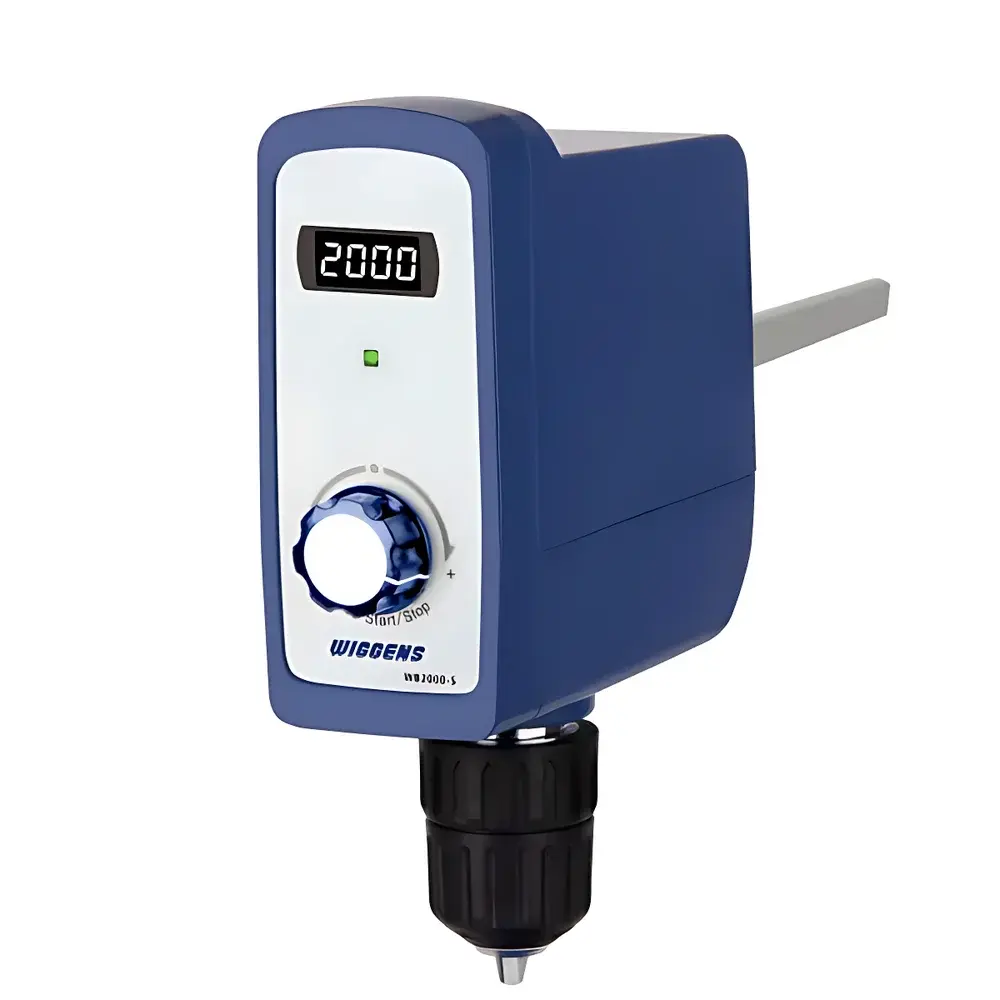
WIGGENS WB2000-S Compact Overhead Stirrer
| Brand | WIGGENS |
|---|---|
| Origin | Germany |
| Model | WB2000-S |
| Max. Stirring Volume | 50 L |
| Speed Range | 70–2000 rpm |
| Motor Type | Brushless DC |
| Torque | ≤62 N·cm |
| Viscosity Range | ≤45,000 mPa·s |
| Display Resolution | 1 rpm (≥1 rpm) |
| Speed Accuracy | ≤±3% (n > 300 rpm) |
| Power Input/Output | 85 W / 60 W |
| Dimensions (W×D×H, w/o support rod) | 66 × 177 × 225 mm |
| Weight (main unit + power supply) | 2.7 kg |
| IP Rating | IP42 |
| Shaft Clamp Range | 0.5–10 mm |
| Hollow Shaft Inner Diameter | 10.2 mm |
| Communication Interface | RS485 |
| Operating Temp. Resolution | 0.1 °C |
| Status Indicators | Standby (blue), Running (green), Alarm (red) |
Overview
The WIGGENS WB2000-S Compact Overhead Stirrer is an engineered solution for precision-controlled mechanical agitation in research, quality control, and production laboratories. Designed around a high-efficiency brushless DC motor architecture, it eliminates carbon brush wear and delivers consistent torque output across its full speed range—enabling stable, long-duration operation under variable load conditions. Its overhead configuration allows direct coupling to reaction vessels via hollow-shaft mounting, supporting scalable mixing from small-scale synthesis (e.g., 500 mL beakers) up to 50 L jacketed reactors without repositioning the drive unit. The device operates on the principle of rotational shear transmission through rigid shaft coupling, with closed-loop microprocessor-based speed regulation ensuring ±3% accuracy above 300 rpm—critical for reproducible kinetic studies, polymer dissolution, suspension homogenization, and emulsion preparation where shear history directly impacts final product structure.
Key Features
- Brushless DC motor with integrated thermal and current overload protection—designed for continuous duty cycles at maximum torque (≤62 N·cm) and viscosity loads up to 45,000 mPa·s.
- Hollow-shaft design (10.2 mm inner diameter) permits unobstructed passage of temperature probes, pH electrodes, or dosing lines during operation—eliminating the need to adjust stirrer height when changing vessel geometry.
- Large-diameter tactile speed control knob optimized for gloved-hand use; LED display with high-brightness digits ensures legibility at distances ≥2 m under standard lab lighting.
- Self-locking, tool-free chuck system with 0.5–10 mm clamping range and high concentricity tolerance (<0.05 mm runout)—ensuring minimal vibration even at 2000 rpm with asymmetric impellers.
- Acoustically damped housing (IP42-rated) achieves ultra-low operational noise (<52 dB(A) at 1 m), suitable for shared lab spaces and laminar flow environments.
- RS485 serial interface enables integration into centralized lab automation systems, supporting SCADA-level monitoring, remote parameter adjustment, and timestamped data logging compliant with 21 CFR Part 11 audit trail requirements.
Sample Compatibility & Compliance
The WB2000-S accommodates a broad spectrum of sample types—including aqueous buffers, organic solvents, non-Newtonian polymer melts, abrasive slurries, and heat-sensitive biologics—provided appropriate impeller geometry (e.g., pitched-blade, anchor, or dissolver discs) and shaft material (stainless steel 316 or PTFE-coated variants) are selected. Its sealed motor housing and corrosion-resistant surface finish meet ISO 14644-1 Class 7 cleanroom compatibility guidelines when used with validated accessories. Electrical safety complies with IEC 61010-1:2010 for laboratory equipment; electromagnetic compatibility conforms to EN 61326-1:2013. Optional lock-screen firmware supports GLP/GMP workflows by preventing unauthorized parameter changes during active runs.
Software & Data Management
While the WB2000-S operates as a standalone instrument via front-panel controls, its RS485 port enables bidirectional communication with third-party software platforms (e.g., LabVIEW, MATLAB, or custom Python-based DAQ systems) using Modbus RTU protocol. Logged parameters include real-time speed, cumulative runtime, fault codes, and optional external temperature inputs (when paired with compatible PT100 probes). All transmitted data packets are time-stamped with UTC synchronization, and local storage on host PCs satisfies FDA 21 CFR Part 11 requirements for electronic records—including user authentication, audit trails, and immutable data archiving. Firmware updates are delivered via secure HTTPS endpoints, with version rollback capability retained for method validation continuity.
Applications
- Chemical synthesis: Controlled addition and mixing in exothermic Grignard or nitration reactions requiring precise shear input and thermal probe integration.
- Pharmaceutical formulation: Homogenization of suspensions (e.g., oral suspensions per USP ) and wet granulation process development under GMP-aligned documentation protocols.
- Materials science: Dispersion of nanomaterials (e.g., graphene oxide, metal oxides) in polymer matrices where agglomerate breakup correlates directly with tip speed and residence time.
- Food & beverage R&D: Viscosity profiling of dairy emulsions and plant-based alternatives under shear-thinning conditions mimicking industrial pumping regimes.
- Environmental testing: Standardized agitation of sediment-water microcosms per ASTM D5888–22 for biodegradation assessment under aerobic/anoxic conditions.
FAQ
What impeller types are compatible with the WB2000-S?
Standard ISO 22675-compliant stirring elements—including propellers, turbines, anchors, and helical ribbons—are supported via the self-locking chuck. Custom shaft lengths and materials (e.g., Hastelloy C-276 for aggressive media) are available upon request.
Does the WB2000-S support analog signal output for PLC integration?
No analog outputs are built-in; however, digital speed and status signals can be mapped via RS485 to PLCs using standard Modbus register addressing—enabling full HMI visibility and interlock logic implementation.
Is calibration required before first use?
The unit ships with factory calibration verified against traceable tachometric standards. Periodic verification (recommended annually) may be performed using an external optical tachometer; no user-accessible calibration routine is provided.
Can the stirrer operate inside a fume hood with restricted airflow?
Yes—the IP42 rating and passive cooling design ensure reliable function in ventilated enclosures. Ambient operating temperature range is 5–40 °C at ≤80% RH non-condensing.
What maintenance intervals are recommended?
Zero scheduled maintenance is required for the brushless motor. Annual visual inspection of chuck integrity, shaft concentricity, and cable strain relief is advised per ISO/IEC 17025 internal audit protocols.



