
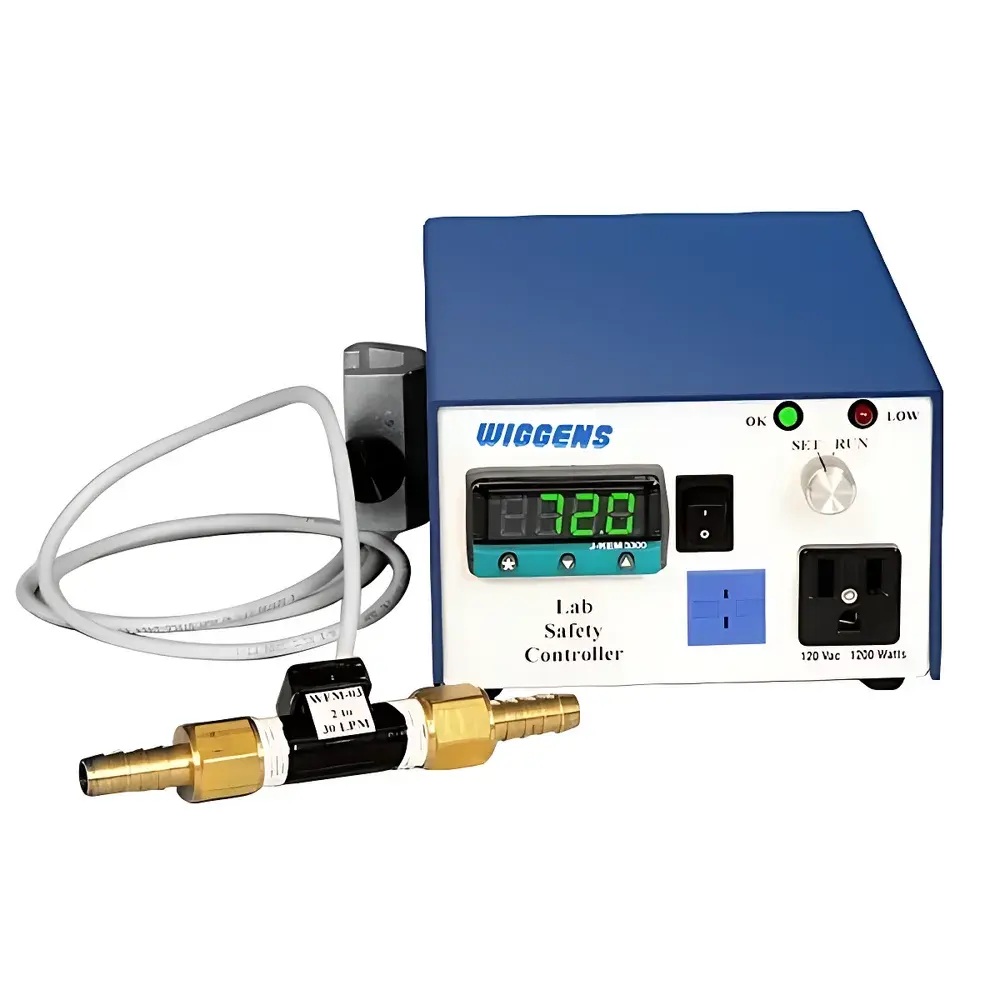
WIGGENS LS230 Laboratory Safety Monitor
| Brand | WIGGENS |
|---|---|
| Origin | Germany |
| Model | LS230 / WFM |
| Dimensions | 82.5 mm (H) × 133.0 mm (W) × 184.0 mm (D) |
| Temperature Input Types | T-type, J-type, K-type thermocouples |
| Temp. Range | LS230-T: −200 to +250 °C |
| LS230-J | 0 to +800 °C |
| LS230-K | −50 to +1200 °C |
| Output Power Rating | 2300 W |
| Flow Sensor Options | WFM-01 (0.1–2.5 L/min), WFM-02 (1–10 L/min), WFM-03 (2–30 L/min) |
| Shut-off Valve | 250 mV actuated water shut-off valve |
| Alarm Module | WFM-OC digital alarm output (170 mA switching current) |
| Interface | USB 2.0 |
| Software Compliance | GLP/GMP-compliant data logging with time-stamped temperature and flow alarms |
Overview
The WIGGENS LS230 Laboratory Safety Monitor is an integrated dual-function safety instrumentation system engineered for real-time protection of laboratory thermal equipment—specifically heating mantles, oil baths, recirculating chillers, condensers, and jacketed reactors. It operates on two parallel, independently configurable monitoring principles: (1) thermocouple-based temperature surveillance with programmable high/low thresholds and relay-triggered power cutoff, and (2) volumetric liquid flow detection using calibrated turbine or paddle-wheel flow sensors (WFM series), coupled with automatic fluid shutoff and electrical load disconnection upon deviation from user-defined flow setpoints. This dual-sensor architecture implements fail-safe interlocks compliant with IEC 61508 SIL 1 functional safety concepts for laboratory-scale process equipment. The device does not perform analytical measurement but serves as a deterministic safety controller—its primary role is to prevent thermal runaway, dry-heating damage, coolant loss-induced overheating, and uncontrolled water discharge in critical lab infrastructure.
Key Features
- Simultaneous independent monitoring of temperature and liquid flow—no shared sensor dependencies or cross-channel interference
- Three thermocouple input variants (T-, J-, K-type) supporting broad operational ranges: −200 °C to +1200 °C depending on selected probe type
- Dual-output safety relays: one for equipment power interruption (2300 W resistive load capacity), one for external valve actuation (250 mV pulse-compatible)
- High-visibility LED display with 4-digit temperature readout and status icons for flow continuity, alarm state, and relay activation
- USB 2.0 interface enabling direct connection to Windows-based PCs for configuration, real-time telemetry, and archival data export
- Configurable hysteresis, delay timers, and alarm latching to suppress transient false triggers during pump startup or thermal stabilization
- Robust DIN-rail mountable housing (IP20 rated) with industrial-grade terminal blocks for sensor and load wiring
Sample Compatibility & Compliance
The LS230 is compatible with standard laboratory-grade thermocouples (IEC 60584-1 compliant) and mechanical flow sensors designed for aqueous and low-viscosity coolant media (e.g., deionized water, glycol/water mixtures). It supports integration with common lab infrastructure including Huber chiller units, Julabo circulators, IKA heating mantles, and custom jacketed glassware systems. From a regulatory standpoint, the LS230 meets essential requirements of EN 61010-1:2019 for electrical safety in laboratory equipment. Its data logging software adheres to ALCOA+ principles—ensuring attributable, legible, contemporaneous, original, accurate, complete, consistent, enduring, and available records—as required under FDA 21 CFR Part 11 Annex 11 and EU GMP Annex 11 for computerized system validation in regulated environments.
Software & Data Management
The included WIGGENS Control Software (v3.2+) provides a validated platform for configuring monitoring parameters, defining alarm thresholds, setting flow timeout windows, and assigning relay behavior (latching vs. auto-reset). All logged entries include UTC timestamp, measured temperature, flow rate (if WFM sensor installed), relay status, and cause-of-alarm metadata (e.g., “Flow Upper Limit”). Export formats include CSV and PDF reports with embedded digital signatures for audit readiness. Audit trails are immutable and support role-based access control (administrator/operator profiles). Data retention policies can be configured per institutional SOPs; logs are stored locally on the host PC with optional network backup via SMB or SFTP protocols.
Applications
- Preventing dry-run failure in rotary evaporators and reflux condensers by cutting heater power when coolant flow drops below 0.5 L/min
- Safeguarding high-temperature synthesis reactors (e.g., autoclaves, microwave digesters) against thermal excursion due to thermocouple drift or sensor detachment
- Enabling unattended overnight operation of chromatography column ovens and GC injectors with continuous temperature verification and hardware-enforced shutdown
- Integrating with facility-wide lab monitoring networks via Modbus RTU gateway adapters (optional third-party add-on)
- Supporting ISO/IEC 17025-accredited testing labs in fulfilling clause 6.4.9 (equipment safety interlocks) and clause 7.7 (result validity assurance)
FAQ
Does the LS230 require calibration certification for GLP compliance?
No—calibration is performed at the sensor level (thermocouple or flow meter), not within the LS230 unit itself. The monitor functions as a pass-through signal processor and relay controller; users must maintain traceable calibration records for connected sensors per ISO/IEC 17025 requirements.
Can multiple LS230 units be daisy-chained or networked?
The LS230 does not support native networking or multi-unit synchronization. Each unit operates autonomously. For centralized oversight, integrate via USB-connected PCs running WIGGENS software with shared database backends or export to SCADA-compatible platforms using CSV-to-OPC UA middleware.
Is the WFM-OC alarm module mandatory for flow monitoring?
No—it is optional. The LS230 generates visual/audible local alarms and cuts power to the monitored device regardless. The WFM-OC adds a 170 mA dry-contact output for interfacing with building management systems (BMS) or external annunciator panels.
What happens during a power outage?
All relay states default to “safe open” (de-energized) upon AC loss. Upon restoration, the unit reboots into last-saved configuration but requires manual reset of any latched alarms before resuming monitoring.
Are replacement sensors covered under warranty?
WFM flow sensors and thermocouples are consumables with no extended warranty; only the LS230 main unit carries a 24-month limited warranty from date of shipment.



