
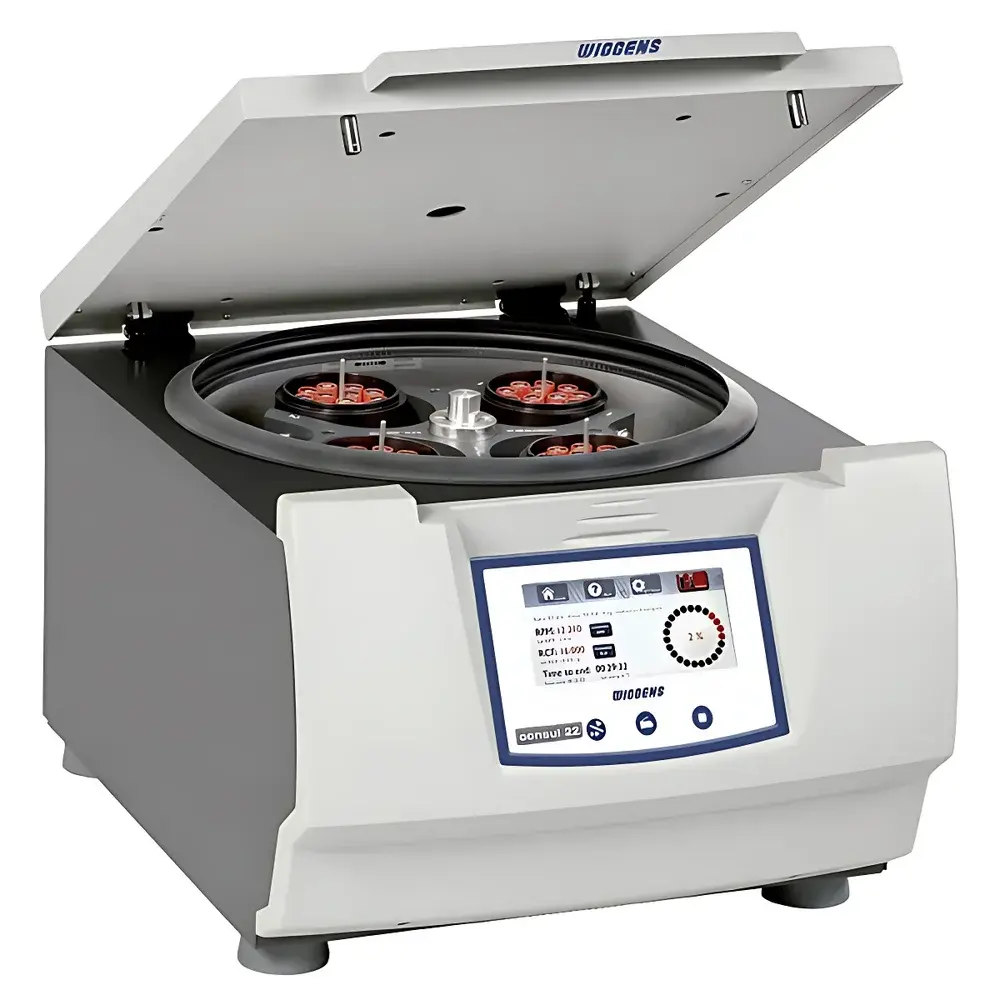
WIGGENS CONSUL22 High-Capacity Benchtop Centrifuge
| Brand | WIGGENS |
|---|---|
| Origin | Germany |
| Model | CONSUL22 |
| Centrifuge Type | Benchtop Centrifuge |
| Maximum Capacity | 4 × 400 mL |
| Maximum Speed | 14,300 rpm |
| Maximum RCF | 21,948 × g |
| Dimensions (W × D × H) | 490 × 620 × 390 mm |
| Weight | 47 kg |
| Voltage | 220–230 V |
| Frequency | 50–60 Hz |
| Power Consumption | 620 W |
| Noise Level | < 60 dB(A) |
| Safety Certifications | EN 61010-1, EN 61010-2-020, EN 61326-1, EN 61326-2-6 |
| EU Directives | 2011/65/EU (RoHS), 2012/19/EU (WEEE), 2014/30/EU (EMC), 2014/35/EU (LVD), 98/79/EC (IVDD) |
Overview
The WIGGENS CONSUL22 is a high-capacity, microprocessor-controlled benchtop centrifuge engineered for reproducible, high-throughput separation tasks in clinical diagnostics, biopharmaceutical R&D, and academic core facilities. It operates on the principle of sedimentation under controlled gravitational force (RCF), enabling efficient separation of heterogeneous mixtures—including whole blood, cell suspensions, culture supernatants, and polymer solutions—based on particle density, size, and shape. With a maximum capacity of 4 × 400 mL and a top speed of 14,300 rpm (21,948 × g), the CONSUL22 bridges the performance gap between standard benchtop units and floor-standing preparative systems—without requiring dedicated infrastructure or structural reinforcement. Its robust stainless-steel chamber, integrated thermal management, and precision-engineered rotor assembly ensure mechanical stability across extended runs, even at maximum load and speed.
Key Features
- TFT color touchscreen interface with 3-meter visibility—displaying real-time RPM, RCF, elapsed time, acceleration/deceleration profiles, and imbalance status
- Programmable control with up to 40 user-defined protocols, password-protected access, and automatic parameter recall
- Stepwise speed/RCF adjustment (10 rpm / 10 × g increments) and dual timing modes: countdown (1 min–99 h, 1 s resolution) and RPM/RCF-activated start/stop
- PCBS (Progressive Control Braking System) offering 175 selectable acceleration/deceleration slopes to minimize sample resuspension and preserve pellet integrity
- ULS (Unbalance Location System) that identifies and displays the exact rotor position (e.g., “Position 3”) where mass asymmetry exceeds tolerance—enabling rapid corrective action without manual rotor inspection
- Automatic rotor recognition and overspeed protection, ensuring compliance with ISO 21501-4 and IEC 61010-2-020 safety requirements
- Brushless DC motor with maintenance-free operation, low acoustic emission (<60 dB[A]), and energy-saving auto-power-off mode
Sample Compatibility & Compliance
The CONSUL22 accommodates a broad range of sample formats—from 0.2 mL microtubes to 400 mL bottles—via over 50 interchangeable adapters and fixed-angle or swing-bucket rotors (sold separately). All rotors and compatible adapters are autoclavable (121 °C, 20 min), supporting GLP-compliant workflows in sterile processing environments. The centrifuge meets stringent international safety and electromagnetic compatibility standards: EN 61010-1 (electrical safety), EN 61010-2-020 (centrifuge-specific requirements), EN 61326-1/-2-6 (EMC for laboratory equipment), and key EU directives including RoHS (2011/65/EU), WEEE (2012/19/EU), EMC (2014/30/EU), LVD (2014/35/EU), and IVDD (98/79/EC). Its mechanical lid interlock system—featuring dual physical locks, emergency release, drop prevention, and transparent viewing window—complies with ISO 13485 design controls for medical device manufacturing.
Software & Data Management
While the CONSUL22 operates as a standalone instrument, its programmable architecture supports audit-ready documentation practices required under FDA 21 CFR Part 11 and EU Annex 11. Each run logs timestamped metadata—including selected program ID, set parameters (RPM, RCF, time), actual measured values, ULS events, and lid status—stored internally for retrieval via USB export. The system records operational history with traceability to user login (if password-enabled), enabling reconstruction of experimental conditions for QA/QC review or regulatory submission. No proprietary software installation is required; exported CSV files integrate natively with LIMS and ELN platforms.
Applications
- Clinical laboratories: Routine serum/plasma separation from whole blood (e.g., ASTM E2912-compliant protocols)
- Bioprocessing: Harvesting mammalian or microbial cells prior to lysis or chromatography
- Virology & vaccine development: Clarification of virus-containing supernatants and ultracentrifugation prep (when paired with appropriate rotors)
- Environmental testing: Sedimentation of suspended solids in water or wastewater samples per ISO 11929
- Academic research: High-volume buffer exchange, organelle isolation, and polymer fractionation
FAQ
Is the CONSUL22 suitable for continuous operation at maximum speed and load?
Yes—its thermally optimized airflow design and brushless motor allow sustained operation at 14,300 rpm with full 4 × 400 mL loading, provided ambient temperature remains ≤25 °C and ventilation clearances are maintained.
Can I use third-party rotors or adapters?
No. Only WIGGENS-certified rotors and adapters are validated for mechanical integrity, RCF accuracy, and safety compliance. Use of non-approved components voids warranty and violates EN 61010-2-020 certification.
Does the CONSUL22 support 21 CFR Part 11 compliance?
It provides foundational elements—user authentication, electronic audit trail, and immutable run logs—but requires integration with a validated LIMS or ELN to fulfill full electronic signature and retention requirements.
What maintenance is required beyond routine cleaning?
None beyond periodic verification of lid lock function, rotor thread integrity, and chamber corrosion resistance. The motor and electronics require no scheduled servicing per manufacturer specifications.
How does the ULS system improve workflow efficiency?
By identifying unbalanced positions numerically rather than triggering generic error codes, ULS reduces troubleshooting time by >70% compared to conventional imbalance detection—critical in high-throughput labs where downtime directly impacts throughput.



