
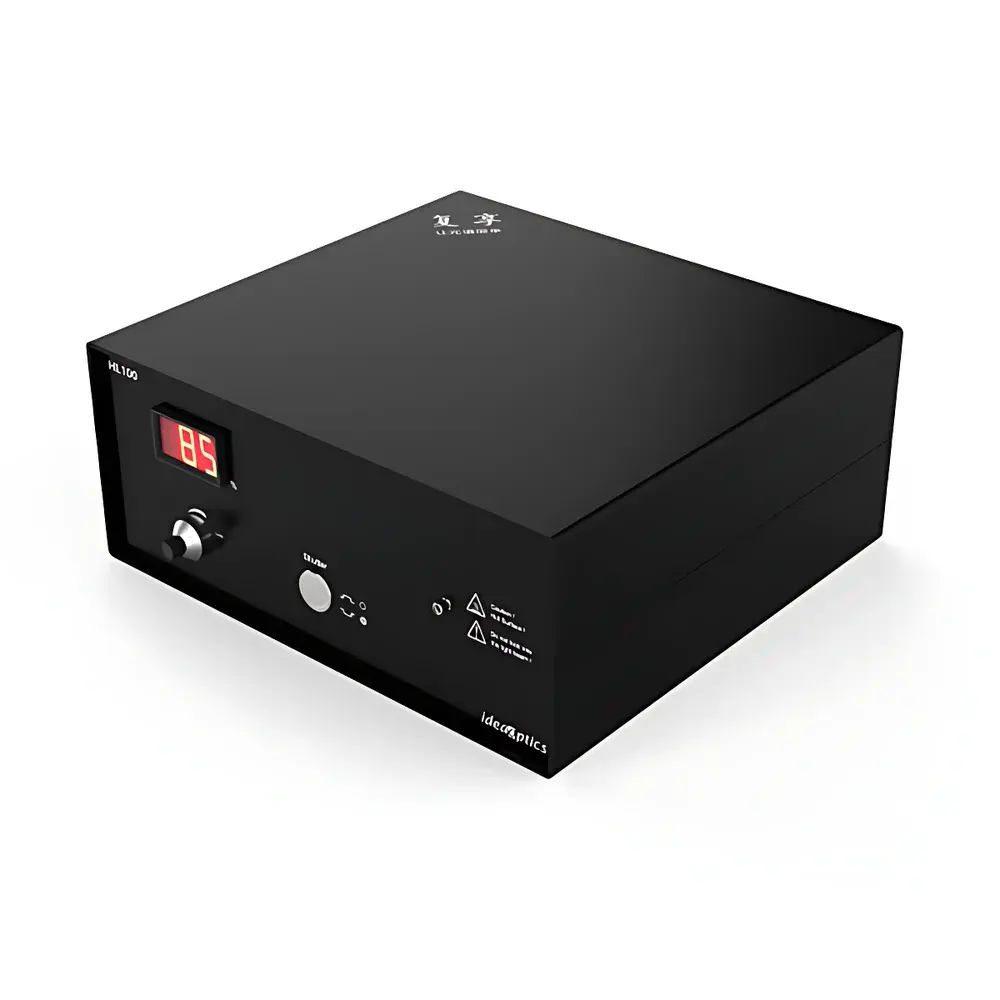
IdeaOptics HL100 High-Power Halogen Light Source
| Brand | IdeaOptics |
|---|---|
| Origin | Shanghai, China |
| Manufacturer Type | Original Equipment Manufacturer (OEM) |
| Product Origin | Domestic (China) |
| Model | HL100 |
| Pricing | Available Upon Request |
Overview
The IdeaOptics HL100 High-Power Halogen Light Source is a broadband, thermally stabilized illumination system engineered for demanding optical laboratory applications requiring continuous spectral output across the ultraviolet–visible–near-infrared (UV-VIS-NIR) range. Based on a 100 W tungsten-halogen lamp operating under precise thermal and electrical regulation, the HL100 delivers a smooth, featureless spectral irradiance from 360 nm to 2500 nm—enabling high-fidelity radiometric and photometric measurements without spectral discontinuities or mercury/xenon line artifacts. Its optical architecture incorporates an integrated condenser lens assembly and optimized filament positioning to maximize spatial coherence and étendue-matched coupling into optical fibers. Designed for integration into spectrophotometric, integrating sphere, microspectroscopic, and angular-resolved measurement platforms, the HL100 addresses critical signal-to-noise ratio (SNR) limitations in low-throughput configurations—particularly where optical attenuation occurs due to beam splitting, diffusers, or integrating sphere wall losses.
Key Features
- Continuous Broadband Emission: Stable 360–2500 nm spectral output with minimal drift (<0.3% RMS over 4 hours), suitable for absolute reflectance, transmittance, and scattering measurements per ASTM E275, ISO 9050, and CIE S 014.
- Fiber-Coupled Output: SMA905-compatible output port with >75% coupling efficiency into 400 µm core diameter silica fiber; supports standard collimators, focusing optics, and modular optical mounts.
- Continuously Adjustable Intensity: Precision potentiometer-controlled DC power supply enables linear, repeatable intensity modulation from 5% to 100% of nominal output—calibrated and displayed on integrated 3-digit LED readout (0–100% scale).
- Mechanical Shutter Integration: Motor-driven, vacuum-compatible metal blade shutter (Topen < 20 ms, Tclose < 15 ms) enables rapid dark-reference acquisition without lamp cycling, supporting GLP-compliant background subtraction protocols.
- Thermal & Electrical Stability: Active temperature-regulated lamp housing and constant-current driver minimize spectral shift and intensity fluctuation; warm-up time to operational stability: <15 minutes.
- Robust Laboratory Integration: Standard 19″ rack-mountable chassis (2U height), IEC 61000-6-3 EMC compliance, and safety interlock interface for synchronized operation with spectrometers or automated stages.
Sample Compatibility & Compliance
The HL100 is compatible with solid, liquid, and thin-film samples mounted in transmission cells, integrating spheres (e.g., Labsphere RSA-UC-12, SphereOptics IS-200), microscope objectives (4×–100×), and goniometric stages. It meets essential regulatory requirements for analytical instrumentation used in quality control environments: compliance with IEC 61010-1 (Safety Requirements for Electrical Equipment for Measurement, Control, and Laboratory Use), RoHS 2011/65/EU, and CE marking. When operated with validated calibration standards (e.g., NIST-traceable reflectance tiles, deuterium/halogen reference lamps), the system supports data integrity frameworks aligned with FDA 21 CFR Part 11 (electronic records/signatures) and ISO/IEC 17025 (competence of testing and calibration laboratories).
Software & Data Management
The HL100 operates as a standalone instrument but supports digital control via optional RS-232 or USB-C interface (firmware v2.1+). SDKs are provided for Python, LabVIEW, and MATLAB, enabling synchronization with spectrometer triggers (TTL input/output), automated intensity ramping, and timestamped shutter actuation logs. All intensity setpoints, shutter states, and runtime diagnostics are recorded with UTC timestamps and exported in CSV or HDF5 format—facilitating audit trails required under GMP/GLP workflows. Firmware updates are performed via signed binary packages verified through SHA-256 checksum validation.
Applications
- Integrating sphere-based total hemispherical transmittance/reflectance (ASTM E1331, ISO 13468)
- Microspectrophotometry of semiconductor wafers, OLED layers, and thin-film coatings
- Angle-resolved scattering (ARS) and bidirectional reflectance distribution function (BRDF) characterization
- Calibration of UV-VIS-NIR spectroradiometers and hyperspectral imagers
- In situ monitoring of photochemical reactions under broadband excitation
- Reference illumination source for ASTM D1003 haze and clarity measurements
FAQ
What is the typical spectral irradiance output at 550 nm?
At full power and with a 400 µm core fiber, the HL100 delivers approximately 1.8 mW/nm·sr at the fiber exit face under collimated conditions (measured with calibrated spectroradiometer).
Can the HL100 be used with liquid light guides?
Yes—compatible with standard 3 mm and 5 mm liquid light guides equipped with SMA905 terminations; coupling efficiency drops ~12–18% compared to solid-core silica fiber.
Is lamp replacement user-serviceable?
Yes—the halogen lamp module is field-replaceable using standard Torx T10 tools; alignment-free mechanical registration ensures consistent filament positioning after replacement.
Does the HL100 support analog modulation input?
No—intensity control is exclusively via front-panel potentiometer or digital command; no 0–10 V or 4–20 mA analog input is provided.
What is the expected lamp lifetime under continuous operation?
Rated average life: 2,000 hours at nominal voltage; lifetime extends to >3,500 hours when operated at ≤80% intensity with stable ambient temperature (<30 °C).





