
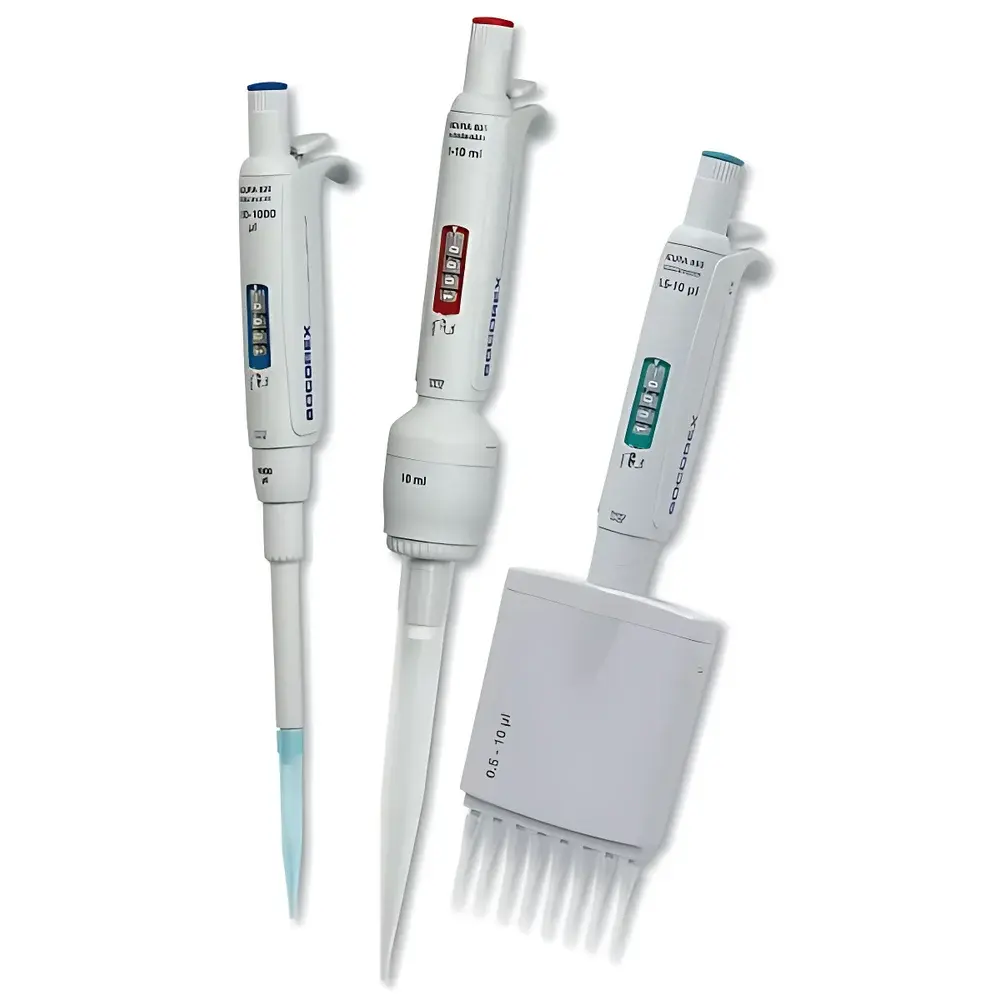
SOCOREX Acura Manual 825/835/855 Precision Adjustable-Volume Pipettes
| Brand | SOCOREX |
|---|---|
| Origin | Switzerland |
| Model | 825 / 835 / 855 |
| Pipette Type | Manual Adjustable-Volume Pipette |
| Channel Configuration | 1–12 channels |
| Volume Range | 0.1 µL – 10 mL (model-dependent) |
| Accuracy | ±0.5% to ±2.0% (varies by model and volume) |
| Precision (CV) | ≤0.2% to ≤1.5% (model- and volume-dependent) |
| Sterilization | Full autoclave-compatible (121 °C, 20 min, 1 bar) |
| Calibration | Tool-free one-button adjustment |
| Compliance | CE-marked |
| conforms to ISO 8655-2 | 2022 (volumetric performance), ISO 8655-5:2022 (testing methods), and IVD Directive 98/79/EC |
Overview
The SOCOREX Acura Manual 825/835/855 series represents a benchmark in precision liquid handling for research laboratories, clinical diagnostics, and quality control environments. Engineered for metrological reliability and ergonomic sustainability, these manually operated, adjustable-volume pipettes employ air-displacement technology validated per ISO 8655 standards. Each model—whether single-channel (825, 835) or multi-channel (855)—is calibrated at the factory against traceable NIST-certified reference standards and supplied with an individual third-party calibration certificate. The 825 series covers ultra-low volumes from 0.1 µL to 1 mL with sub-microliter resolution; the 835 series extends capacity up to 10 mL for high-throughput bulk transfers; and the 855 series delivers parallel dispensing across 8 or 12 channels within ranges spanning 0.5 µL to 350 µL—optimized for microplate-based workflows including ELISA, qPCR setup, and cell culture seeding.
Key Features
- Ergonomic short-body design reduces hand fatigue during extended use—mechanical actuation force as low as 1.0 N for first-stop aspiration and 0.8 N for second-stop dispensing.
- Patented Justip™ tip ejection system with height-adjustable plunger enables consistent compatibility across >95% of commercially available sterile filter tips (including Ultra-Low Retention, 10 µL, 200 µL, 350 µL, 1000 µL, and 5 mL formats).
- Digital volume display positioned on the front-facing panel ensures continuous readability without reorientation during operation.
- Full autoclavability: entire pipette body—including internal piston assembly and seals—can withstand repeated sterilization cycles (121 °C, 20 min, saturated steam) without performance degradation or dimensional drift.
- Tool-free one-button calibration system allows rapid in-lab recalibration following ISO 8655-6 guidelines—no disassembly or external service required.
- “Click-lock” volume setting mechanism prevents accidental volume shifts during handling or transport; rotary volume dial features tactile feedback and angular locking at each increment.
- Chemically resistant construction using medical-grade PEEK, stainless steel, and fluoropolymer-coated components ensures long-term stability in contact with organic solvents, acids, and bases.
Sample Compatibility & Compliance
All Acura Manual pipettes are designed for aqueous, viscous, and volatile liquids commonly encountered in molecular biology, pharmaceutical QC, and environmental testing. Tip compatibility has been verified with major OEMs (e.g., Eppendorf, Gilson, Thermo Fisher, Sarstedt) and generic low-retention consumables. Regulatory compliance includes CE marking under Directive 98/79/EC (IVD), adherence to ISO 8655 Parts 2, 5, and 6, and full alignment with GLP/GMP documentation requirements. Traceable calibration records support audit readiness for FDA 21 CFR Part 11–governed environments when paired with optional electronic logbook integration.
Software & Data Management
While the Acura Manual series is hardware-only (no onboard electronics or Bluetooth), its calibration architecture supports seamless integration into laboratory quality management systems (QMS). Each unit ships with a unique serial number and a certified calibration report containing initial accuracy/precision data at three volume points (10%, 50%, and 100% of nominal range), uncertainty values (k=2), and environmental conditions during verification. Laboratories may import this data directly into LIMS or electronic lab notebooks (ELN) via CSV export. Optional annual recalibration services—including on-site verification and updated certificates—are available through SOCOREX-authorized service centers globally.
Applications
- High-sensitivity nucleic acid quantification (e.g., RNA-seq library prep requiring 0.5–10 µL transfers)
- Cell-based assays involving serial dilution across 96- or 384-well plates
- Standard curve preparation for HPLC and LC-MS calibration
- Reagent dispensing in diagnostic kit manufacturing (ISO 13485-compliant settings)
- Environmental water analysis where trace-level analyte spiking demands sub-µL accuracy
- QC release testing of parenteral formulations under USP analytical instrument qualification protocols
FAQ
Are the Acura Manual pipettes suitable for handling corrosive or high-viscosity liquids?
Yes—seals and internal components are chemically inert to common laboratory solvents, 10% sodium hypochlorite, 70% ethanol, and glycerol solutions up to 50% w/v. For highly viscous media (>100 cP), reverse-pipetting mode is recommended per ISO 8655-2 Annex C.
Can I autoclave the 855 multi-channel pipette without disassembling it?
Yes—the entire 855 unit, including the channel manifold and tip ejector mechanism, is rated for full-cycle autoclaving (121 °C, 20 min, 1 bar). Post-sterilization, allow complete cooling and dryness before reuse; verify volume delivery using gravimetric testing per ISO 8655-5.
What documentation accompanies each pipette upon delivery?
Each unit includes a factory calibration certificate (traceable to national metrology institutes), CE declaration of conformity, ISO 8655 conformance statement, user manual (EN/DE/FR), and autoclave validation guide.
Is third-party calibration accepted for regulatory audits?
Yes—provided calibration is performed by an ISO/IEC 17025-accredited laboratory using reference standards traceable to SI units, and reports include measurement uncertainty, environmental conditions, and test methodology aligned with ISO 8655-6.
How does the Justip™ tip ejection system improve reproducibility in multi-channel workflows?
By enabling independent vertical adjustment of the ejection rod per channel, Justip™ eliminates tip wobble and inconsistent release force—critical for uniform tip seating and reduced carryover in 96-well plate applications.



