
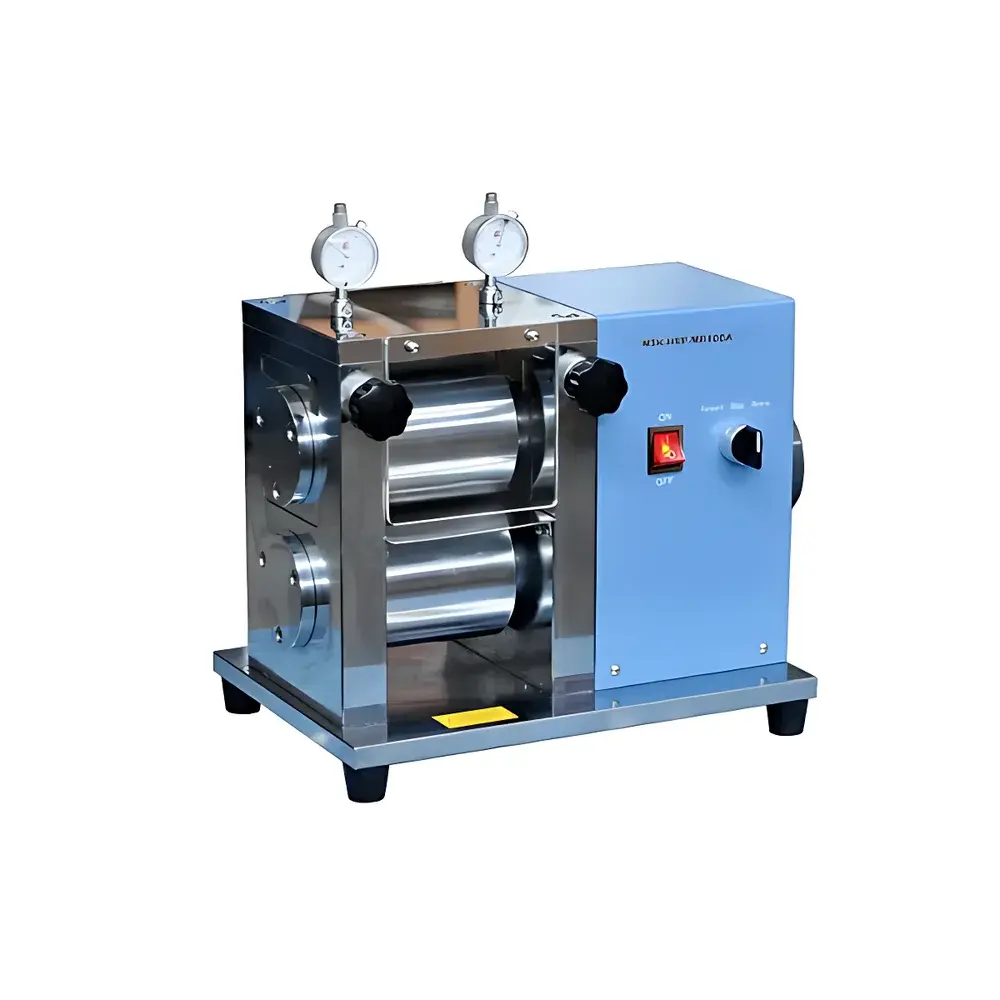
合肥科晶 MSK-HRP-MR100A Precision Motorized Roll Press for Electrode Fabrication
| Brand | Hefei Kejing |
|---|---|
| Origin | Anhui, China |
| Model | MSK-HRP-MR100A |
| Voltage | 220 V AC, 50/60 Hz |
| Roller Material | Carbon steel with chromium plating (Rockwell hardness RC > 62) |
| Roller Dimensions | Φ100 × 100 mm |
| Gap Adjustment Range | 0–1.8 mm (via precision dial indicator) |
| Linear Speed | 22 mm/s |
| Motor Type | High-torque DC motor (0.55 A, 40 W) |
| Dimensions (L×W×H) | 381 × 241.3 × 355.6 mm |
| Weight | 55 kg |
| Certification | CE |
| Warranty | 1 year (lifetime technical support) |
| Max. Sample Hardness | ≤50 HRC |
| Min. Achievable Thickness (typical) | 0.04 mm (graphite-coated Cu foil), 0.09 mm (LiFePO₄-coated Al foil) |
Overview
The Hefei Kejing MSK-HRP-MR100A Precision Motorized Roll Press is a compact, laboratory-scale calendering system engineered specifically for electrode fabrication in electrochemical energy storage research. Unlike general-purpose rolling mills, this instrument implements controlled uniaxial compression through two parallel, chromium-plated carbon steel rollers—designed to deliver consistent thickness reduction, improved particle packing density, and enhanced interfacial contact in composite electrode coatings. Its operation is grounded in mechanical deformation principles: applied compressive force induces plastic flow and densification of the active material layer while preserving substrate integrity. The device is not an electrochemical workstation per se, but a critical *pre-electrochemical processing tool*—used upstream of cell assembly to standardize electrode geometry, porosity, and mass loading prior to cyclic voltammetry, galvanostatic charge/discharge, or EIS testing. It is intended exclusively for ambient-air operation and must not be deployed inside inert-atmosphere gloveboxes due to electrical safety constraints.
Key Features
- Precision gap control via calibrated dial indicator (0–1.8 mm resolution), enabling repeatable thickness targeting across multiple passes
- Chromium-plated rollers (RC > 62) offering high surface hardness, corrosion resistance, and low adhesion to slurry-coated foils
- Adjustable bidirectional DC drive (forward/reverse/stop) for controlled material feeding and roll-back correction
- Compact footprint (381 × 241.3 × 355.6 mm) and modular design suitable for fume hoods, laminar flow benches, or shared lab workstations
- Integrated safety cutoff and CE-compliant electrical architecture for low-risk daily operation
- Optimized for small-batch processing: accommodates substrates up to 75 mm wide × 260 mm long, ideal for R&D-scale electrode optimization
Sample Compatibility & Compliance
The MSK-HRP-MR100A supports metallic current collectors (e.g., Al foil, Cu foil) coated with cathode (LiCoO₂, NMC, LiFePO₄, LiMn₂O₄) or anode (graphite, Si/C composites, LTO) slurries. Substrate hardness must not exceed 50 HRC to prevent roller damage or uneven deformation. Minimum final thickness is material-dependent; empirical data shows reproducible reduction to 0.04 mm for graphite on Cu and 0.09 mm for LiFePO₄ on Al—achievable only through incremental multi-pass rolling to mitigate cracking and delamination. The system complies with CE marking requirements for electromagnetic compatibility (EMC Directive 2014/30/EU) and low-voltage safety (LVD Directive 2014/35/EU). It is not certified for use under ISO 14644-1 Class 5 cleanroom conditions or GMP environments without additional enclosure integration.
Software & Data Management
This is a manually operated mechanical press with no embedded microcontroller, digital interface, or data logging capability. All operational parameters—including gap setting, pass count, direction sequence, and post-rolling inspection—are documented externally by the user in laboratory notebooks or LIMS-compatible electronic records. For traceability in GLP-aligned workflows, users are advised to record gap settings (in mm), roller surface condition (visual inspection log), cleaning protocol adherence (e.g., isopropanol wipe frequency), and maintenance events (e.g., Cr-layer integrity check, lubrication schedule). No firmware updates or cybersecurity features apply.
Applications
- Electrode thickness calibration and density optimization for Li-ion, solid-state, and Na-ion battery prototyping
- Preparation of uniform thin films for impedance spectroscopy substrate validation
- R&D-scale processing of flexible electrodes, printed electronics, and conductive polymer composites
- Controlled densification studies correlating roll pressure with ionic conductivity and binder distribution
- Teaching laboratories: demonstration of mechanical property effects on electrochemical performance metrics (e.g., rate capability vs. electrode thickness)
FAQ
Can the MSK-HRP-MR100A be used inside an argon-filled glovebox?
No. The motor and internal wiring are not rated for inert atmospheres. Operation in argon poses risk of electrical short-circuit and insulation failure.
What maintenance is required between uses?
Rollers must be cleaned with anhydrous isopropanol and lint-free wipes after each session to remove residual binder or conductive additives. Long-term storage requires light coating with rust-inhibiting oil and sealed wrapping.
Is real-time force or pressure monitoring available?
No. The system does not incorporate load cells or pressure transducers. Compression is inferred indirectly via gap setting and material response.
Does it support automated multi-pass sequencing?
No. Pass count, direction, and gap adjustment are fully manual. Users must execute sequential reductions using external documentation.
What is the maximum recommended throughput per day?
For optimal roller longevity and dimensional repeatability, ≤20 sample passes per 8-hour shift is advised—subject to operator training and material abrasiveness.





