
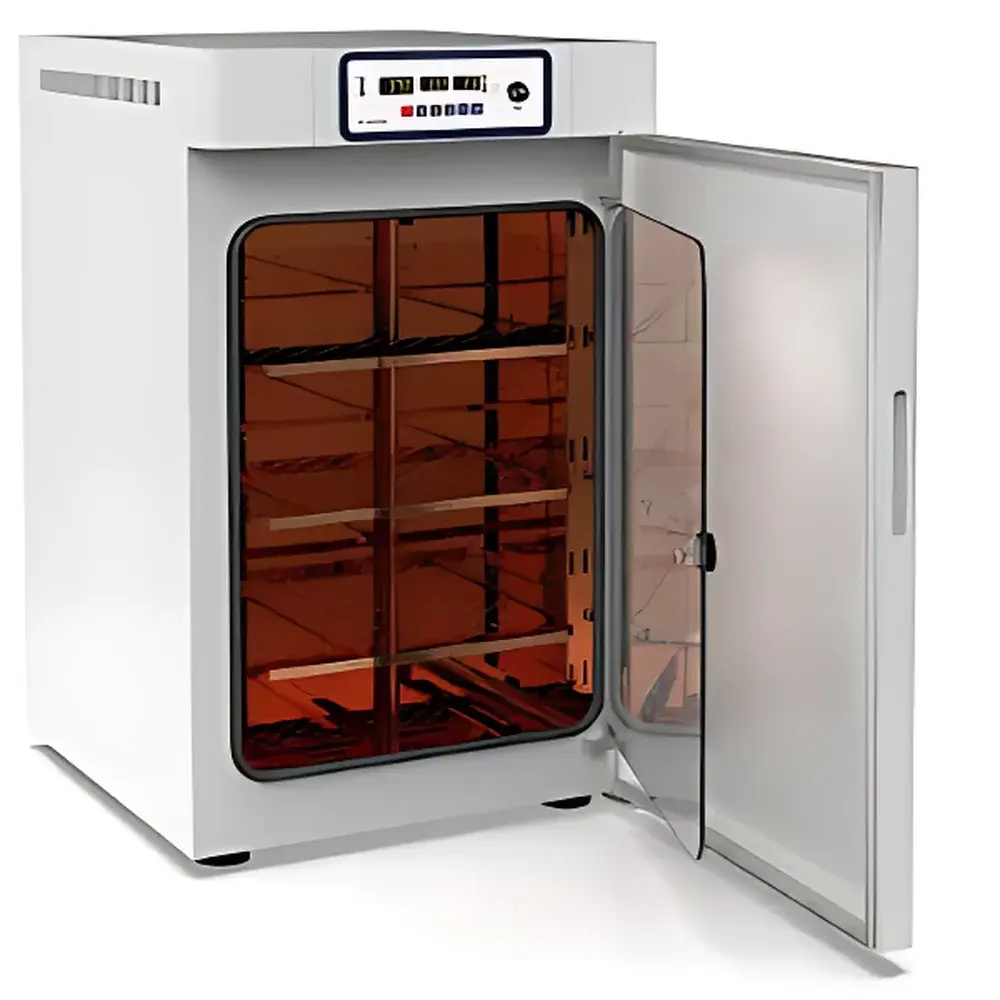
WIGGENS WCI-180Cu Copper-Lined CO₂ Incubator
| Brand | WIGGENS |
|---|---|
| Origin | Germany |
| Model | WCI-180Cu |
| Capacity | 180 L |
| Temperature Range | Ambient +5°C to 60°C |
| Temp. Uniformity | ±0.3°C (at 37°C / 20°C ambient) |
| Temp. Display Accuracy | ±0.1°C (at 37°C) |
| Temp. Resolution | 0.1°C |
| Control Algorithm | Digital PID |
| CO₂ Range | 0–20% |
| CO₂ Accuracy | ±0.1% (at 5% setpoint, 37°C) |
| CO₂ Resolution | 0.1% |
| CO₂ Sensor | Dual-beam infrared |
| Inlet Pressure Range | 0.3–0.5 bar |
| Heating Power | 320 W |
| Chamber Material | Electrolytic copper (oxidized surface) |
| Jacket Type | Air-jacketed (6-sided gradient heating) |
| Standard Shelving | 3 shelves (up to 8 optional) |
| Sterilization Mode | Dry-heat compatible (180°C) |
| Display | LED with independent dual-channel keypad |
Overview
The WIGGENS WCI-180Cu Copper-Lined CO₂ Incubator is an engineered solution for cell culture environments demanding high biological integrity, rapid recovery after door openings, and sustained sterility assurance. Designed around a monolithic electrolytic copper inner chamber—oxidized to form a stable CuO surface—the incubator leverages the well-documented oligodynamic effect of copper ions to inhibit microbial adhesion and biofilm formation on internal surfaces. Unlike stainless steel or aluminum chambers, the copper lining provides continuous, passive antimicrobial activity without requiring UV lamps or hydrogen peroxide cycles. The system operates on air-jacketed (6-sided gradient) heating architecture, enabling precise thermal control across the full operating range (ambient +5°C to 60°C), with uniformity maintained within ±0.3°C at both physiological (37°C) and ambient (20°C) reference conditions. CO₂ concentration is regulated via a dual-beam infrared sensor, delivering real-time feedback with ±0.1% accuracy at 5% setpoint—a specification aligned with ISO 13408-2 and ASTM E2924 requirements for controlled-atmosphere cell culture equipment.
Key Features
- Copper chamber construction: Electrolytic copper inner walls with oxidized CuO surface layer, validated for reduced microbial load in accordance with ISO 22196:2011 (antimicrobial activity of plastics and other non-porous surfaces)
- Air-jacketed thermal design: Independent 6-sided heating elements ensure minimal temperature overshoot and fast stabilization (<15 min to recover 37°C after 30-sec door opening)
- Digital PID temperature control: High-resolution (0.1°C) setpoint adjustment with ±0.1°C display accuracy at 37°C; programmable ramp-soak profiles supported
- Dual-beam IR CO₂ sensing: Non-consumptive, drift-resistant measurement with automatic baseline compensation; avoids cross-sensitivity to water vapor or ethanol
- Dry-heat sterilization compatibility: Chamber rated for sustained operation at 180°C for ≥2 hours, supporting GLP-compliant decontamination protocols without chamber degradation
- Independent dual-channel interface: Dedicated keypads for temperature and CO₂ setpoints reduce operator error during multi-parameter adjustments
- Pressure-regulated gas delivery: Integrated inlet pressure control (0.3–0.5 bar) ensures consistent CO₂ mass flow across varying line pressures and ambient conditions
Sample Compatibility & Compliance
The WCI-180Cu accommodates standard tissue culture formats including T-25/T-75/T-175 flasks, 6–96-well plates, Petri dishes, and roller bottles—up to eight adjustable copper-coated shelves (standard configuration: three). All interior surfaces—including shelf supports and door gasket recesses—are fabricated from or coated with copper alloy to maintain biocidal continuity. The system meets essential safety and performance criteria outlined in IEC 61010-1 (electrical safety), EN 61326-1 (EMC), and complies with ISO 13408-2 Annex A for CO₂ incubator validation parameters. Its dry-heat sterilization capability aligns with USP and EU GMP Annex 1 recommendations for periodic microbial decontamination of critical cell culture infrastructure.
Software & Data Management
While the WCI-180Cu operates as a standalone unit with embedded microcontroller logic, its analog/digital I/O ports support integration into facility-wide environmental monitoring systems (EMS) via 4–20 mA or 0–10 V signal outputs for temperature and CO₂. Optional RS-485 Modbus RTU communication enables connection to SCADA platforms for automated data logging, alarm forwarding, and audit-trail generation compliant with FDA 21 CFR Part 11 requirements when paired with validated third-party software. All parameter changes—including setpoints, sterilization cycles, and calibration offsets—are timestamped and stored in non-volatile memory with user ID tagging (when integrated with external authentication modules).
Applications
This incubator is routinely deployed in academic core facilities, biopharmaceutical QC labs, and contract development and manufacturing organizations (CDMOs) for applications including: human mesenchymal stem cell (hMSC) expansion under low-oxygen priming conditions; hybridoma culture for monoclonal antibody production; primary neuronal culture maintenance requiring stringent mycoplasma suppression; and induced pluripotent stem cell (iPSC) differentiation protocols where chamber sterility directly impacts lineage fidelity. Its copper-lined architecture is particularly advantageous in high-throughput labs with frequent access cycles and limited access to automated decontamination systems.
FAQ
Is the copper chamber compatible with routine alcohol-based surface disinfection?
Yes—ethanol and isopropanol solutions (≤70%) do not degrade the oxidized copper layer; however, chlorine-based disinfectants (e.g., sodium hypochlorite) must be avoided to prevent pitting corrosion.
Can the WCI-180Cu be validated for GMP use?
Yes—the unit supports IQ/OQ/PQ execution per ASTM E2500 and ISPE Good Automated Manufacturing Practice (GAMP®) guidelines; documentation packages include factory-assembled calibration certificates traceable to NIST standards.
What is the maximum allowable shelf loading weight?
Each copper shelf is rated for 15 kg distributed load; total chamber load must not exceed 60 kg to maintain thermal uniformity specifications.
Does the dual-beam CO₂ sensor require annual recalibration?
No—factory-calibrated sensors exhibit ≤0.05% drift/year under normal operating conditions; recalibration is recommended only after physical impact, exposure to >80% RH for >72 h, or failure of internal diagnostic self-tests.
Is the dry-heat cycle programmable through the front panel?
Yes—predefined 180°C/2 h sterilization mode is accessible via dedicated function key; temperature ramp rate, hold time, and cooling profile are fixed per EN 285 steam sterilizer equivalence testing protocols.



