
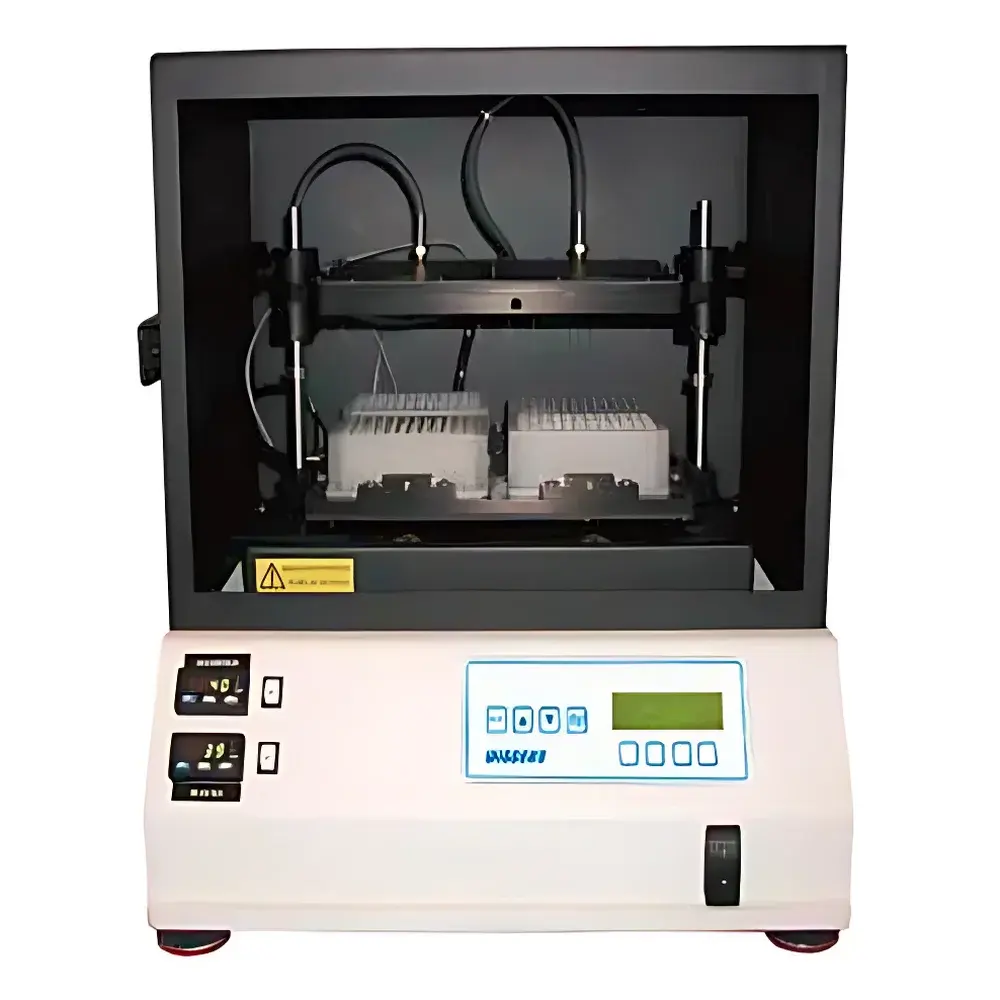
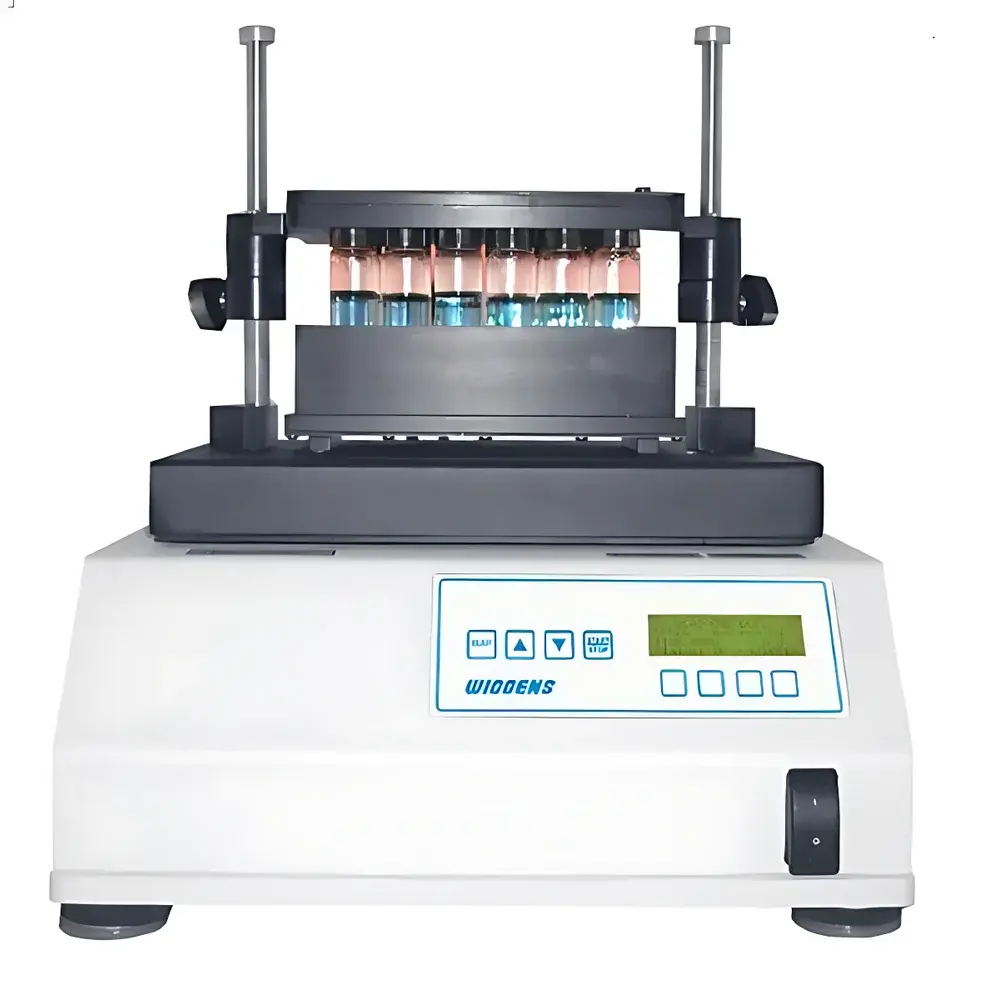
WIGGENS DPM24E24 Digital Pulse Vortex Evaporator with Integrated Concentration Module
| Brand | WIGGENS |
|---|---|
| Origin | Germany |
| Model | DPM24E24 |
| Heating Method | Dry-block heating |
| Oscillation Speed Range | 150–800 rpm (1 rpm resolution, 10 rpm increment) |
| Pulse Frequency | 1–100 pulses/min |
| Duty Cycle | 1–99% |
| Timer Range | 1 sec–24 hr |
| Platform Temperature | Up to 80 °C |
| Base Block Temperature | Up to 105 °C |
| Orbital Displacement | 0.070° |
| Dimensions (W×D×H) | 48.9 × 58.4 × 50.8 cm |
| Platform Size | 25.4 × 30.5 cm |
| Weight | 36.3 kg |
| Compliance | Designed for EPA-compliant sample preparation workflows |
| Interface | USB port, optional PC software control |
| Safety | Over-temperature protection, integrated exhaust fan for solvent recovery cabinets |
Overview
The WIGGENS DPM24E24 Digital Pulse Vortex Evaporator is an integrated laboratory instrument engineered for parallel sample concentration and controlled vortex-assisted solvent removal in regulated analytical environments. Unlike conventional nitrogen blow-down systems, the DPM24E24 combines dry-block heating, digitally modulated orbital vortex agitation, and precisely timed nitrogen gas delivery into a single platform. Its operational principle relies on pulsed mechanical energy transfer—intermittent vortex motion synchronized with nitrogen flow—to accelerate evaporation while minimizing thermal degradation and analyte loss. Each of the 24 positions features an independently directed nitrogen nozzle, ensuring uniform gas coverage across all EPA-certified sample vials (e.g., 40 mL amber EPA vials). The system is optimized for applications requiring high reproducibility in environmental, clinical, and food safety laboratories where adherence to EPA Methods 502.2, 525.3, and 8270 is routine.
Key Features
- Digital pulse vortex control: Adjustable pulse frequency (1–100 pulses/min) and duty cycle (1–99%) enable fine-tuned energy input—critical for thermolabile compounds such as pesticides, PAHs, or pharmaceutical metabolites.
- Independent dual-zone temperature control: Heated platform (max 80 °C) maintains consistent vial wall temperature, while the base block (max 105 °C) ensures rapid thermal equilibration without overshoot.
- High-precision speed regulation: 150–800 rpm range with 1 rpm resolution and 10 rpm step increments supports method transfer across diverse matrix viscosities and solvent boiling points.
- Integrated safety architecture: Over-temperature cutoff, real-time thermal monitoring, and an exhaust-compatible fan assembly facilitate safe operation inside solvent recovery cabinets per OSHA and NFPA 30 guidelines.
- Robust mechanical design: Low-orbit displacement (0.070°) combined with internal vibration-damping mounts minimizes energy transmission to adjacent instrumentation—essential in shared analytical workspaces.
- Comprehensive timing and logging: Programmable timer spans seconds to 24 hours; USB interface enables firmware updates and optional GLP-compliant data export via WIGGENS PC software (v3.2+).
Sample Compatibility & Compliance
The DPM24E24 accommodates standard 24-position configurations for 40 mL EPA vials (included), with optional adapters for 15 mL conical tubes or 250 mL round-bottom flasks (DPM24E6 variant). All contact surfaces are constructed from chemically resistant stainless steel and PTFE-coated aluminum, compatible with acetonitrile, methanol, dichloromethane, ethyl acetate, and hexane. The system meets structural and operational requirements referenced in EPA SW-846 Chapter Four (Sample Preparation) and aligns with ISO/IEC 17025:2017 clause 6.4.3 for equipment suitability verification. When used with the optional SRC solvent recovery cabinet (order no. SRC), it satisfies local VOC emission controls under EU Directive 2010/75/EU (IED) and U.S. EPA 40 CFR Part 63 Subpart HHHHH.
Software & Data Management
The optional PC control software provides remote parameter configuration, real-time monitoring of speed, temperature, and elapsed time, and timestamped event logging. Audit trails include operator ID (via login), method name, start/stop timestamps, and deviation alerts—fully compliant with FDA 21 CFR Part 11 requirements when deployed with electronic signature modules. Export formats include CSV and PDF reports suitable for inclusion in LIMS or ELN systems. Firmware updates preserve calibration integrity and are validated per IEC 62304 Class B software lifecycle standards.
Applications
- Environmental analysis: Pre-concentration of aqueous extracts prior to GC-MS or LC-MS/MS analysis per EPA Methods 508.1, 525.3, and 8270D.
- Clinical toxicology: Rapid cleanup and concentration of urine or plasma samples containing benzodiazepines, opioids, or stimulants.
- Food residue testing: Parallel evaporation of QuEChERS extracts with minimal analyte oxidation or ester hydrolysis.
- Pharmaceutical QC: Solvent exchange and volume reduction in stability-indicating assays under ICH Q5C conditions.
- Forensic chemistry: Controlled nitrogen-assisted drying of seized drug evidence extracts without thermal artifact formation.
FAQ
Is the DPM24E24 compatible with non-EPA vial formats?
Yes—adapters for 15 mL conical tubes, 2 mL HPLC vials, and 250 mL flasks are available as accessories (order codes: ADPT-15C, ADPT-2HPLC, DPM24E6).
Does the system support 21 CFR Part 11 compliance out-of-the-box?
The hardware includes secure USB communication and thermal/event logging; full Part 11 compliance requires deployment of the validated PC software package with role-based access control and electronic signatures.
Can the pulse function be disabled for continuous vortex operation?
Yes—the instrument operates in both continuous and pulse modes; mode selection is configurable via front-panel menu or PC software.
What maintenance is required for long-term accuracy?
Annual verification of temperature uniformity (per ASTM E2209) and speed calibration (per ISO 17025 accredited procedure) is recommended; no user-serviceable consumables are present.
Is solvent recovery integration mandatory?
No—the exhaust fan is designed for optional use with fume hoods or solvent recovery cabinets (SRC); standalone operation is permitted in well-ventilated areas meeting local VOC exposure limits.



