
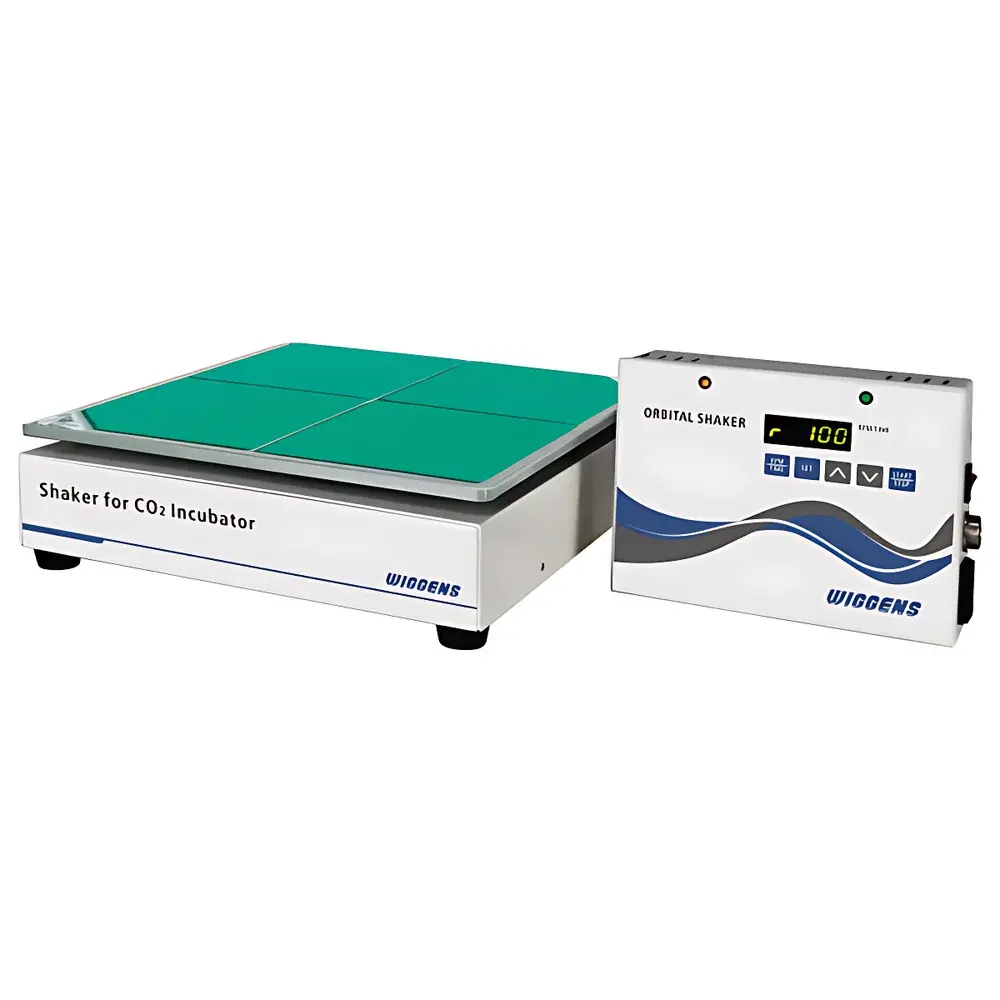
WIGGENS CRC CO₂ Incubator-Compatible Orbital Shaker
| Brand | WIGGENS |
|---|---|
| Origin | Germany |
| Manufacturer Type | Authorized Distributor |
| Origin Category | Imported |
| Model | CRC |
| Temperature Control Range & Accuracy | Ambient temperature |
| CO₂ Concentration Control Range & Accuracy | Ambient range % |
| Humidity Control Range & Accuracy | Ambient humidity %RH |
| Capacity | 100–8000 mL |
| Dimensions | 496 × 415 × 120 mm |
| Sterilization | Not suitable for full-unit autoclaving |
Overview
The WIGGENS CRC CO₂ Incubator-Compatible Orbital Shaker is an engineered solution for continuous, low-thermal-impact agitation of cell cultures inside controlled-environment incubators. Designed specifically for integration into CO₂ incubators—where thermal stability, gas integrity, and humidity preservation are critical—the CRC employs electromagnetic induction drive technology to deliver precise orbital motion without resistive heating. Unlike conventional motor-driven shakers, its core actuation mechanism generates negligible heat (<0.3 °C surface rise under continuous operation), eliminating thermal load on the incubator chamber and maintaining tight temperature uniformity (±0.3 °C at 37 °C) as defined by ISO 13408-1 and ASTM E2928-13 for cell culture equipment validation. The unit operates exclusively in orbital mode (25 mm or 50 mm selectable amplitude) at speeds ranging from 30 to 300 rpm, with programmable timing up to 9 days, 23 hours, and 59 minutes—enabling unattended long-term suspension or microcarrier-based bioreactor runs compliant with GLP and cGMP workflows.
Key Features
- Electromagnetic induction drive system ensures zero brush wear, no mechanical friction, and <0.5 W thermal dissipation—validated per IEC 61000-6-3 for electromagnetic compatibility in lab environments.
- Hermetically sealed internal electronics: motor windings and PCBs coated with medical-grade epoxy resin (UL 94 V-0 rated), providing IP65-rated protection against condensate and 95% RH sustained exposure.
- Externally mounted remote controller with magnetic or hook-mount options; ultra-thin (1.2 mm) hermetic cable passes through standard incubator glass doors without requiring internal power outlets.
- Real-time parameter display (speed, amplitude, elapsed/remaining time, error codes) without opening the incubator door—reducing CO₂ loss by >70% per access event versus conventional setups (per internal WIGGENS comparative study, 2022).
- Stainless steel platform (400 × 370 mm) with non-slip silicone mat interface; load capacity supports up to thirty-six 100 mL flasks or nine 250 mL Erlenmeyer vessels simultaneously.
- No internal control panel or LED indicators—full separation of user interface from humidified chamber eliminates condensation-related failure points common in integrated incubator shakers.
Sample Compatibility & Compliance
The CRC accommodates standard tissue culture vessels including T-flasks (T-25 to T-225), roller bottles, deep-well plates, and spinner flasks (up to 8 L total volume). Its 25/50 mm amplitude selection allows optimization for both adherent cell detachment protocols and high-density suspension culture homogenization. All wetted surfaces comply with USP Class VI biocompatibility standards. The device meets EN 61010-1:2019 safety requirements for laboratory equipment and is CE-marked for use in EU-regulated life science facilities. While not autoclavable as a complete unit, platform trays and clamps may be sterilized via ethanol wipe-down or UV-C irradiation (254 nm, ≥10 mJ/cm²) between runs—fully compatible with ISO 14644-1 Class 5 cleanroom practices when deployed in laminar flow hoods adjacent to incubators.
Software & Data Management
The CRC operates as a standalone hardware-controlled instrument with no embedded firmware or network connectivity—intentionally designed to avoid cybersecurity vulnerabilities and regulatory complications associated with connected lab devices. All operational parameters are set and monitored via the external controller’s tactile keypad and 4-digit LED display. Audit trails are maintained manually via lab notebook entries or integrated into LIMS via optional RS-232 serial output (available upon request with WIGGENS Interface Module WIM-RS232). This architecture satisfies FDA 21 CFR Part 11 requirements for electronic records where handwritten logs or validated printouts serve as the source-of-record—a configuration widely adopted in QC/QA labs performing USP cell culture process verification.
Applications
- Suspension mammalian cell culture (CHO, HEK293, hybridoma) in CO₂-regulated environments for monoclonal antibody production.
- Microcarrier-based expansion of mesenchymal stem cells (MSCs) under 5% CO₂ and 95% RH, minimizing shear-induced apoptosis (validated per ASTM F3021-15).
- Long-term microbial fermentation studies requiring stable pH and dissolved oxygen profiles—paired with incubator-integrated DO probes.
- Organoid differentiation protocols demanding gentle, uninterrupted agitation over 7–21 day timelines without thermal drift-induced phenotypic variance.
- Biobanking workflows involving cryopreserved cell line revival and pre-freeze expansion under GMP-aligned conditions.
FAQ
Can the CRC be used inside a water-jacketed CO₂ incubator?
Yes—its epoxy-sealed electronics and absence of internal cooling fans make it compatible with both air-jacketed and water-jacketed incubators operating at 37 °C and 95% RH.
Is the platform compatible with vacuum-sealed culture bags?
The flat stainless steel surface supports rigid-bottomed bags up to 5 L; flexible bags require secondary clamping fixtures (e.g., WIGGENS Bag Holder Kit BH-100, sold separately).
Does the CRC meet ISO 5 cleanroom requirements when installed in a biosafety cabinet?
While the unit itself is not ISO 5-certified, its non-shedding stainless construction and lack of moving parts outside the sealed housing allow safe placement within Class II BSCs—provided airflow patterns are verified post-installation per NSF/ANSI 49.
What maintenance is required?
None beyond periodic visual inspection of the epoxy coating integrity and cleaning of the platform with 70% ethanol; no lubrication, calibration, or filter replacement is specified in the manufacturer’s service manual (Rev. 4.2, 2023).
Related Products






