
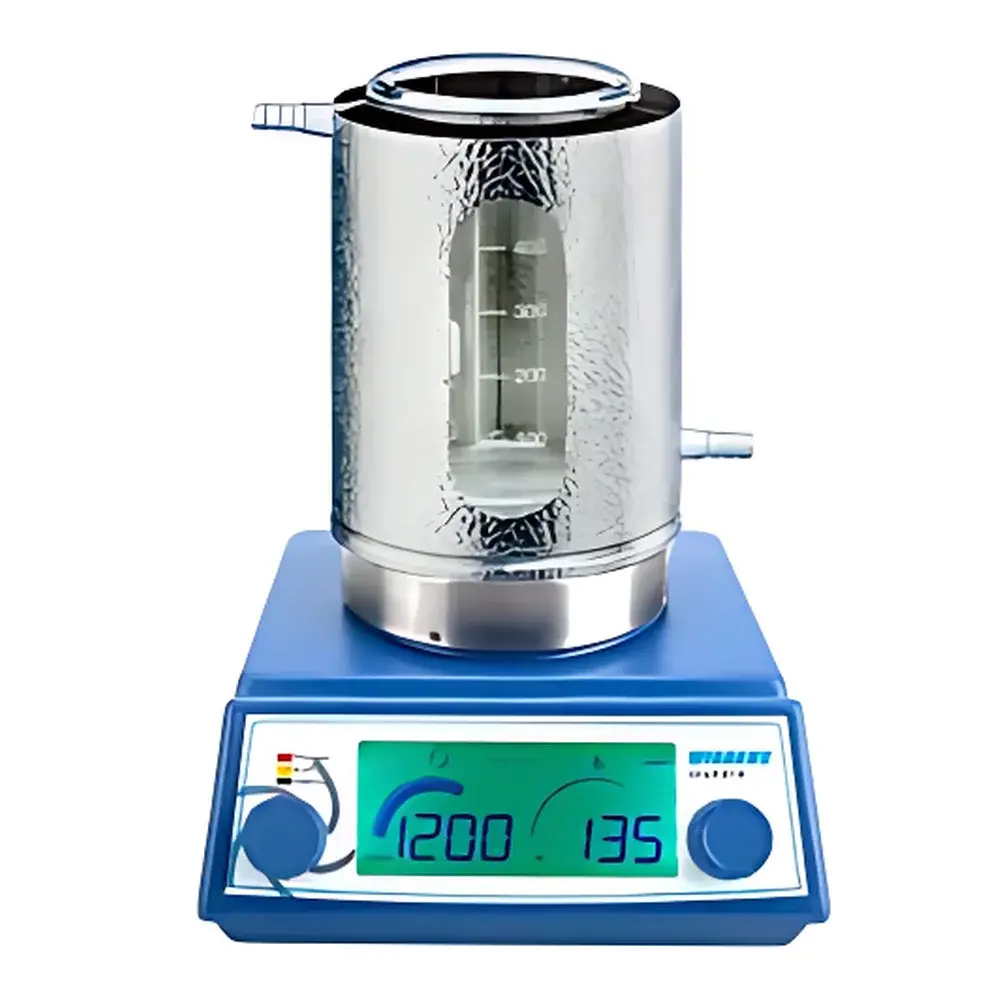
WIGGENS MRD1-E Series Magnetic Stirring Dewar Flask
| Brand | WIGGENS |
|---|---|
| Origin | Germany |
| Model | MRD1-E |
| Internal Volume | 550 mL |
| Inner Diameter × Height | 85 mm × 100 mm |
| Temperature Range | –200 °C to +200 °C |
| Compatibility | Designed for use with WIGGENS magnetic stirrers and standard PTFE- or glass-coated magnetic stir bars |
Overview
The WIGGENS MRD1-E Series Magnetic Stirring Dewar Flask is a purpose-engineered cryogenic and high-temperature laboratory vessel designed for precise, stable agitation of samples across an exceptionally wide thermal range (–200 °C to +200 °C). Unlike conventional Dewar flasks, the MRD1-E integrates a thermally optimized double-walled vacuum-insulated structure with a bottom-mounted ferromagnetic coupling interface—enabling efficient torque transmission from external WIGGENS magnetic stirrers while maintaining thermal integrity. Its construction adheres to DIN 12796 and ISO 8536-5 specifications for borosilicate glass containment vessels used in low-temperature applications, ensuring mechanical stability under rapid thermal cycling and vacuum conditions. The flask is not a standalone stirring device but a critical consumable-grade component within a closed-loop magnetic stirring system, where temperature uniformity, minimal heat ingress, and rotational reproducibility are essential—particularly in cryobiology, low-T reaction kinetics, and superconducting material synthesis.
Key Features
- Vacuum-insulated double-wall borosilicate glass body with silvered outer surface for enhanced infrared reflectivity and reduced radiative heat transfer
- Integrated ferromagnetic base plate engineered for optimal coupling efficiency with WIGGENS digital magnetic stirrers (e.g., MS-H-S10, MS-30D), minimizing slippage at sub-ambient temperatures
- Compact cylindrical geometry (Ø85 mm × H100 mm) enabling compatibility with standard laboratory cryostats, glove boxes, and benchtop cold traps
- Chemically inert internal surface compliant with USP Class VI requirements for contact with biological and pharmaceutical samples
- Thermal shock resistance validated per ASTM C1525: withstands direct immersion into liquid nitrogen (–196 °C) followed by immediate transfer to +100 °C water bath without fracture or seal failure
- Graduated volume markings (±2% accuracy) laser-etched on the outer wall for traceable volumetric referencing under cryogenic viewing conditions
Sample Compatibility & Compliance
The MRD1-E supports homogeneous mixing of aqueous buffers, organic solvents (e.g., THF, toluene, DMSO), cryoprotectant solutions (e.g., DMSO/glycerol blends), and low-viscosity molten salts—provided solvent vapor pressure remains below 10 mbar at operating temperature. It is unsuitable for strongly oxidizing agents (e.g., fuming nitric acid) or halogenated solvents above 60 °C due to potential glass etching. The flask complies with EN 61000-6-3 (EMC emission limits) when operated with certified WIGGENS stirrers and meets ISO/IEC 17025 traceability requirements for calibration of associated temperature monitoring probes. For GLP-regulated workflows, its use requires documented verification of stir bar retention force (>0.8 N at –150 °C) and thermal gradient mapping (≤ ±1.2 °C radial deviation at mid-height under static LN₂ boil-off conditions).
Software & Data Management
While the MRD1-E itself contains no embedded electronics, it functions as a validated physical interface within WIGGENS’ ecosystem of digitally controlled stirrers. When paired with models supporting RS-485 or USB-C communication (e.g., MS-PRO series), users can log real-time parameters—including setpoint temperature (via external Pt100 probe), actual RPM (0–1200 rpm, resolution 1 rpm), and motor current draw—into LIMS-compatible CSV or .tdms files. Audit trails generated via WIGGENS LabControl Software comply with FDA 21 CFR Part 11 requirements for electronic records, including user authentication, immutable timestamps, and change history for all parameter modifications during a run.
Applications
- Cryopreservation protocol development: uniform dispersion of cryoprotectants in cell suspensions during controlled-rate cooling (–80 °C to –150 °C)
- Low-temperature catalysis: homogeneous mixing of Grignard reagents or organolithium compounds in anhydrous ether at –78 °C
- Quantum material synthesis: dissolution and aging of precursor solutions for metal–organic frameworks (MOFs) under inert atmosphere at –196 °C
- Calorimetric standardization: preparation of certified reference materials requiring thermal homogeneity across multi-phase cryogenic systems
- Pharmaceutical stability testing: agitation of lyophilized formulations during accelerated freeze-thaw cycling per ICH Q5C guidelines
FAQ
Can the MRD1-E be used with non-WIGGENS magnetic stirrers?
Yes, provided the stirrer generates a minimum rotating field strength of 35 mT at 10 mm distance and supports continuous operation below –40 °C ambient. However, torque transmission efficiency and thermal drift compensation are only validated with WIGGENS MS-series controllers.
Is the flask suitable for pressurized applications?
No. The MRD1-E is rated for atmospheric pressure only. Vacuum operation is permitted; positive pressure exceeding 0.1 bar absolute may compromise vacuum jacket integrity.
How often should the vacuum insulation be re-evacuated?
Under normal laboratory handling (≤5 thermal cycles/week), the vacuum lifetime exceeds 8 years. A measurable increase in liquid nitrogen boil-off rate (>15% over baseline) indicates vacuum degradation and warrants service by an authorized WIGGENS technical center.
Does the MRD1-E require special cleaning protocols after cryogenic use?
Yes. Residual condensate must be removed via gentle N₂ purge before warming to room temperature. Avoid ultrasonic cleaning or alkaline detergents, which may degrade the silvered outer coating and compromise emissivity.
Related Products




