
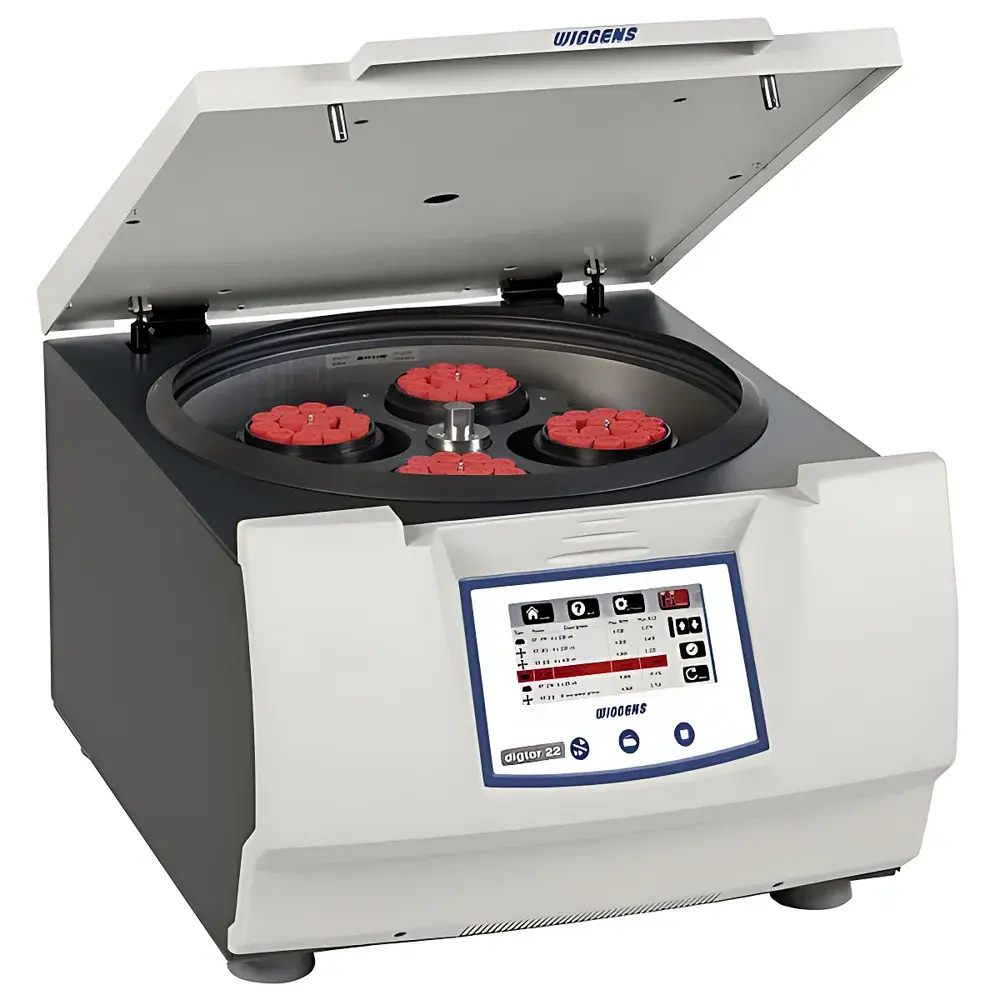
WIGGENS DIGTOR 22 Benchtop Centrifuge
| Brand | WIGGENS |
|---|---|
| Origin | Germany |
| Model | DIGTOR 22 |
| Instrument Type | Benchtop Centrifuge |
| Speed Range | 100–14,300 rpm |
| Max RCF | 21,948 × g |
| Max Capacity | 4 × 750 mL |
| Dimensions (W × D × H) | 540 × 650 × 390 mm |
| Weight | 50 kg |
| Power Supply | 220–230 V, 50–60 Hz |
| Power Consumption | 1020 W |
| Noise Level | <60 dB(A) |
| Compliance | EN 61010-1, EN 61010-2-020, EN 61326-1, EN 61326-2-6 |
Overview
The WIGGENS DIGTOR 22 is a high-performance benchtop centrifuge engineered for precision, reproducibility, and operational safety in regulated laboratory environments. Designed around a brushless DC motor architecture and microprocessor-based control system, it delivers precise rotational dynamics across a wide speed range (100–14,300 rpm), generating up to 21,948 × g relative centrifugal force (RCF). Its rotor dynamics adhere to Couette-flow principles optimized for sedimentation-based separation of biological macromolecules—including proteins, nucleic acids, subcellular organelles, and viral particles—making it suitable for applications ranging from routine sample preparation to method-critical workflows in QC/QA, clinical diagnostics, and academic research. The instrument’s structural integrity, thermal management via forced internal air circulation, and stainless-steel centrifuge chamber ensure long-term mechanical stability and compliance with ISO 13485-aligned handling protocols.
Key Features
- TFT color touchscreen interface with >3 m visibility—displays real-time RPM, RCF, elapsed time, acceleration/deceleration profiles, and imbalance status
- Programmable operation with up to 40 user-defined protocols, password-protected memory, and audit-trail-capable parameter logging
- Ultra-Low Imbalance Sensing (ULS): detects and visually identifies unbalanced rotor position (e.g., “Rotor Position #3”) before or during run initiation
- Precision Control by Step: 10 rpm / 10 × g increments for fine-tuned method development and SOP adherence
- Real-time RCF calculation dynamically adjusted to the installed rotor and adapter geometry—ensuring accurate force reporting per ICH Q5A and USP <1058> guidance
- PCBS (Progressive Control Braking System): 175 selectable acceleration/deceleration ramps prevent resuspension of pelleted material and support gradient integrity
- Full safety interlock suite: dual mechanical + electromagnetic lid lock, emergency manual release, drop-prevention hinge, transparent viewing window, automatic shutdown on imbalance detection
- Autoclavable rotors and adapters (121°C, 20 min, steam sterilization); rotor recognition and overspeed protection embedded in firmware
- Noise emission <60 dB(A) at 1 m distance—meets ISO 7779 and EN ISO 3744 acoustic performance criteria
Sample Compatibility & Compliance
The DIGTOR 22 accommodates volumes from 0.2 mL to 750 mL per tube using over 50 certified adapter configurations—including fixed-angle, swing-out, and vertical rotors—enabling seamless transition between microcentrifuge tubes, conical centrifuge bottles, and large-volume processing vessels. All rotors are validated per ISO 21501-4 for dimensional repeatability and certified to EN 61010-2-020 for mechanical stress under maximum load conditions. The stainless-steel chamber and removable rotor carrier comply with GLP/GMP cleaning validation requirements, supporting traceable decontamination cycles. CE marking confirms conformity with the EU In Vitro Diagnostic Medical Devices Directive (98/79/EC), Electromagnetic Compatibility (2014/30/EU), Low Voltage (2014/35/EU), RoHS (2011/65/EU), and WEEE (2012/19/EU) directives.
Software & Data Management
While the DIGTOR 22 operates as a standalone instrument, its embedded firmware supports full parameter traceability required under FDA 21 CFR Part 11 Annex 11 and EU GMP Annex 11. Each run logs timestamped metadata—including rotor ID, speed profile, RCF history, temperature drift (via integrated thermal sensor), and ULS event flags—exportable via USB to CSV for LIMS integration. Programmable start/stop, auto-lid opening post-run, and real-time speed adjustment during operation enable adaptive protocol execution without interrupting centrifugation kinetics. Firmware updates are performed offline via encrypted USB key, preserving configuration integrity during version transitions.
Applications
- Isolation of extracellular vesicles and exosomes from cell culture supernatants (100,000 × g equivalent via k-factor optimization)
- Clarification of bacterial lysates prior to chromatographic purification
- Preparative separation of plasma lipoprotein fractions (HDL, LDL, VLDL) using density gradient media
- Routine blood fractionation in clinical laboratories (serum/plasma separation, PBMC isolation)
- High-yield pelleting of recombinant protein aggregates for solubility assessment
- Quality control of mRNA-LNP formulations under cold-chain-compatible operating conditions
FAQ
Does the DIGTOR 22 support regulatory-compliant data archiving?
Yes—run metadata including timestamps, rotor identification, speed/RCF profiles, and imbalance events are stored internally and exportable in CSV format for audit-ready documentation.
Can rotors be sterilized in an autoclave?
All standard rotors and adapters are rated for 121°C, 20-minute steam sterilization cycles per ISO 17665-1, with full mechanical certification provided in the Declaration of Conformity.
Is real-time RCF recalculated when changing adapters?
Yes—the system automatically adjusts displayed RCF based on the selected rotor model and tube geometry, ensuring force accuracy independent of operator input.
What safety standards does the DIGTOR 22 meet?
It complies with EN 61010-1 (safety of electrical equipment), EN 61010-2-020 (particular requirements for centrifuges), and relevant EU directives governing EMC, low voltage, RoHS, WEEE, and IVD classification.
How is imbalance detected and managed during operation?
The Ultra-Low Imbalance Sensing (ULS) system continuously monitors vibration harmonics and displays the exact rotor position number where mass asymmetry exceeds 5 g·cm tolerance—triggering immediate deceleration if threshold is breached.



