
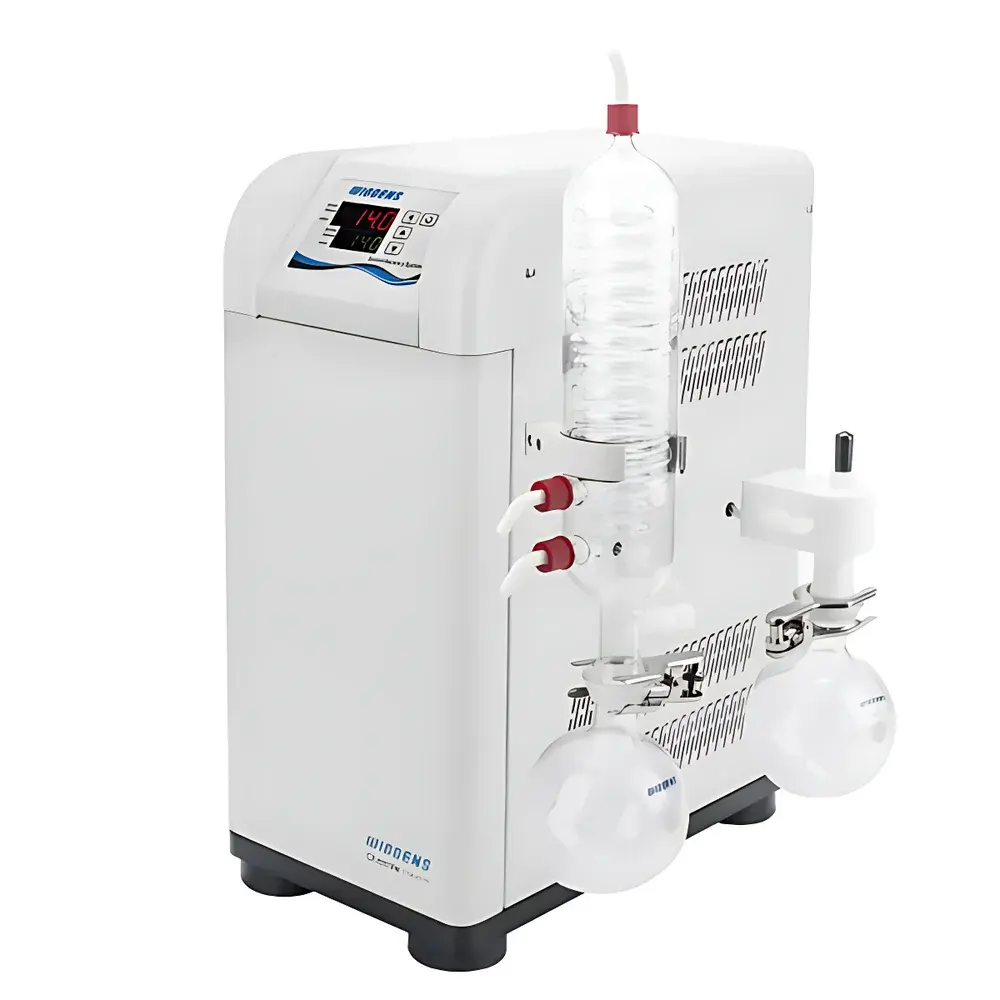
WIGGENS CSC900E Corrosion-Resistant Solvent Recovery Diaphragm Vacuum Pump
| Brand | WIGGENS |
|---|---|
| Origin | Germany |
| Pump Type | Oil-Free Diaphragm Vacuum Pump |
| Air Displacement Rate | 95 L/min |
| Ultimate Vacuum | < 30 mbar |
| Dimensions (W×D×H) | 220 × 400 × 495 mm |
| Weight | 25 kg |
| Motor Power | 400 W |
| Vacuum Control Resolution | 0.1 mbar |
| Vacuum Range | 0.1–1000 mbar |
| Inlet/Outlet Port Diameter | 10 mm |
| Noise Level | 50 dB(A) |
| Compliance | CE, RoHS |
Overview
The WIGGENS CSC900E is an oil-free, corrosion-resistant diaphragm vacuum pump engineered for solvent recovery applications in demanding laboratory and pilot-scale chemical processing environments. It operates on the principle of positive displacement via PTFE-coated elastomeric diaphragms, eliminating lubricating oil contamination and enabling safe handling of aggressive vapors—including organic solvents, acidic fumes, alkaline mists, and halogenated compounds. Unlike rotary vane or water-ring pumps, the CSC900E delivers consistent vacuum performance without degradation from condensable vapors or particulate ingress, making it ideal for integration into closed-loop distillation, rotary evaporation, crystallization, freeze-drying, and vacuum filtration systems where solvent reuse, process reproducibility, and operator safety are critical. Its modular architecture supports seamless coupling with condensers, buffer flasks, and digital vacuum controllers to form a complete, self-contained recovery system compliant with modern green chemistry and lab sustainability standards.
Key Features
- PTFE-lined wetted path—including diaphragms, valves, and internal chamber—providing broad chemical resistance per ASTM D543 and ISO 178 for exposure to HCl, HNO₃, NaOH, acetone, THF, chloroform, and other common process solvents
- Integrated frequency-controlled motor with AI-enabled PID auto-tuning algorithm, enabling precise vacuum setpoint regulation (±0.5 mbar repeatability) across dynamic load conditions
- Intelligent energy management: automatic motor speed reduction or standby mode during low-load or stable-vacuum operation, reducing power consumption by up to 40% versus fixed-speed equivalents
- Low-noise design (<50 dB[A] at 1 m), achieved through vibration-damped mounting, optimized airflow routing, and acoustic enclosure integration
- Modular construction allows field-replaceable components—including inlet buffer flask (with liquid trap), condenser interface, and digital vacuum controller—minimizing downtime and simplifying maintenance
- No oil changes, no carbon vanes, no scheduled lubrication: fully maintenance-free operation under normal laboratory use per manufacturer’s service guidelines
Sample Compatibility & Compliance
The CSC900E is validated for continuous duty with vapors and aerosols generated during vacuum-assisted evaporation of Class I–III solvents (per NFPA 30), including methanol, ethanol, ethyl acetate, dichloromethane, and acetonitrile. Its PTFE-wetted materials meet USP Class VI biocompatibility requirements and resist swelling or embrittlement after prolonged exposure to strong acids (e.g., 37% HCl, 65% HNO₃) and bases (e.g., 50% NaOH). The system conforms to IEC 61000-6-3 (EMC emission limits), IEC 61000-6-2 (immunity), and carries CE marking under the EU Machinery Directive 2006/42/EC and Low Voltage Directive 2014/35/EU. Optional configurations support GLP-compliant audit trails when paired with WIGGENS’ optional vacuum data logger (model VDL-200), which records timestamped pressure, flow, and motor RPM with 21 CFR Part 11–ready user authentication and electronic signature capability.
Software & Data Management
The integrated digital vacuum controller features a 4.3-inch TFT touchscreen interface supporting multi-segment programmable vacuum ramps (up to 10 steps), real-time graphical trend display, and dual-unit selection (mbar, torr, kPa, psi). Communication is enabled via RS-485 Modbus RTU or optional Ethernet/IP for integration into centralized lab information management systems (LIMS) or SCADA platforms. All setpoints, alarms (e.g., overpressure, thermal cutoff), and operational logs are stored internally with 30-day retention; data export is supported via USB-C or SD card in CSV format. Firmware updates are performed remotely via secure HTTPS-based OTA protocol, ensuring alignment with evolving regulatory expectations for instrument qualification (IQ/OQ/PQ) documentation.
Applications
- Vacuum distillation and fractional evaporation of heat-sensitive APIs and fine chemicals
- Solvent recovery in parallel synthesis reactors and automated purification platforms
- Controlled drying of hygroscopic or oxidation-prone materials in glovebox-integrated systems
- Membrane degassing and vacuum-assisted filtration in pharmaceutical QC labs
- Removal of residual solvents from polymer films and battery electrode coatings in R&D cleanrooms
- Extraction and concentration workflows in environmental testing labs (e.g., EPA Method 3510C, 502.2)
FAQ
Is the CSC900E suitable for handling hydrogen chloride or sulfur dioxide gas streams?
Yes—the entire gas path is constructed from PTFE, FFKM, and 316L stainless steel, providing documented resistance to anhydrous HCl and SO₂ at concentrations up to 1000 ppm and temperatures ≤40°C.
Can the vacuum controller be calibrated in-house?
Yes—field calibration is supported using NIST-traceable reference manometers via the controller’s built-in calibration menu; certificate generation follows ISO/IEC 17025 procedures.
What is the expected service life of the diaphragm under continuous operation?
Based on accelerated lifetime testing per DIN EN 60068-2-64, the PTFE-reinforced diaphragm achieves ≥15,000 hours MTBF at 70% rated speed and ambient temperature ≤30°C.
Does the system meet explosion-proof requirements for Zone 1 environments?
No—the standard CSC900E is rated for non-hazardous locations only; ATEX-certified variants (e.g., CSC900E-ATEX) are available under separate order codes and require third-party hazardous area certification.
How is condensate managed when recovering low-boiling solvents like diethyl ether?
The integrated inlet buffer flask includes a 500 mL borosilicate glass collection vessel with PTFE stopcock and level sensor; optional cryogenic traps (-20°C to -80°C) can be added upstream for enhanced capture efficiency.



