
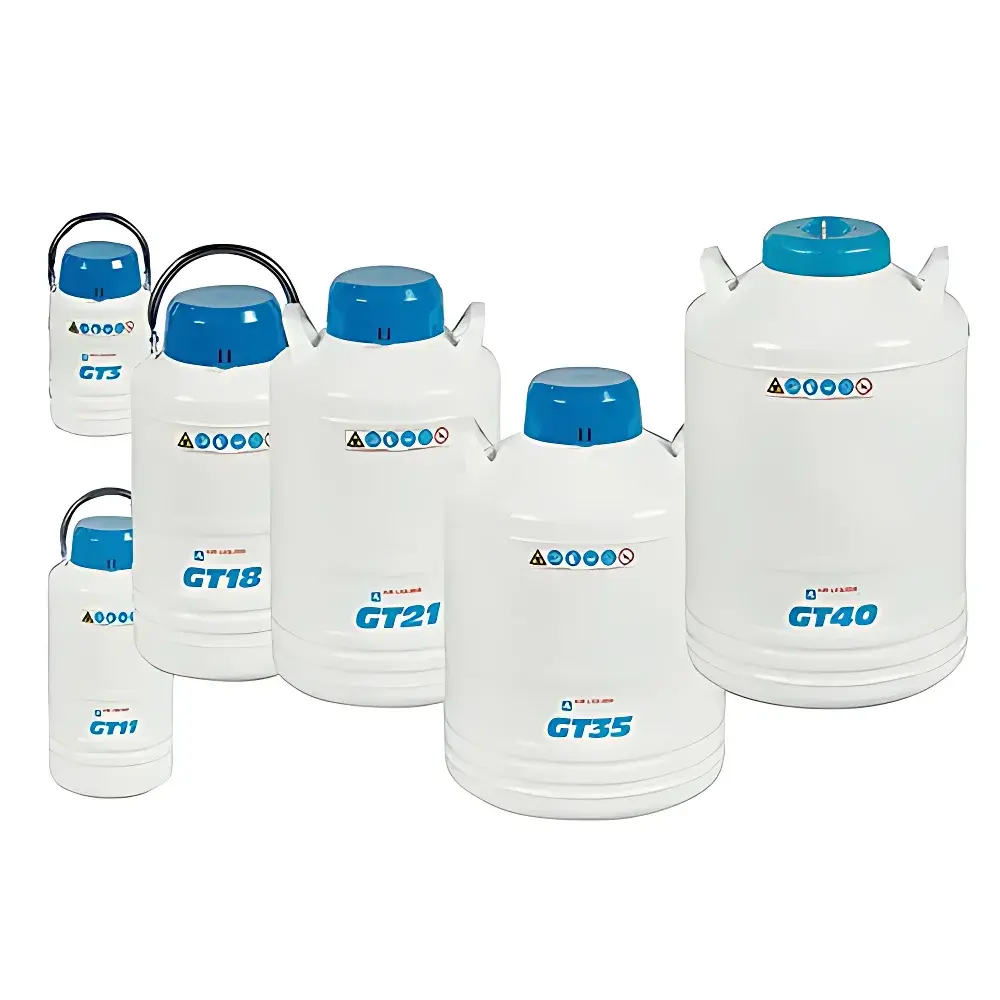
WIGGENS GT Series Biological Liquid Nitrogen Storage Dewars
| Brand | WIGGENS |
|---|---|
| Origin | Germany |
| Manufacturer Type | Authorized Distributor |
| Product Origin | Imported |
| Model | GT Series |
| Price Range | USD 2,700 – 6,800 (FOB Hamburg) |
| Construction | Aluminum Alloy Vessel with Multi-layer Vacuum Insulation |
| Regulatory Compliance | ADR/RID Certified for Hazardous Goods Transport |
| Evaporation Rate | 0.09–0.29 L/day |
| Capacity Range | 3.7–40 L |
| Sample Storage Configurations | Standardized 38 mm & 67 mm Ø Canisters (120 mm / 280 mm height), Compatible with 0.25 mL, 0.5 mL, 2 mL, 5 mL Cryovials and Straws |
Overview
The WIGGENS GT Series Biological Liquid Nitrogen Storage Dewars are high-integrity, vacuum-insulated cryogenic containers engineered for long-term, ultra-low-temperature preservation of sensitive biological materials—including cell lines, stem cells, embryos, oocytes, sperm, genomic DNA, and primary tissues—at −196 °C. Designed and manufactured in Germany by KGW, a globally recognized leader in precision Dewar fabrication, the GT Series integrates aerospace-grade aluminum alloy construction with multi-layer reflective vacuum insulation to achieve industry-leading thermal stability and minimal liquid nitrogen (LN₂) boil-off. Each unit operates passively—requiring no external power—making it ideal for secure, off-grid, or backup storage in biobanks, IVF clinics, academic core facilities, and GMP-compliant bioprocessing environments. The dewars comply fully with ADR (European Agreement concerning the International Carriage of Dangerous Goods by Road) and RID (Regulations concerning the International Carriage of Dangerous Goods by Rail), enabling validated transport of LN₂ and biological specimens across international borders without regulatory compromise.
Key Features
- Aluminum alloy outer vessel with seamless inner liner—lightweight (7.2–24 kg empty), corrosion-resistant, and structurally robust for repeated handling and stacking
- Multi-layer vacuum insulation system with getter-activated high-vacuum maintenance—ensures sustained thermal performance over >15 years service life
- Lowest-in-class evaporation rates: 0.09–0.29 L/day depending on model and ambient conditions—maximizing LN₂ retention and reducing replenishment frequency
- Integrated safety components: dual-function vacuum valve (for pressure equalization and vacuum integrity monitoring), ergonomic carrying handles, and high-efficiency insulated lid with vapor-tight seal
- Modular canister architecture supporting standardized 38 mm and 67 mm diameter stainless steel or plastic cryo-canisters (120 mm and 280 mm heights)
- Factory-calibrated fill-level indicators and optional LN₂ level sensors (compatible with third-party monitoring systems)
Sample Compatibility & Compliance
All GT Series dewars support broad-format biological sample storage, including 0.25 mL and 0.5 mL cryovials (up to 16,400 per GT40), 2 mL and 5 mL vials (custom racks available), and 0.25 mL straws (e.g., for semen/embryo banking). The internal geometry accommodates both vertical and horizontal orientation of canisters, ensuring uniform thermal distribution and minimizing temperature gradients during extended storage (>225 days hold time at full fill). Units meet ISO 20577:2017 (Cryobiology — Requirements for cryogenic storage systems) and are routinely deployed in laboratories operating under GLP, CAP, and CLIA frameworks. Documentation packages include EU Declaration of Conformity, ADR/RID transport certification, and material traceability records for all critical components.
Software & Data Management
While the GT Series dewars operate as standalone passive systems, they are designed for integration into digital cold-chain infrastructures. Optional accessories include wireless LN₂ level transmitters (4–20 mA or LoRaWAN output) and RFID-enabled canister tracking modules compatible with LIMS platforms such as LabVantage, STARLIMS, and Thermo Fisher SampleManager. All sensor data logs are timestamped and support audit-trail compliance per FDA 21 CFR Part 11 when paired with validated software interfaces. No proprietary firmware is embedded—ensuring interoperability, cybersecurity resilience, and long-term data portability.
Applications
- Long-term biobanking of human and animal biospecimens under ISO 20387:2018 accreditation requirements
- Clinical embryology and reproductive medicine workflows requiring uninterrupted −196 °C stability for gamete and embryo cryopreservation
- Stem cell banking and regenerative medicine R&D with strict viability retention criteria (≥90% post-thaw recovery)
- Pharmaceutical QC labs storing reference standards, viral vectors, and mRNA-LNP formulations
- Academic research facilities deploying cryo-archiving for longitudinal omics studies (genomic, proteomic, metabolomic)
- Transport of temperature-critical reagents between satellite labs and central repositories under ADR-compliant conditions
FAQ
Are GT Series dewars suitable for liquid-phase or vapor-phase storage?
Yes—GT models support both configurations. Vapor-phase operation (−150 °C to −190 °C) is recommended for routine cell banking to minimize cross-contamination risk; liquid-phase (−196 °C) is used for maximum thermal stability in high-value archival applications.
Can I retrofit a GT dewar with automated monitoring hardware?
Yes—standardized mounting threads and electrical feedthroughs allow field installation of third-party LN₂ level sensors, temperature probes, and alarm relays without voiding warranty or compromising vacuum integrity.
What documentation is provided for regulatory submissions?
Each unit ships with CE marking, ADR/RID transport certification, ISO 20577 conformance statement, material test reports (MTRs), and vacuum decay test records—all traceable to serial number.
Is custom canister rack design available?
Yes—WIGGENS collaborates with end users to engineer application-specific racks for non-standard vial formats (e.g., 5 mL tubes, microtiter plates, or cryo-straw cassettes), subject to minimum order quantities.
How often does vacuum integrity require verification?
KGW recommends annual vacuum assessment using calibrated Pirani or capacitance manometers. Typical vacuum lifetime exceeds 15 years; degradation manifests as measurable rise in daily LN₂ consumption (>10% increase over baseline).




