
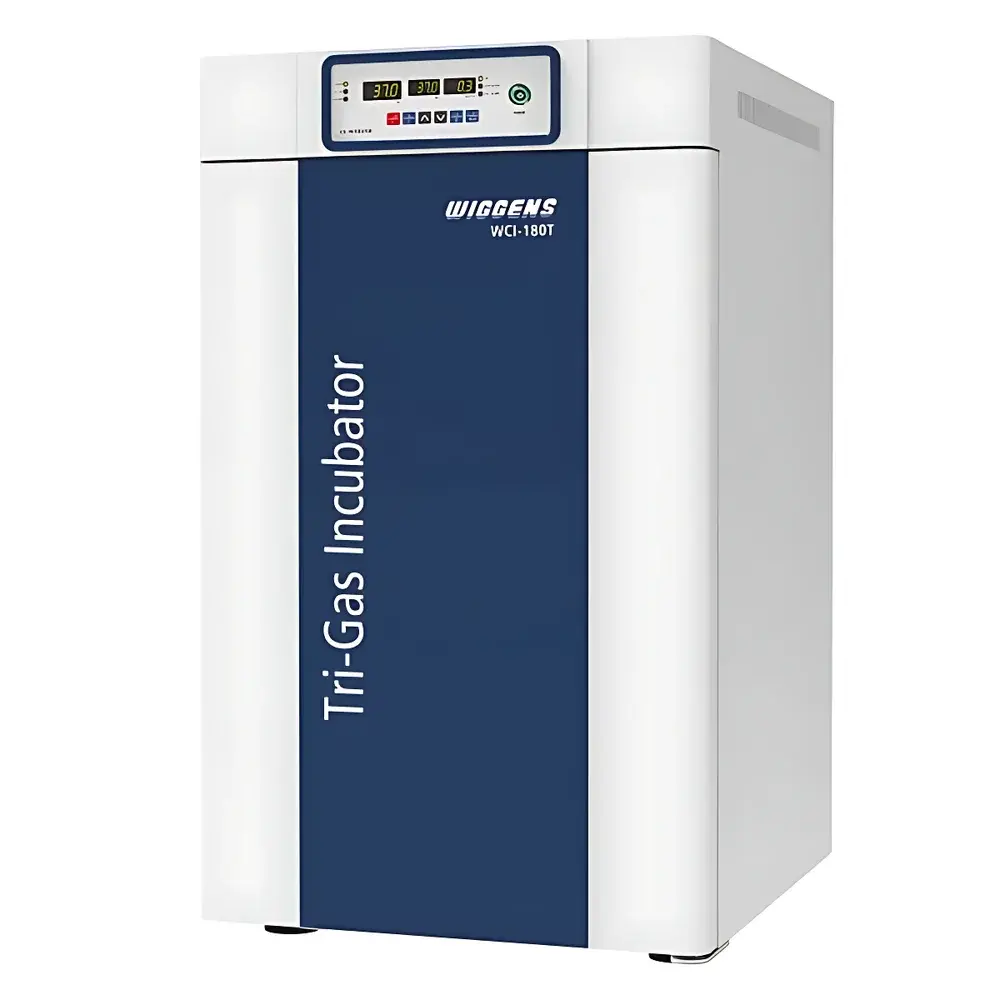
WIGGENS WCI-180T Tri-Gas Incubator
| Brand | WIGGENS |
|---|---|
| Origin | Germany |
| Model | WCI-180T |
| Type | Air-jacketed tri-gas incubator |
| Temperature Range | Ambient +5°C to 60°C |
| Temperature Uniformity | ±0.1°C at 37°C |
| CO₂ Control Range | 0.6–85% (v/v) |
| O₂ Control Range | 0.6–85% (v/v) |
| Chamber Capacity | 180 L |
| External Dimensions (W×D×H) | 560 × 620 × 945 mm |
| Chamber Material | AISI 304 stainless steel |
| Heating System | Six-sided air-jacketed gradient heating with independent thermal sensors per zone |
| Gas Sensors | Dual-beam infrared CO₂ sensor |
| Humidification | Bottom-mounted water pan heater with forced-air distribution |
| Door Design | Heated glass door with anti-condensation frame |
| Control System | Microprocessor-based PID controller with dual-channel LED display |
| Communication Interface | RS232 / RS485 |
| Compliance | Designed for GLP-compliant cell culture workflows |
Overview
The WIGGENS WCI-180T Tri-Gas Incubator is an air-jacketed, microprocessor-controlled environmental chamber engineered for precise, reproducible regulation of temperature, CO₂, and O₂ concentrations in sensitive life science applications. It operates on a robust gas-mixing principle—utilizing mass flow controllers (MFCs) to deliver defined ratios of CO₂, O₂, and N₂ into the sealed chamber—enabling stable hypoxic, normoxic, or hyperoxic conditions essential for stem cell expansion, embryology, anaerobic microbiology, and tissue engineering. Unlike water-jacketed systems, its six-sided air-jacket architecture provides rapid thermal recovery (<10 min after door opening at 37°C), minimal heat loss, and uniform temperature distribution (±0.1°C at setpoint), verified per ISO 13408-1 Annex C protocols for incubator qualification.
Key Features
- Six-sided gradient air-jacket heating system with individually calibrated Pt100 sensors per wall section ensures spatial thermal homogeneity and eliminates cold spots.
- Dual-beam infrared CO₂ sensor and zirconia-based electrochemical O₂ sensor provide long-term stability, immunity to humidity drift, and measurement accuracy of ±0.1% at 5% CO₂ and 21% O₂ (37°C).
- Heated anti-condensation door and perimeter frame prevent moisture accumulation on observation windows and internal surfaces—critical for uninterrupted microscopic monitoring.
- Forced-air humidification via bottom-mounted water pan heater and top-mounted circulation fan achieves >95% RH with no localized saturation or condensate formation.
- Modular internal partition doors (six per chamber) allow physical segregation of cultures without cross-contamination or gas exchange interference.
- Optional sterilization modules—including 4 W UV-C lamp (positioned adjacent to fan, non-irradiating samples), ozone (O₃) generation, and dry-heat cycle (≤125°C)—support ISO 14644-1 Class 5 cleanroom-compatible decontamination.
- Peltier-based cooling unit enables operation across full temperature range (+5°C to 60°C) without refrigerant use—eliminating oil leakage risks and extending service intervals.
Sample Compatibility & Compliance
The WCI-180T accommodates standard T-25 to T-225 flasks, Petri dishes, multiwell plates, roller bottles, and custom bioreactor inserts. Its AISI 304 stainless-steel chamber, rounded internal corners, and removable shelving support routine cleaning with ethanol, hydrogen peroxide vapor (HPV), or validated sporicidal agents. The system meets mechanical and electrical safety requirements per IEC 61010-1 and carries CE marking under the EU Medical Device Regulation (MDR) Annex XVI for ancillary equipment used in human cell therapy manufacturing. When configured with optional data logging and user access control, it supports 21 CFR Part 11 compliance for electronic records and signatures in GMP-regulated environments.
Software & Data Management
The embedded controller logs temperature, CO₂, O₂, and humidity values at user-defined intervals (1–60 min) with timestamped storage for ≥30 days. RS232/RS485 interfaces enable integration with laboratory information management systems (LIMS) or SCADA platforms for remote monitoring, alarm forwarding (via email/SMS gateways), and automated report generation. Optional WIGGENS LabLink™ software provides real-time graphical trending, deviation alerts, and export to CSV/PDF formats compatible with FDA-submission workflows. All parameter changes are recorded with operator ID, timestamp, and pre-/post-values—fulfilling ALCOA+ data integrity principles.
Applications
- Mammalian cell culture under physiologically relevant O₂ tensions (e.g., 1–5% for mesenchymal stem cells)
- In vitro fertilization (IVF) and embryo culture requiring strict CO₂/O₂ co-regulation
- Microaerophilic and obligate anaerobic bacterial cultivation (e.g., Helicobacter pylori, Clostridium difficile)
- Plant tissue culture with controlled ethylene suppression via N₂ flushing
- 3D organoid development where metabolic gradients necessitate dynamic gas modulation
- Bioprocess validation studies requiring ISO 13408-2-compliant environmental mapping
FAQ
Does the WCI-180T support simultaneous CO₂ and O₂ control during operation?
Yes—the system employs independent MFCs and closed-loop feedback from both IR and zirconia sensors to maintain target gas fractions concurrently, even during frequent door openings.
Can the incubator be validated per IQ/OQ/PQ protocols?
Absolutely. Its modular sensor architecture, traceable calibration certificates (NIST-traceable Pt100 and gas sensors), and configurable data logging meet ISO/IEC 17025 and ASTM E2500 requirements for equipment qualification.
Is the UV sterilization function safe for ongoing cultures?
Yes—UV-C irradiation occurs only during dedicated cycles with interlocked door safety switches; the lamp is shielded from direct line-of-sight to shelves, and no UV exposure occurs during active incubation.
What maintenance is required for long-term gas sensor accuracy?
The dual-beam CO₂ sensor requires no field recalibration for 24 months; the zirconia O₂ electrode is rated for ≥18 months under continuous operation and includes automatic baseline compensation.
Can external environmental monitoring devices interface with the WCI-180T?
Yes—via RS485 Modbus RTU protocol, third-party particulate counters, differential pressure sensors, or HVAC BMS systems can synchronize with chamber status and trigger adaptive ventilation responses.
Related Products




