
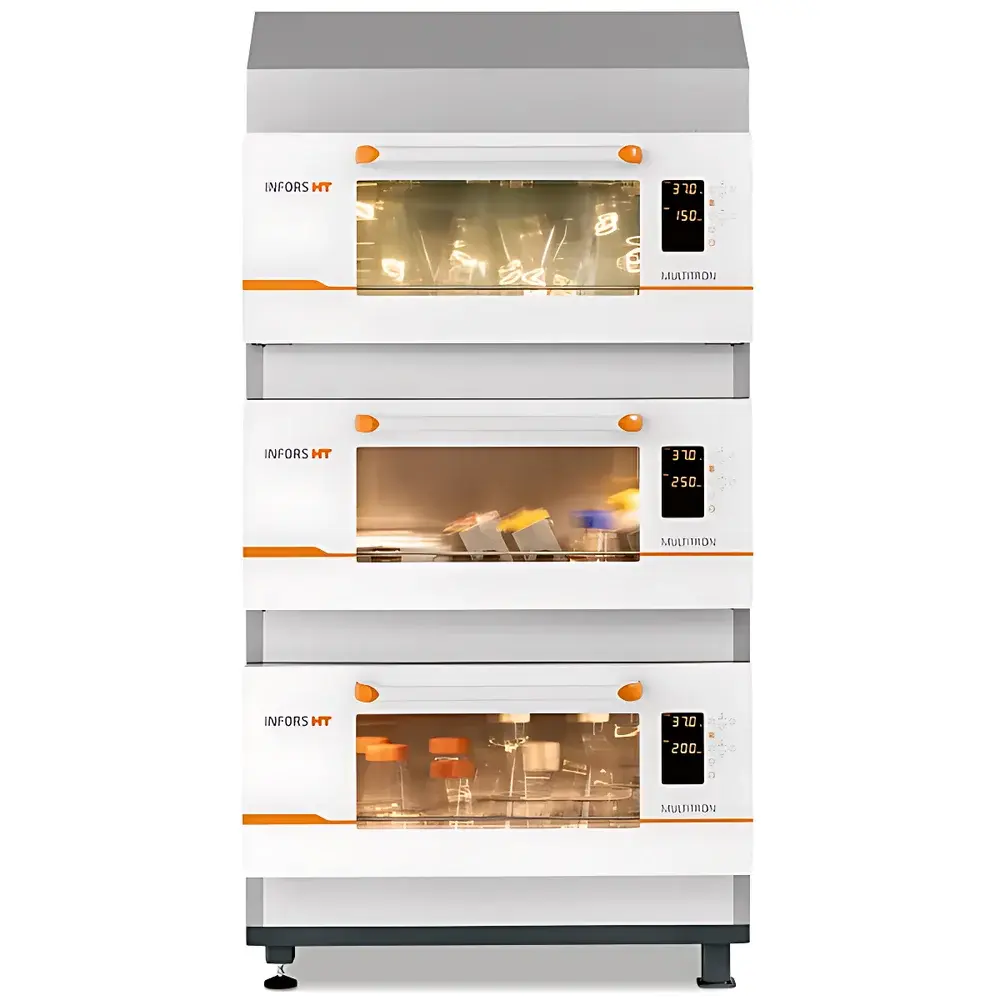
INFORS Multitron Cell Multilayer Incubated Orbital Shaker
| Brand | INFORS |
|---|---|
| Origin | Switzerland |
| Model | Multitron Cell |
| Instrument Type | Air-jacketed incubated shaker |
| Oscillation Frequency | 20–400 rpm |
| Adjustable Amplitude | 12.5, 19, 25, 50 mm |
| Temperature Range | RT−15 °C to 65 °C (with optional refrigeration unit) |
| Stackable Layers | Up to 3 independent decks |
| Maximum Load per Deck | 55 kg |
| Chamber Volume | 250 L (single), 750 L (triple-stack) |
| Temperature Uniformity | ±0.2 °C |
| Temperature Stability | ±0.1 °C |
| Control Options | CO₂ (0–20 %, IR sensor), Humidity (20–85 % RH), LED Illumination (up to 200 µmol·m⁻²·s⁻¹), UV Sterilization (optional), Antimicrobial Coating (optional) |
Overview
The INFORS Multitron Cell is a high-precision, multilayer incubated orbital shaker engineered for demanding life science applications—including mammalian cell culture, microbial fermentation, microplate-based screening, and photobiological studies. Built upon over five decades of Swiss engineering expertise in bioprocess instrumentation, the Multitron Cell employs a patented five-point magnetic drive system that delivers vibration-free, low-noise operation with exceptional mechanical stability—even under asymmetric or high-mass loading conditions. Its air-jacketed thermal architecture combines polyurethane-carbon fiber composite insulation with stainless steel chamber construction and an optimized forced-air circulation system, eliminating thermal gradients and ensuring uniform temperature distribution across the entire working volume (±0.2 °C uniformity, ±0.1 °C stability). The system supports full environmental control: temperature, shaking speed (20–400 rpm, resolution 0.1 rpm), amplitude (12.5–50 mm selectable), CO₂ (0–20 %, IR detection, ±1 % FS accuracy), relative humidity (20–85 % RH, ±1 % RH accuracy), and programmable LED illumination (0–200 µmol·m⁻²·s⁻¹). Designed for GLP-compliant laboratories, it meets critical operational requirements for reproducibility, traceability, and long-term reliability in regulated environments.
Key Features
- Five-point dynamic balancing magnetic drive system ensures silent, jitter-free operation—no mechanical wear, no particle generation, ideal for cleanroom and sterile applications.
- Triple-stack configuration (up to 3 independently controlled decks) maximizes lab space efficiency: total capacity up to 750 L and >23,000 parallel experiments (e.g., 96-well plates at 3 mm amplitude).
- Full-spectrum environmental control: integrated CO₂ module (IR sensor, PID-controlled), direct-clean steam humidification (autoclavable 5 L Schott reservoir), and programmable LED lighting with circadian rhythm simulation via EVE software.
- Ergonomic access design: downward-opening, load-bearing door forms an integrated work platform; telescoping trays with precision linear rails and auto-locking mechanisms support safe handling of up to 55 kg per deck.
- Dual-pane safety glass door with vacuum-sealed insulation enables clear internal observation even at sub-ambient temperatures (down to −15 °C with refrigeration unit).
- Modular expansion architecture: users may add CO₂, humidity, UV sterilization, antimicrobial surface coating (certified >10⁵ log reduction, stable for ≥10 years), or static incubation shelves without hardware modification.
- Robust contamination protection: all moisture- and heat-sensitive electronics and motors are externalized; chamber base features drain port and IPX5-rated wash-down capability using standard disinfectants or autoclave-compatible agents.
Sample Compatibility & Compliance
The Multitron Cell accommodates diverse vessel formats—from 1.5 mL tubes to 5 L baffled flasks—via interchangeable platforms: universal M-trays (850 × 470 mm), adhesive FSM trays (full-surface silicone-based bonding), and microtiter plate isolation boxes (sterilizable, 0.2 µm gas-permeable filters, 99.9% airborne microbial reduction per IEC 62471. Antimicrobial chamber surfaces (Ag⁺-doped ceramic coating) are validated per ISO 22196 and remain effective after repeated cleaning and UV exposure.
Software & Data Management
Control and monitoring are executed through INFORS’ EVE (Enhanced Vessel Environment) software suite, accessible locally via the intuitive capacitive touchscreen interface or remotely via Ethernet (TCP/IP). EVE provides real-time visualization of all active parameters—including simultaneous multi-deck temperature, speed, CO₂, humidity, and light intensity—with configurable alarm thresholds and automated event logging. Users can define multi-step programs (up to 9 days duration) with conditional triggers (e.g., initiate cooling upon reaching target OD₆₀₀), and replay prior runs for process validation. Data export is supported in CSV and PDF formats; raw logs include operator ID, parameter changes, alarms, and system diagnostics. EVE integrates seamlessly with LIMS and SCADA systems via Modbus TCP or OPC UA protocols. Firmware updates are performed over-the-air, and all configuration backups are encrypted and version-controlled.
Applications
- Mammalian cell culture: CO₂-regulated, direct-steam humidified environment eliminates condensation and maintains physiological pH; optional antimicrobial surfaces and UV cycling reduce cross-contamination risk in shared facilities.
- High-density microbial fermentation: 50 mm amplitude supports vigorous aeration of bacterial and yeast cultures in vessels up to 5 L; precise speed control (±0.1 rpm) ensures reproducible oxygen transfer rates (kLa).
- High-throughput screening: At 3 mm amplitude and 1000 rpm (special mode), the system enables accelerated growth kinetics in 96- and 384-well plates—validated to increase protein yield by up to 35% versus conventional shakers.
- Photobioreactor studies: Uniform LED illumination (200 µmol·m⁻²·s⁻¹, PAR spectrum) combined with CO₂ and temperature control enables scalable algal and cyanobacterial cultivation under diurnal or pulsed-light regimes.
- Stem cell and organoid expansion: Static incubation shelves allow side-by-side comparison of shaken vs. static conditions under identical environmental parameters—critical for mechanistic differentiation studies.
FAQ
What is the maximum number of 96-well plates supported per deck?
Up to 3 microtiter plate isolation boxes (Art. No. 66399) can be mounted per tray, accommodating 18 standard 96-well plates or 12 deep-well plates—each operating at up to 400 rpm.
Can the Multitron Cell operate unattended over weekends?
Yes. EVE software supports time-based scheduling, alarm escalation (email/SNMP), and automatic recovery after power interruption—including restoration of original setpoints and notification of fault events.
Is the humidification system compatible with sterile processing workflows?
Yes. The autoclavable 5 L reservoir, stainless steel heating plate (140 °C), and sterile-grade tubing/filter assembly comply with ASME BPE and EN 285 standards for SIP (steam-in-place) validation.
How does the five-point drive system improve performance compared to conventional eccentric drives?
By distributing torque across four peripheral contact points around a central offset shaft, the system dynamically compensates for mass imbalance—eliminating harmonic resonance, reducing bearing stress, and extending service life beyond 20,000 hours MTBF.
Does INFORS provide IQ/OQ documentation packages for GMP environments?
Yes. Factory-verified Installation Qualification (IQ) and Operational Qualification (OQ) protocols—including calibration certificates for temperature, CO₂, and humidity sensors—are available upon request and align with ASTM E2500 and EU Annex 15 guidelines.





