
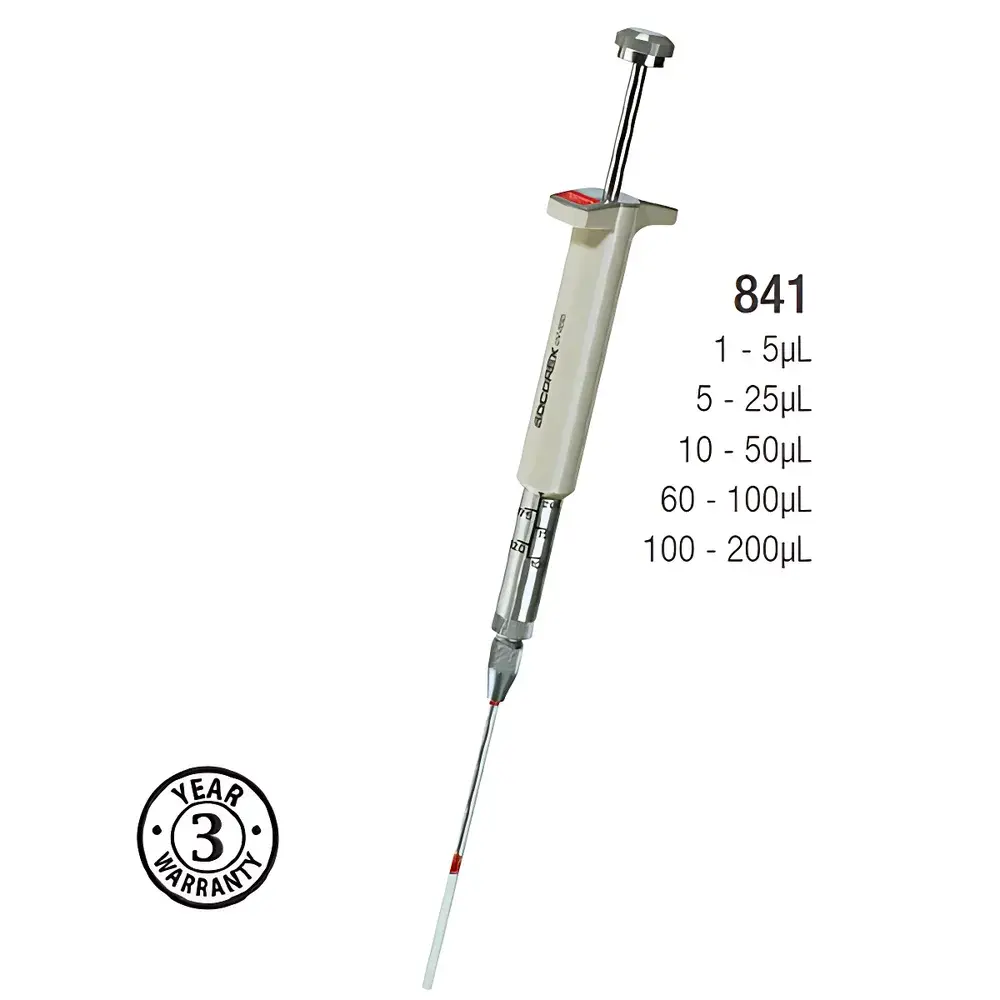
SOCOREX Acura® Positive Displacement Pipette Model 841
| Brand | SOCOREX |
|---|---|
| Origin | Switzerland |
| Model | 841 |
| Pipette Type | Manual Positive Displacement Pipette |
| Channel Configuration | Single-Channel (adjustable volume per tip) |
| Volume Range | 1–200 µL (5 fixed-volume variants per unit) |
| Maximum Capacity | 200 µL |
| Accuracy (E%) | ±0.7% to ±2.0% (volume-dependent) |
| Precision (CV%) | ≤0.8% |
| Tip Material | PTFE-coated piston with ETFE cap |
| Compliance | ISO 8655-3, ISO 8655-5, GLP-ready design |
Overview
The SOCOREX Acura® Positive Displacement Pipette Model 841 is an ISO 8655-compliant manual liquid handling instrument engineered for high-fidelity transfer of challenging samples where air-cushion (gas displacement) pipettes exhibit significant error. Unlike conventional piston-driven pipettes relying on an air gap between the piston and liquid, the Model 841 employs a positive displacement principle: a chemically inert PTFE-tipped piston moves within a precision-bore glass capillary tube, directly contacting and displacing the sample. This eliminates compressibility effects, vapor pressure interference, and surface tension artifacts—critical for accurate volumetric delivery of volatile solvents, viscous fluids, foaming agents, and corrosive reagents. Designed and manufactured in Switzerland, the 841 integrates metrological traceability, mechanical robustness, and ergonomic serviceability into a single-platform system validated for routine use in QC laboratories, pharmaceutical process development, and analytical chemistry workflows requiring GLP/GMP-aligned documentation.
Key Features
- Positive displacement architecture with PTFE-coated stainless-steel piston and borosilicate glass capillary—ensures direct liquid contact and eliminates air-gap variability.
- Five pre-calibrated fixed-volume variants per unit (e.g., 1/2/3/4/5 µL; 5/10/15/20/25 µL; up to 100/120/150/175/200 µL), each factory-adjusted and certified per ISO 8655-3.
- ETFE piston cap provides broad chemical resistance against strong acids, bases, halogenated solvents, and oxidizing agents—compatible with acetone, ethyl acetate, concentrated HNO₃, and glycerol-based formulations.
- Color-coded volume identification system: intuitive cap color coding enables rapid visual verification of nominal volume without reading engraved markings.
- Mechanically adjustable volume selector with tactile feedback and lockable setting—prevents accidental volume drift during repetitive operation.
- ISO 8655-5 compliant calibration certificate supplied with each unit, including as-delivered accuracy (E%) and repeatability (CV%) data across all five set points.
Sample Compatibility & Compliance
The Model 841 is explicitly validated for applications where conventional air-displacement pipettes fail: low-volatility organic solvents (e.g., chloroform, DMF), high-viscosity liquids (≥500 cP, including silicone oils and syrup formulations), surfactant-rich solutions (e.g., SDS buffers, cell culture media), and biological matrices prone to foaming (whole blood, serum, protein lysates). Its all-glass/PTFE/ETFE wetted path meets USP requirements for analytical instrument qualification and supports FDA 21 CFR Part 11–aligned electronic record retention when used with calibrated logbooks or LIMS-integrated tracking. The device conforms to ISO 8655 Parts 1–5 for specification, performance testing, calibration, and uncertainty evaluation—making it suitable for ISO/IEC 17025-accredited testing laboratories.
Software & Data Management
As a fully manual, non-electronic instrument, the Model 841 does not incorporate onboard software or digital interfaces. However, its metrological design supports rigorous paper-based or electronic quality management systems. Each unit ships with a traceable calibration report listing measured E% and CV% values at all five preset volumes, aligned with ISO/IEC 17025 clause 6.4.2. Users may integrate the pipette into laboratory-wide calibration schedules using standard SOPs (e.g., SOP-LAB-023 “Manual Pipette Calibration and Verification”), with documented interval checks per ASTM E2758. Maintenance logs—including piston seal replacement dates and capillary inspection records—can be maintained in ELN or LIMS platforms to satisfy GLP audit requirements for equipment history.
Applications
- Precision dispensing of volatile standards in GC and HPLC method development, where evaporation-induced under-delivery compromises calibration curve linearity.
- Transfer of high-viscosity reference materials in polymer rheology labs, ensuring consistent sample loading into viscometers without air entrapment.
- Accurate dosing of detergent-containing lysis buffers in molecular biology workflows—minimizing foam generation and cross-contamination risk.
- Handling of corrosive reagents in inorganic synthesis labs, including anhydrous HF mixtures and bromine solutions, leveraging ETFE/PTFE chemical inertness.
- Regulatory batch release testing in pharmaceutical manufacturing, where volumetric accuracy must comply with ICH Q2(R2) validation parameters for assay methods.
FAQ
How does the Model 841 differ from standard air-displacement pipettes?
It uses direct piston-to-liquid contact via a PTFE-tipped plunger inside a glass capillary—eliminating air compressibility, solvent evaporation losses, and surface tension errors inherent in air-cushion designs.
Can the same Model 841 unit be used across multiple volume ranges?
No—each physical unit is factory-set to one of five discrete volumes within a given range tier (e.g., 10/20/30/40/50 µL). Interchangeable tips are not supported; volume selection is mechanical and fixed per unit.
Is recalibration required before first use?
No—each unit is supplied with a valid ISO 8655-3 calibration certificate. Routine verification per ISO 8655-5 is recommended every 3–6 months depending on usage frequency and criticality of application.
What maintenance procedures are specified for long-term accuracy?
Annual piston seal replacement and capillary bore inspection are advised. Cleaning requires only isopropanol rinse and air-drying—no ultrasonic or autoclave exposure permitted due to glass component constraints.
Does SOCOREX provide traceable calibration services outside initial certification?
Yes—authorized service centers offer accredited recalibration per ISO/IEC 17025, including uncertainty budgeting and full test reports compatible with internal QA audits and regulatory inspections.



