
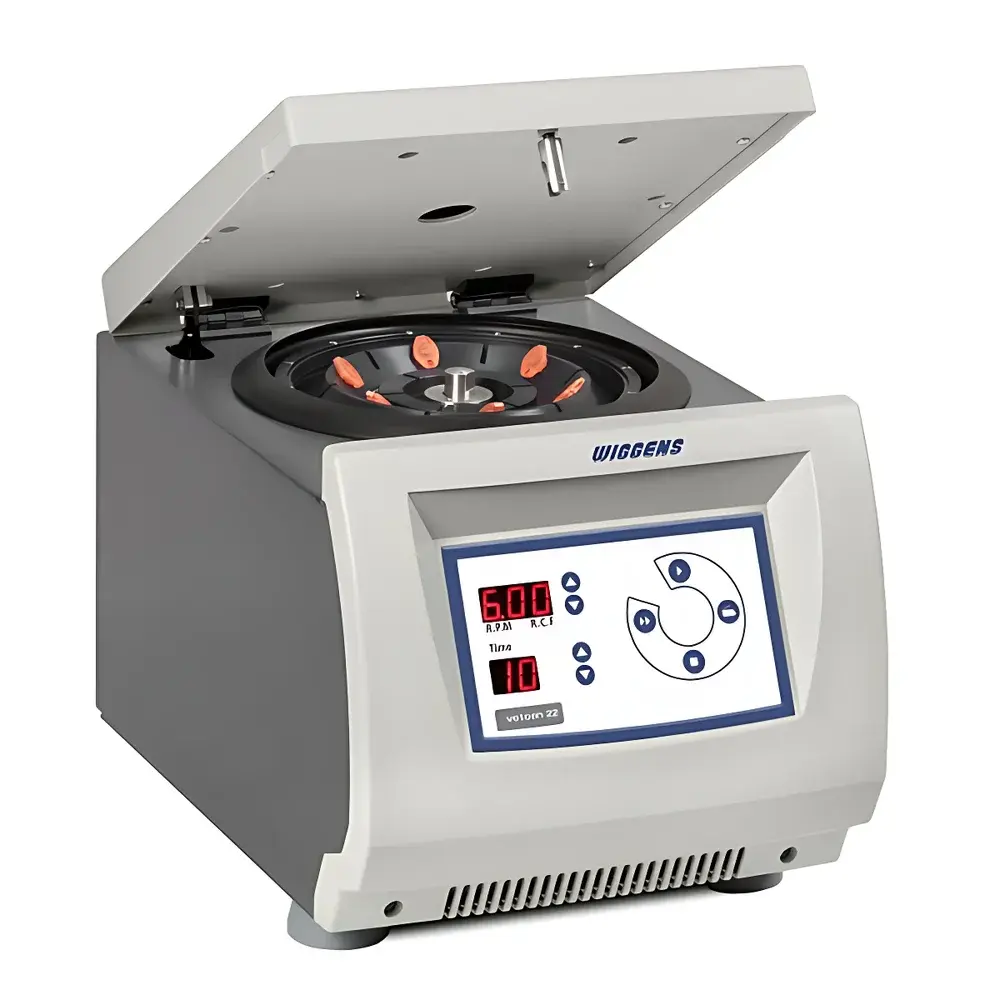
WIGGENS VETCEN Desktop Centrifuge
| Brand | WIGGENS |
|---|---|
| Origin | Germany |
| Model | VETCEN |
| Instrument Type | Benchtop Centrifuge |
| Speed Range | 0–11,500 rpm |
| Max RCF | 12,716 ×g |
| Capacity | 6 × 1.5–2 mL + 6 × 1.5 × 75 mm capillaries |
| Dimensions (W×D×H) | 276 × 390 × 272 mm |
| Noise Level | <60 dB(A) |
| Compliance | EN 61010-1, EN 61010-2-020, EN 61326-1, EN 61326-2-6 |
| Certifications | 2011/65/EU (RoHS), 2012/19/EU (WEEE), 2014/30/EU (EMC), 2014/35/EU (LVD), 98/79/EC (IVDR) |
Overview
The WIGGENS VETCEN Desktop Centrifuge is an engineered solution for routine and high-reproducibility centrifugation tasks in veterinary diagnostics, clinical pathology, and small-scale life science laboratories. Designed around a brushless DC motor architecture, the VETCEN delivers precise control over rotational speed and relative centrifugal force (RCF), operating within a validated range of 0–11,500 rpm and generating up to 12,716 ×g. Its dual-rotor compatibility—supporting both conical microtubes (1.5–2 mL) and standardized capillary tubes (1.5 × 75 mm)—enables parallel processing of hematocrit, serum separation, and nucleic acid preps without rotor interchange. The instrument employs fixed-angle rotor geometry optimized for rapid pelleting of biological macromolecules—including proteins, cellular organelles, and viral particles—while maintaining thermal stability through forced-air ventilation and low-power idle modes. As a Class I laboratory device per EN 61010-1, it meets stringent safety requirements for use with biosafety level 1 (BSL-1) and select BSL-2 applications when operated with sealed rotors and appropriate containment.
Key Features
- Simultaneous processing of 6 × 1.5–2 mL microcentrifuge tubes and 6 × 1.5 × 75 mm capillaries using the RT130 multifunctional rotor
- High-resolution LED display showing real-time RPM, RCF, elapsed time, and remaining runtime
- Precise speed control in 50 rpm increments; RCF adjustment in 10 ×g steps
- Programmable timer (1–99 min, 1-min resolution) with forward or reverse countdown options
- Three-stage acceleration/deceleration profiles: rapid, medium, and inertia-based coast-down
- Microprocessor-based control system with rotor memory, last-parameter recall, and automatic lid unlocking upon completion
- Acoustic and visual status alerts during operation, including imbalance detection and automatic shutdown
- Brushless motor design ensuring maintenance-free operation and extended service life
- Stainless steel centrifuge chamber (AISI 304) with integrated thermal shielding and removable rotor carrier
- Noise emission ≤60 dB(A) at 1 m distance under full-load conditions
Sample Compatibility & Compliance
The VETCEN supports common diagnostic sample formats used in veterinary practice, including heparinized or EDTA-treated whole blood (for hematocrit determination), serum separator tubes, and low-volume nucleic acid lysates. Both the RT126 swing-out and RT130 fixed-angle rotors are autoclavable at 121 °C for 20 minutes (ISO 17665-1 compliant), enabling reuse in GLP-aligned workflows. All rotor adapters—including those for capillary tubes and 1.5–2 mL tubes—are manufactured from medical-grade polypropylene certified to USP Class VI standards. The unit complies with European directives governing electrical safety (2014/35/EU), electromagnetic compatibility (2014/30/EU), restriction of hazardous substances (2011/65/EU), and in vitro diagnostic devices (98/79/EC). Full conformity documentation—including Declaration of Conformity and test reports aligned with EN 61010-2-020 (safety for centrifuges) and EN 61326-2-6 (EMC for lab equipment)—is supplied with each unit.
Software & Data Management
While the VETCEN operates as a standalone instrument without external PC connectivity, its embedded firmware supports audit-ready operational integrity. All parameter changes—including speed, time, acceleration profile, and RCF mode—are logged internally with timestamped entries accessible via service menu. The system retains the last 10 executed protocols and includes hardware-level safeguards against unauthorized configuration changes. For laboratories subject to FDA 21 CFR Part 11 or ISO/IEC 17025 requirements, optional third-party validation packages are available, covering IQ/OQ documentation, performance verification across speed/RCF ranges, and mechanical safety checks per EN 61010-2-020 Annex BB. Firmware updates are performed via secure USB interface under controlled change management procedures.
Applications
- Routine hematocrit measurement in avian, equine, and companion animal samples using calibrated capillary tubes
- Serum and plasma separation from whole blood specimens prior to ELISA, PCR, or biochemical analysis
- Concentration of extracellular vesicles and exosomes from low-volume biological fluids (e.g., synovial fluid, cerebrospinal fluid)
- Preparation of bacterial cell pellets for DNA extraction or antibiotic susceptibility testing
- Clarification of tissue homogenates and subcellular fractionation in comparative pathology studies
- Processing of point-of-care diagnostic cartridges requiring on-device centrifugation
FAQ
Is the VETCEN suitable for use with infectious samples?
Yes—when equipped with sealed rotors (e.g., RT130 with capillary inserts) and operated inside a certified biosafety cabinet, the VETCEN meets containment requirements for BSL-2 agents per WHO Laboratory Biosafety Manual, 4th ed.
Can rotor RT126 and RT130 be interchanged without tools?
Yes—the quick-release rotor mount allows tool-free installation and removal; both rotors share identical radius (86 mm) and maximum speed rating (11,500 rpm).
Does the VETCEN support regulatory-compliant data archiving?
It maintains internal execution logs but does not export raw data; integration with LIMS requires external time-stamped logging via RS-232 or optional Ethernet module (sold separately).
What is the recommended maintenance interval?
No scheduled maintenance is required for the brushless motor; biannual inspection of lid latch mechanism, rotor threads, and chamber corrosion is advised per EN 61010-1 Clause 7.3.2.
Is calibration traceable to national standards?
Speed and RCF calibration is performed using NIST-traceable tachometry and gravimetric reference methods; certificate of calibration is provided with each instrument shipment.
Related Products



