NS Ion Beam Etcher 10-M/NS-5
| Origin | Japan |
|---|---|
| Manufacturer Type | Authorized Distributor |
| Origin Category | Imported |
| Model | 10-M/NS-5 |
| Price Range | USD 135,000 – 205,000 |
| Substrate Diameter | 6-inch (150 mm) |
| Cooling | Direct substrate cooling with independent ion source cooling |
| Ion Source | 10 cm Kaufman-type ion source (KRI OEM) |
| Power Supply | WELL-2000 (compatible with domestic AC input upon request) |
| Beam Tilt | Adjustable RF-driven angular control (0°–90°) |
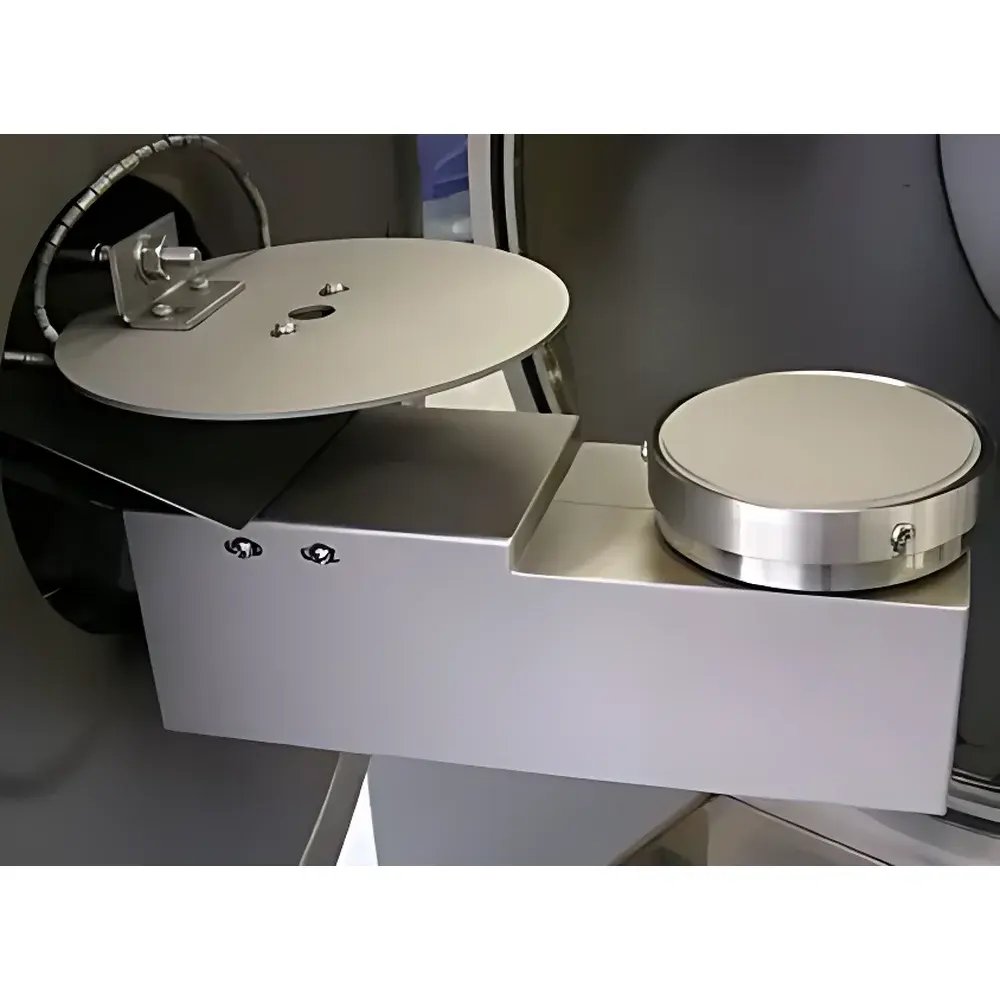
| Motion Control | Planetary rotation (substrate revolution + spin) |
| Process Environment | High-vacuum compatible (≤1×10⁻⁵ Pa base pressure, typical operating range 1×10⁻⁴–5×10⁻³ Pa) |
Overview
The NS Ion Beam Etcher 10-M/NS-5 is a high-precision, benchtop-scale physical vapor etching system engineered for R&D laboratories and low-volume production environments in semiconductor, magnetic thin-film, and advanced microdevice fabrication. It operates on the principle of inert-gas ion beam sputtering—where argon or xenon ions, accelerated through a Kaufman-type ion source, bombard the sample surface at controlled energy (typically 100–1500 eV) and incidence angle to remove material via momentum transfer. Unlike reactive ion etching (RIE), this dry, non-chemical process eliminates plasma-induced damage, charging effects, and residue formation—making it uniquely suited for delicate functional layers such as CoFeB, NiFe, YBCO, Pt, Au, and other noble or magnetic alloys where stoichiometry and interfacial integrity are critical. The system achieves sub-10 nm depth resolution with excellent uniformity (<±3% across 6-inch wafers) and high reproducibility under GLP-compliant operation protocols.
Key Features
- 10 cm diameter Kaufman ion source manufactured by KRI (USA), delivering stable, long-lifetime ion beams with adjustable extraction voltage and current density up to 1.2 mA/cm²
- Direct substrate cooling stage integrated with liquid nitrogen or chilled water interface, enabling cryogenic etching down to −120 °C to suppress thermal diffusion and enhance anisotropy
- Motorized, dual-axis planetary motion system: simultaneous substrate revolution (3–15 rpm) and rotation (10–60 rpm) ensures <±2.5% etch rate uniformity across full 6-inch wafers
- Full-angle beam tilt mechanism (0°–90°) driven by precision RF actuation—enabling vertical sidewall profiles, tapered structures, or angled trenching without mask repositioning
- Modular vacuum architecture compatible with turbomolecular pumping (base pressure ≤1×10⁻⁵ Pa), equipped with residual gas analyzer (RGA) port for real-time process monitoring
- Integrated PLC-based controller with password-protected recipe management, event logging, and emergency stop compliance per IEC 61508 SIL2
Sample Compatibility & Compliance
The 10-M/NS-5 accommodates single 6-inch (150 mm) substrates—including Si, SiO₂, quartz, sapphire, flexible polyimide carriers, and magnetic multilayers on AlTiC or glass sliders. Its physical sputtering mechanism imposes no chemical compatibility constraints: it etches conductive, insulating, and semiconducting films alike—including FePt, CoCrTa, MgO tunnel barriers, NbN superconductors, and chalcogenide phase-change materials. The system meets ISO 14644-1 Class 5 cleanroom integration requirements and supports audit-ready documentation for ISO 9001, ISO/IEC 17025, and FDA 21 CFR Part 11 when paired with optional electronic signature and audit trail modules. All electrical components conform to CE/UL 61010-1 safety standards; vacuum chamber design complies with ASME BPVC Section VIII Div. 1.
Software & Data Management
Control is executed via NS proprietary EtherCAT-based GUI running on Windows 10 IoT Enterprise. The interface provides real-time display of ion current, beam voltage, chamber pressure, substrate temperature, and motion status. Up to 99 process recipes can be stored with version timestamping, user ID tagging, and change history tracking. Raw sensor data (including time-stamped ion current waveforms and thermocouple readings) are exported in CSV or HDF5 format for post-processing in MATLAB or Python. Optional OPC UA server enables seamless integration into MES platforms (e.g., Siemens Opcenter, Rockwell FactoryTalk) for traceability in GMP-regulated pilot lines.
Applications
- Spintronic device fabrication: patterning of MTJ stacks (CoFeB/MgO/CoFeB), GMR sensors, and skyrmion-hosting chiral magnets
- Thin-film magnetic head R&D: precision shaping of write poles and shield gaps with sub-50 nm edge definition
- MEMS/NEMS release etching: residue-free removal of sacrificial SiO₂ or Al layers without stiction or undercut
- RF filter and BAW resonator trimming: frequency tuning of LiNbO₃ or AlN piezoelectric layers via controlled thickness reduction
- Optical grating and metasurface fabrication: high-fidelity topography transfer into fused silica, CaF₂, or chalcogenide glasses
- Superconductor circuit prototyping: clean ablation of YBCO or NbTiN films without oxygen vacancy generation
FAQ
What vacuum level is required for stable ion beam operation?
Base pressure ≤1×10⁻⁵ Pa is recommended; typical operating pressure during etching ranges from 1×10⁻⁴ to 5×10⁻³ Pa depending on gas flow and beam current.
Can the system be upgraded to support reactive ion beam etching (RIBE)?
Yes—optional gas injection nozzles (O₂, Cl₂, SF₆) and RF bias electrode can be retrofitted to enable chemically assisted sputtering for enhanced selectivity.
Is remote diagnostics supported?
Standard Ethernet connectivity allows secure VNC-based remote troubleshooting; optional TLS-encrypted API access enables integration with centralized facility monitoring systems.
What maintenance intervals are recommended for the Kaufman ion source?
Ion source refurbishment is advised every 2,000–3,000 operational hours; filament replacement and grid cleaning are field-serviceable tasks requiring <30 minutes downtime.
Does the system comply with electromagnetic compatibility (EMC) regulations for cleanroom deployment?
Yes—certified to EN 61326-1:2013 for laboratory equipment, with conducted and radiated emission levels fully within Class A limits for industrial environments.