
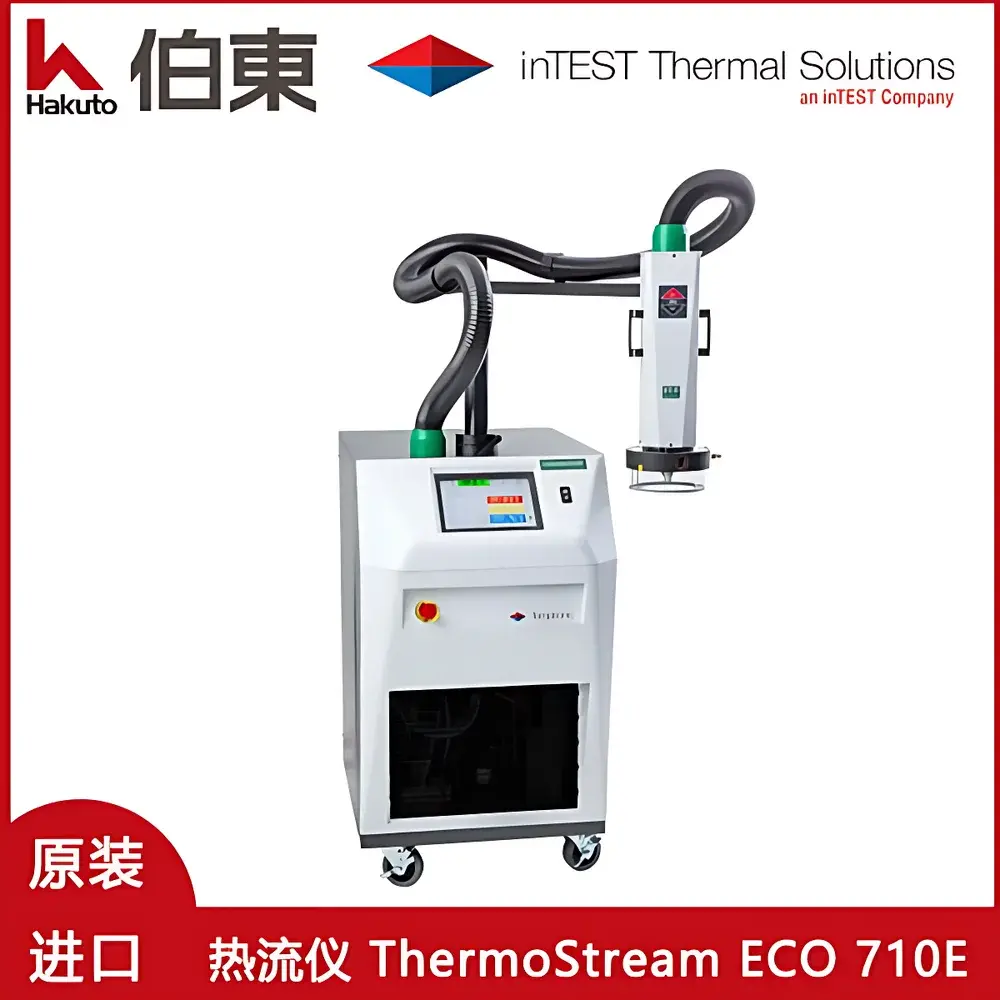
inTEST ECO-710E Thermal Shock Test System
| Brand | inTEST–Temptronic |
|---|---|
| Origin | USA |
| Model | ECO-710E |
| High Temp Range | +225 °C |
| Low Temp Range | −80 °C |
| Thermal Shock Range | −80 to +225 °C |
| Temperature Stability | ±0.1 °C |
| Ramp Rate (−55 to +125 °C) | ~10 s |
| Ramp Rate (+125 to −55 °C) | ~10 s |
Overview
The inTEST ECO-710E Thermal Shock Test System is an engineered solution for high-fidelity, rapid thermal transient testing of electronic components and assemblies under controlled, non-chambered conditions. Unlike conventional environmental chambers, the ECO-710E employs a directed, high-velocity air stream—delivered via precision-engineered nozzle configurations—to impose precise, repeatable temperature transitions directly onto device-under-test (DUT) surfaces. Its core architecture integrates a dual-stage refrigeration circuit with a high-efficiency heating module, enabling sub-10-second transitions between −55 °C and +125 °C without reliance on cryogenic consumables such as liquid nitrogen (LN₂) or liquid CO₂. This closed-loop, fluorocarbon-free refrigerant system complies with EPA SNAP and EU F-Gas Regulation requirements, supporting sustainable lab operations while maintaining full traceability to ASTM E1545 and IEC 60068-2-14 standards for thermal shock testing.
Key Features
- WhisperStream® acoustic optimization: operational noise ≤56 dBA at 1 m—engineered for integration into shared laboratory environments without structural isolation
- Low-power electrical profile: nominal 20 A @ 208 VAC input; intelligent standby mode reduces idle power draw by >65%
- Dry-air purge function: integrated desiccant-assisted air drying prevents condensation during low-temperature exposure cycles
- Auto-defrost cycle: thermally triggered internal defrost sequence clears frost accumulation from evaporator surfaces without interrupting test sequences
- Programmable thermal limits: user-configurable upper/lower temperature bounds with hardware-enforced safety cutoff at +230 °C (factory default)
- Fluorine-free refrigerant (R-513A): non-toxic, non-flammable, zero ozone depletion potential (ODP = 0), GWP < 600
- Modular thermal shroud options: 4.5″ and 5.5″ diameter configurations for DUT-specific thermal coupling efficiency
Sample Compatibility & Compliance
The ECO-710E accommodates bare die, packaged ICs (QFN, BGA, LGA), PCBAs up to 300 mm × 300 mm, and multi-chip modules mounted on handler interfaces or probe stations. Its open-stream design eliminates chamber-induced thermal mass lag, enabling direct correlation with JEDEC JESD22-A104 (Temperature Cycling) and JESD22-A106 (Thermal Shock) protocols. All temperature control algorithms are validated per ISO/IEC 17025:2017 calibration traceability requirements. The system supports GLP/GMP-compliant operation through optional audit-trail-enabled firmware (21 CFR Part 11 compliant data logging available with ThermoStream Control Suite v5.2+).
Software & Data Management
- Embedded Windows® IoT Enterprise OS with 10.1″ capacitive touchscreen HMI
- Real-time temperature profiling with 100 Hz sampling rate and timestamped CSV export
- Ethernet (TCP/IP), IEEE-488 (GPIB), and RS-232 interfaces for SCPI command compatibility with ATE platforms (e.g., Teradyne, Advantest, Cohu)
- Test sequence scripting via Python API (included SDK) for custom ramp-hold-soak profiles and conditional branching
- Integrated data historian: stores ≥1 million temperature/time points locally; configurable auto-sync to network file shares or cloud-based S3 buckets
Applications
The ECO-710E is deployed in semiconductor qualification labs for accelerated reliability stress screening—including early-life failure detection (ELF), solder joint fatigue assessment, and package-level CTE mismatch evaluation. It serves as a primary thermal stimulus in functional test setups integrated with Delta Design handlers and FormFactor probe cards. Additional use cases include thermal validation of automotive ADAS sensors (ISO 16750-4), aerospace-grade FPGA burn-in, and failure analysis workflows requiring synchronized thermal-electrical stimulation (e.g., thermal mapping of leakage current hotspots). Its rapid transition capability enables high-throughput thermal cycling at rates exceeding 1,200 cycles per 24 hours—significantly reducing time-to-data versus traditional chamber-based methods.
FAQ
Does the ECO-710E require external chill water or LN₂?
No—it operates as a self-contained, air-cooled system with no external utility dependencies beyond standard 208–240 VAC power.
Can it interface with automated test equipment (ATE)?
Yes: native SCPI command support over GPIB, Ethernet, or RS-232 enables seamless integration into existing ATE software stacks.
What is the maximum DUT size supported without custom shrouds?
Standard nozzle configuration delivers uniform thermal coverage to devices ≤120 mm in diameter; larger footprints require application-specific shroud engineering.
Is NIST-traceable calibration documentation included?
Each unit ships with a factory calibration certificate referencing NIST SRM 1750 thermocouples and ASME PTC 19.3 TW-2018 methodology.
How is temperature uniformity verified across the DUT surface?
Uniformity is characterized per IEC 60068-3-5 using a 9-point thermocouple array; typical spatial deviation is ≤±0.5 °C at steady-state within the central 75% of the effective test area.



