
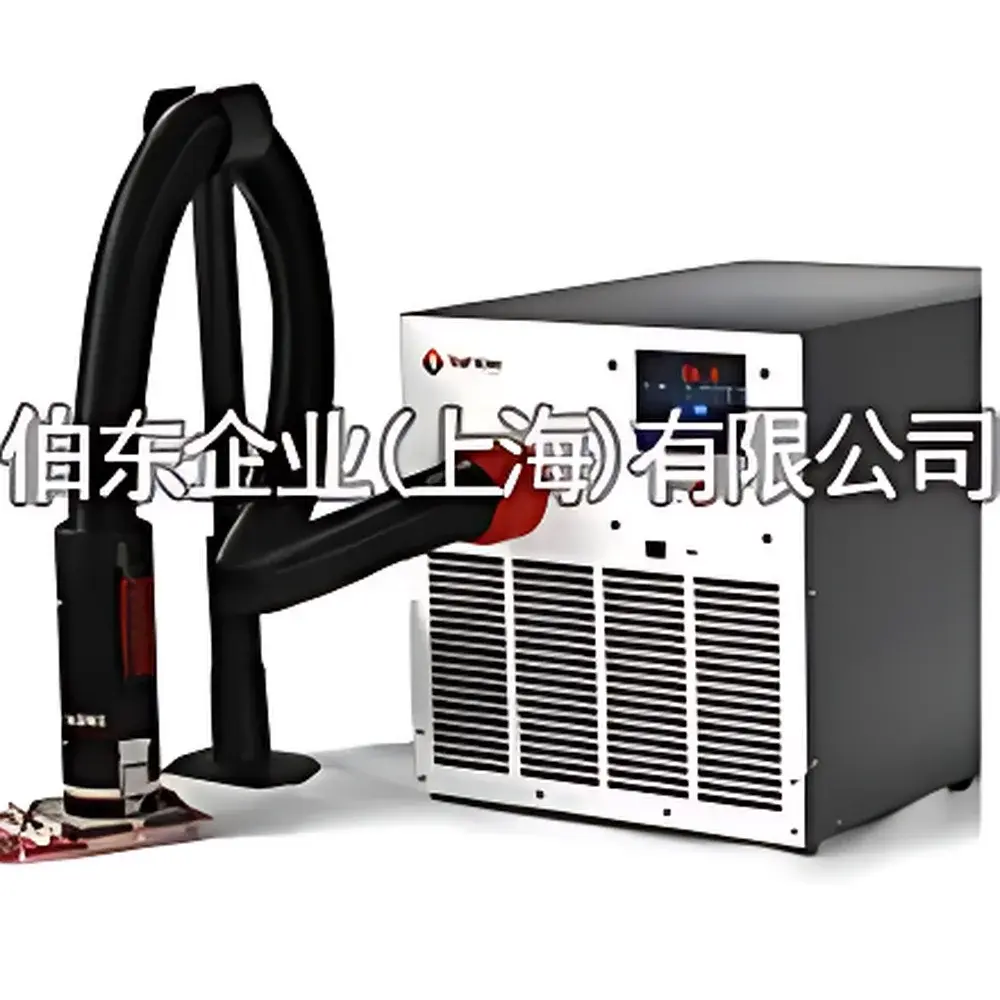
inTEST Temptronic ThermoSpot DCP-102 Desktop Thermal Shock Test System
| Brand | inTEST-Temptronic |
|---|---|
| Origin | USA |
| Model | DCP-102 |
| Temperature Shock Range | -65 to 175°C |
| Temperature Stability | ±0.3°C |
| Heating Rate | 25°C to +125°C in <1.5 min |
| Cooling Rate | 25°C to -40°C in <35 sec |
| Cooling Power | 55W @ -55°C, 125W @ -40°C, 250W @ 0°C |
| DUT Force Range | 2–100 kgf |
| DUT Size Compatibility | 2×2 mm to 100×100 mm |
| Heat Sink Diameter | 89 mm |
| Required Gas Supply | Dry, clean air or nitrogen at -70°C, 0.1 cfm @ 0.2 bar |
| Weight | 66 kg |
| Sensor Options | RTD, K-type thermocouple, diode, 100 Ω RTD, analog input |
| Calibration | Software-based |
| Communication Interfaces | Ethernet (TCP/IP), optional USB, IEEE-488 (GPIB), RS-232 |
Overview
The inTEST Temptronic ThermoSpot DCP-102 is a high-performance desktop thermal shock test system engineered for rapid, precise, and repeatable temperature cycling of semiconductor devices under test (DUTs). Utilizing solid-state thermoelectric (Peltier) technology—rather than compressor-based refrigeration—the DCP-102 delivers exceptional thermal agility without requiring external chillers or cryogenic fluids. Its core operating principle relies on bidirectional heat pumping across thermally optimized ceramic modules, enabling sub-second transitions between extreme thermal states while maintaining tight stability (±0.3°C) across the full operational range of –65°C to +175°C. Designed specifically for wafer-level and packaged IC characterization, the system supports dynamic thermal profiling essential for parametric testing, burn-in screening, failure mode analysis (FMA), and reliability qualification per JEDEC JESD22-A104 and A110 standards. The compact, self-contained architecture eliminates vibration coupling and acoustic noise typical of mechanical cooling systems—critical for sensitive probe station integration and automated test equipment (ATE) synchronization.
Key Features
- Ultra-fast thermal transition: Achieves 25°C → –40°C in under 35 seconds and 25°C → +125°C in less than 1.5 minutes—enabling high-throughput thermal stress screening.
- High-resolution thermal control: Integrated platinum RTD and optional K-type thermocouple, diode, or 100 Ω RTD sensing with software-based calibration traceable to NIST standards.
- Programmable DUT interface force: Adjustable clamping pressure from 2 to 100 kgf ensures optimal thermal contact across diverse package types—from 2×2 mm bare dies to 100×100 mm multi-chip modules—without mechanical damage.
- Modular thermal interface design: Standard 89 mm diameter heat sink aperture accommodates custom cold/hot plates and third-party probe cards; optional interfaces support QFN, BGA, LGA, and flip-chip configurations.
- Industrial-grade communication stack: Native Ethernet (TCP/IP) interface enables seamless integration into LabVIEW, Python, or proprietary ATE environments; optional GPIB (IEEE-488), USB 2.0, and RS-232 support legacy system compatibility.
- Gas-assisted thermal management: Requires only dry, oil-free compressed air or nitrogen at –70°C dew point (0.1 cfm @ 0.2 bar) for condensation-free operation—eliminating dependency on liquid nitrogen or mechanical chillers.
Sample Compatibility & Compliance
The DCP-102 supports a broad spectrum of semiconductor packages and substrates, including bare die, wafer fragments, leaded and leadless surface-mount devices (e.g., SOIC, QFP, QFN, BGA), power modules, MEMS sensors, and optoelectronic components. Its open DUT chamber design allows direct probing with micropositioners and RF probes. From a regulatory standpoint, the system complies with IEC 61000-4-2 (ESD immunity), IEC 61000-4-3 (radiated RF immunity), and UL/CSA 61010-1 for electrical safety. When operated within validated test protocols, it supports GLP/GMP documentation workflows and satisfies data integrity requirements under FDA 21 CFR Part 11 when paired with compliant software platforms. Test methods executed on the DCP-102 align with ASTM E1545 (thermal shock resistance of electronic packages), JEDEC JESD22-A104 (temperature cycling), and MIL-STD-883 Method 1010 (thermal shock).
Software & Data Management
The DCP-102 operates via inTEST’s ThermoControl™ software suite—a Windows-based application supporting script-driven test sequencing, real-time thermal profiling, and synchronized data logging at up to 10 Hz sampling rate. All temperature setpoints, ramp rates, dwell times, and sensor readings are timestamped and stored in CSV or binary format with embedded metadata (operator ID, DUT ID, calibration epoch). Audit trails record all parameter modifications, user logins, and calibration events—meeting ALCOA+ principles for data integrity. Remote monitoring and control are enabled via RESTful API endpoints over Ethernet, allowing integration into MES and SPC systems. Firmware updates are delivered through signed, version-controlled packages with SHA-256 verification.
Applications
- Parametric characterization of transistors, diodes, and RF power amplifiers across temperature extremes.
- Early-life failure detection during high-temperature operating life (HTOL) and temperature-humidity-bias (THB) preconditioning.
- Thermal coefficient of resistance (TCR) and thermal drift measurement for precision analog and sensor ICs.
- Package-level thermal interface material (TIM) evaluation under dynamic load conditions.
- Failure analysis root cause determination—including delamination, solder joint fatigue, and intermetallic growth—via controlled thermal cycling.
- Qualification testing for automotive AEC-Q100 Grade 0–3 devices and aerospace-grade components subjected to MIL-PRF-38534 requirements.
FAQ
Does the DCP-102 require external refrigeration or liquid nitrogen?
No. It uses solid-state thermoelectric modules and requires only dry, clean compressed air or nitrogen at –70°C dew point.
Can the DCP-102 be integrated with automated probe stations?
Yes. Its low-vibration design, Ethernet interface, and programmable DUT force make it compatible with semi-automated and fully automated wafer probers.
What is the maximum DUT weight the system can accommodate?
The DCP-102 supports DUTs up to 100 kgf clamping force, with mechanical limits determined by interface plate rigidity—not system mass.
Is NIST-traceable calibration provided with the instrument?
Factory calibration is performed using NIST-traceable reference standards; users may perform field verification and software recalibration using certified secondary sensors.
How is thermal uniformity verified across the DUT interface surface?
Uniformity is characterized per IEC 60068-3-5 using a 9-point grid thermocouple mapping protocol; typical spatial deviation is ≤ ±0.5°C over the central 50 mm diameter.
Does inTEST provide application support for test method development?
Yes. In-house applications engineers assist with thermal profile optimization, interface selection, and compliance documentation for JEDEC, AEC-Q, and MIL-STD qualification programs.



