
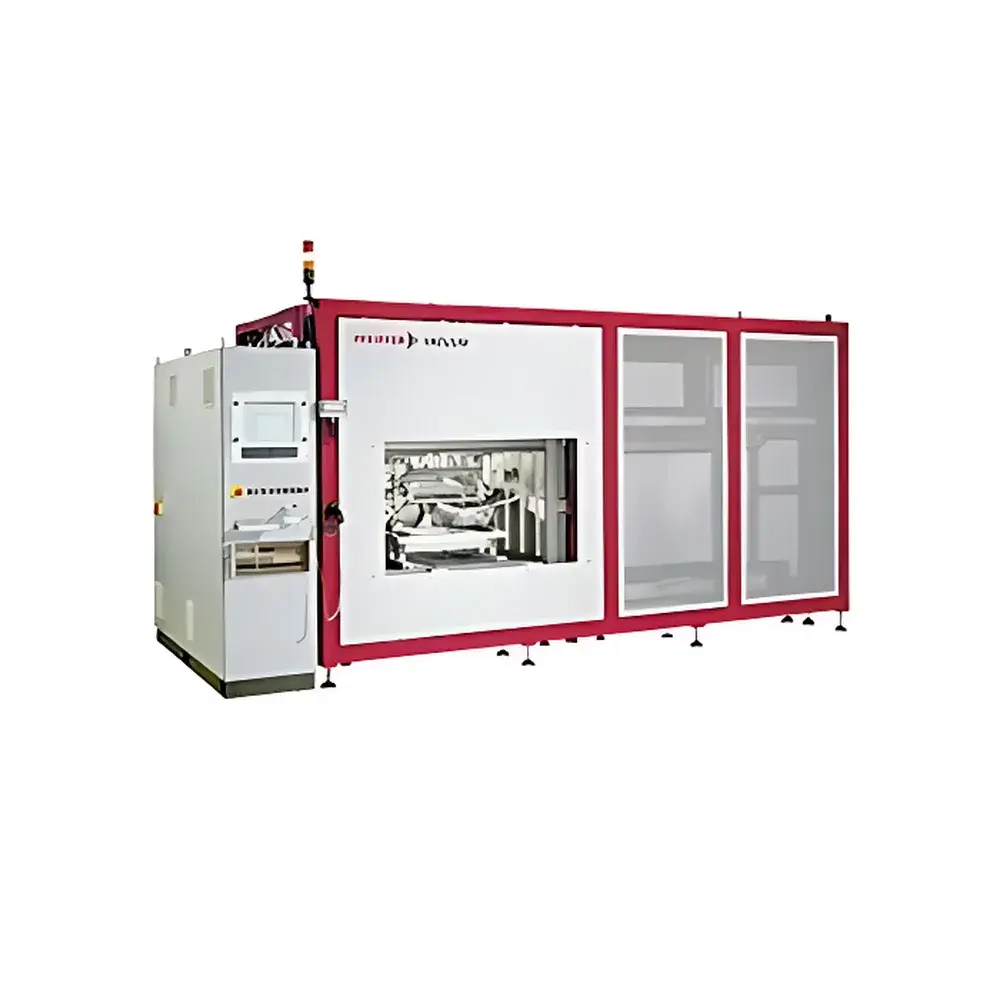
Pfeiffer ASM 340 Helium Mass Spectrometer Leak Detection System
| Brand | Pfeiffer Vacuum |
|---|---|
| Origin | Germany |
| Model | ASM 340 |
| Minimum Detectable Leak Rate (He) | 5 × 10⁻¹³ Pa·m³/s |
| Detection Modes | Vacuum Mode & Sniffer Mode |
| Detectable Gases | ⁴He, ³He, H₂ |
| Pump-Down/Startup Time | ~3 min |
| Helium Pumping Speed | 2.5 L/s |
| Max Inlet Pressure | 25 hPa |
| Forepump Required | 15 m³/h |
| Weight | 56 kg |
Overview
The Pfeiffer ASM 340 Helium Mass Spectrometer Leak Detection System is an industrial-grade, high-sensitivity leak detection platform engineered for precision vacuum integrity verification in mission-critical manufacturing and research environments. Based on quadrupole mass spectrometry with magnetic sector-free ion optics, the system operates on the principle of selective ionization and mass-resolved detection of helium (⁴He, ³He) and hydrogen (H₂) tracer gases. Its core measurement architecture leverages a compact, high-transmission ion source coupled to a robust quadrupole mass filter optimized for unit-mass resolution at m/z = 4 (helium), enabling trace-level detection down to 5 × 10⁻¹³ Pa·m³/s under calibrated vacuum conditions. Designed for integration into automated production lines or deployment as a standalone benchtop station, the ASM 340 meets the stringent repeatability and stability requirements of semiconductor equipment qualification, vacuum metallurgy (e.g., brazing furnaces), optical coating systems, and power generation components — all without requiring cryogenic cooling or external magnetic fields.
Key Features
- High-sensitivity helium detection limit of 5 × 10⁻¹³ Pa·m³/s, verified per ISO 9934-2 and ASTM E432 standards
- Dual operational modes: high-vacuum test mode (for pressurized or evacuated parts) and sniffer probe mode (for localized leak localization)
- Multi-gas capability supporting ⁴He, ³He, and H₂ detection — enabling flexibility in tracer gas selection based on application constraints (e.g., background interference, safety, cost)
- Rapid system readiness: full operational status achieved within approximately 3 minutes from cold start, minimizing downtime in high-throughput inspection workflows
- Integrated helium pumping speed of 2.5 L/s at the analyzer inlet, ensuring efficient signal response during dynamic leak testing
- Maximum allowable inlet pressure of 25 hPa, permitting direct connection to rough vacuum stages without intermediate throttling
- Modular architecture compatible with standard forepumps delivering ≥15 m³/h pumping capacity — facilitating seamless integration with existing vacuum infrastructure
- Robust mechanical design with 56 kg total mass, engineered for vibration resistance and long-term thermal stability in factory-floor environments
Sample Compatibility & Compliance
The ASM 340 system accommodates a broad range of component geometries and materials, including stainless steel vacuum chambers, aluminum semiconductor process modules, copper heat exchangers, ceramic insulators, and hermetically sealed electronic housings. It supports both internal pressurization (with helium or helium-nitrogen mixtures) and external vacuum evacuation protocols. The system conforms to key international regulatory and quality frameworks: its firmware architecture supports audit trails and user-access controls aligned with FDA 21 CFR Part 11 requirements for electronic records; data export formats comply with ASTM E1444 and ISO 10893-10 for non-destructive testing documentation; and hardware calibration procedures follow traceable NIST-equivalent reference standards maintained by Pfeiffer Vacuum’s certified service centers. Routine operation adheres to GLP/GMP environmental monitoring guidelines when deployed in pharmaceutical packaging line validation or medical device sterilization chamber certification.
Software & Data Management
The ASM 340 is operated via Pfeiffer’s proprietary LeakTest Control Suite — a Windows-based application providing real-time spectral visualization, multi-channel trend logging, and configurable pass/fail threshold logic. All measurement sessions are timestamped and associated with operator ID, test parameter set, and environmental metadata (ambient temperature, barometric pressure). Raw ion current data is stored in HDF5 format for post-acquisition reprocessing and statistical analysis. The software supports automated report generation in PDF and CSV formats, with embedded digital signatures for compliance reporting. Optional OPC UA integration enables bidirectional communication with MES/SCADA platforms for inline SPC charting and predictive maintenance alerts based on pump performance decay trends or detector gain drift.
Applications
- Semiconductor fabrication equipment: leak validation of CVD/PVD chambers, load locks, and gas delivery manifolds prior to process qualification
- Vacuum metallurgy: integrity testing of vacuum brazing furnaces, sintering ovens, and electron beam welders
- Optoelectronics: verification of hermeticity in laser diode packages, fiber optic isolators, and MEMS sensor cavities
- Energy infrastructure: commissioning checks on turbine condenser shells, nuclear coolant loop instrumentation housings, and hydrogen electrolyzer stacks
- Research instrumentation: pre-installation screening of ultra-high vacuum (UHV) systems for synchrotron beamlines and surface science apparatus
- Aerospace components: final acceptance testing of satellite propulsion tanks, thermal control radiators, and avionics enclosures
FAQ
What is the recommended forepump configuration for optimal ASM 340 performance?
A dry scroll or oil-lubricated rotary vane pump rated at ≥15 m³/h is required; Pfeiffer recommends the HiCube Eco series for oil-free operation in cleanroom environments.
Can the ASM 340 detect leaks in pressurized systems without evacuation?
Yes — using the sniffer probe mode with external helium spray, the system localizes leaks in pressurized vessels up to 10 bar, provided ambient helium background remains below 5 ppm.
Is hydrogen (H₂) detection subject to the same sensitivity as helium?
H₂ detection sensitivity is approximately one order of magnitude lower than helium due to molecular fragmentation and background interference; quantitative H₂ measurements require baseline subtraction and mass calibration against certified gas standards.
Does the system support automated calibration routines?
Yes — built-in leak calibrators (e.g., Pfeiffer QGA-1000 reference leaks) can be triggered via software command to verify system response across three decades of leak rate (10⁻⁹ to 10⁻¹¹ Pa·m³/s).
How is data integrity ensured during extended 24/7 production line operation?
The system logs all critical parameters (ion gauge readings, filament emission current, quadrupole RF voltage) at 1 Hz intervals with cyclic redundancy check (CRC) validation; logs are mirrored to redundant SSD storage with automatic cloud backup via optional Ethernet gateway module.
Related Products



