
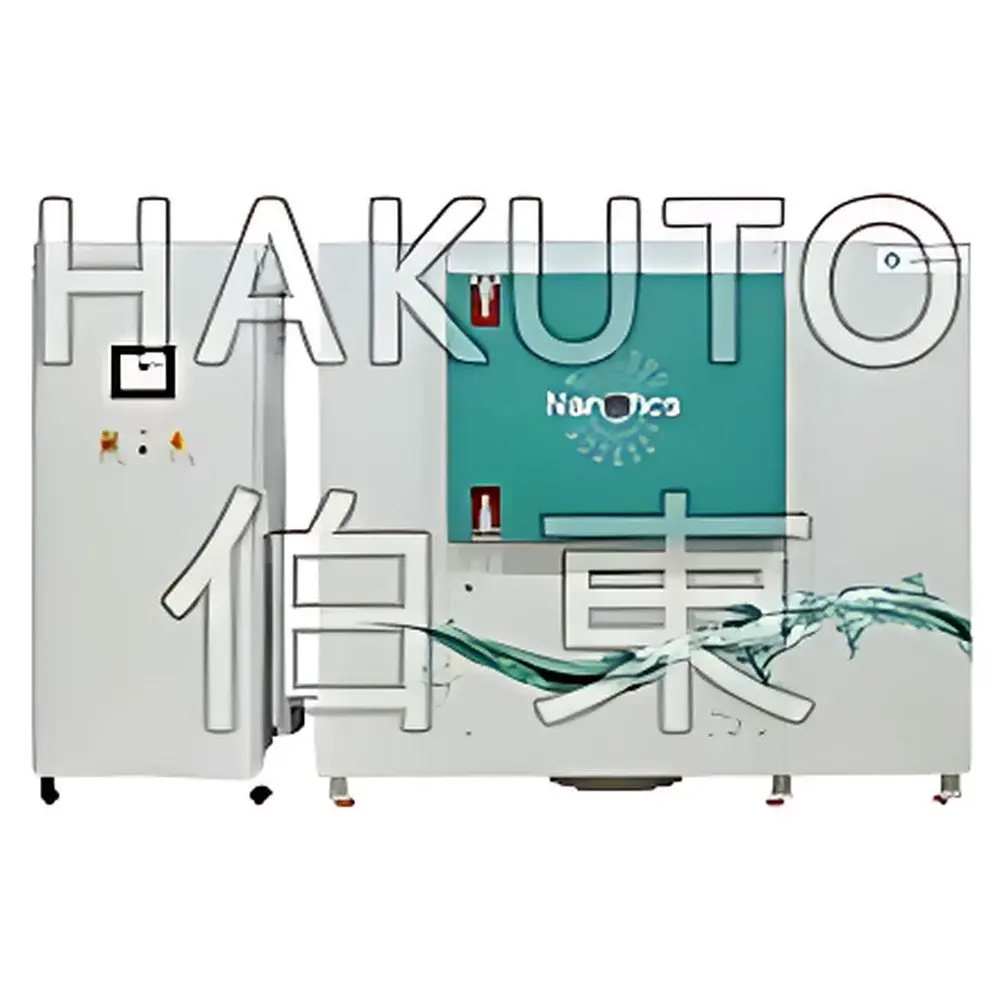
Europlasma CD-1836-Europlasma Low-Pressure Plasma Surface Treater
| Brand | Europlasma |
|---|---|
| Origin | Belgium |
| Model | CD-1836-Europlasma |
| Power | 5 kW |
| Chamber Dimensions | 1600 × 1350 × 850 mm |
| Chamber Volume | 1836 L |
| Chamber Material | Aluminum |
| Process Gases | Oxygen, Argon, and other reactive/inert gases |
| Control System | Fully Automated |
| Equipment Type | Imported Low-Pressure Plasma Surface Treatment System |
| Compliance | Designed for ISO 13485-aligned cleanroom integration and GLP-compliant process documentation |
Overview
The Europlasma CD-1836-Europlasma Low-Pressure Plasma Surface Treater is an industrial-grade vacuum plasma system engineered for precise, uniform surface activation, functionalization, and ultra-thin nanocoating deposition. Operating under controlled low-pressure conditions (typically 0.1–10 Pa), the system generates stable, non-thermal plasma using radiofrequency (RF) or microwave excitation—enabling highly reproducible surface modification without bulk thermal damage. Unlike atmospheric plasma or wet chemical treatments, this system achieves molecular-level control over surface chemistry via plasma polymerization, grafting, or atomic layer deposition (ALD)-compatible precursor injection. Its 1836-liter aluminum chamber supports large-format or high-throughput batch processing of three-dimensional components—including medical devices with complex lumens, flexible electronics, and multi-layered textile assemblies—while maintaining sub-micron coating uniformity across sharp edges, deep cavities, and microstructured surfaces.
Key Features
- 5 kW RF-powered plasma generation with real-time impedance matching for stable discharge across variable load geometries
- Aluminum vacuum chamber (1600 × 1350 × 850 mm) optimized for thermal stability, electromagnetic shielding, and long-term vacuum integrity (base pressure <5 × 10⁻³ Pa)
- Full automation via integrated PLC and HMI interface, supporting recipe-driven operation, cycle logging, and remote diagnostics
- Multi-gas capability: seamless switching between O₂ (for hydrophilic activation), Ar (for physical sputtering pretreatment), N₂, CF₄, and custom monomer vapors (e.g., Nanofics® precursors)
- Patented Nanofics® plasma polymerization platform enabling conformal coatings as thin as 10–100 nm with tunable surface energy (20–72 mN/m)
- PlasmaGuard® halogen-free coating technology compliant with IEC 61249-2-21 and RoHS 3, eliminating PFAS-related regulatory exposure
- Scalable architecture: compatible with optional mass flow controllers, residual gas analyzers (RGA), and in-situ ellipsometry for process validation
Sample Compatibility & Compliance
The CD-1836 accommodates substrates ranging from rigid metallic implants to delicate acoustic transducers, silicone catheters, lithium-ion battery separators, and nonwoven filtration media. Its deep-cavity penetration capability ensures complete surface coverage—even within 5-mm-diameter lumens exceeding 300 mm in length—validated per ASTM F2525 for hydrophobic barrier performance. The system meets mechanical safety requirements per EN 61000-6-2/6-4 and is designed for integration into ISO 13485-certified medical device manufacturing lines. Process records—including pressure profiles, power delivery, gas composition, and cycle timestamps—are automatically archived with audit-trail functionality aligned with FDA 21 CFR Part 11 expectations for electronic records and signatures.
Software & Data Management
The embedded control software provides ISO/IEC 17025-compatible data handling: all operational parameters are timestamped, version-controlled, and exportable in CSV or XML formats. Optional add-ons include Ethernet/IP or OPC UA connectivity for MES/SCADA integration, automated report generation (PDF/HTML), and configurable alarm thresholds with email/SMS notification. For R&D applications, the system supports manual parameter override and script-based sequence programming—facilitating DOE-driven optimization of plasma exposure time, power ramping, and purge cycles.
Applications
- Medical device manufacturing: surface activation of polyurethane catheters prior to adhesive bonding; hydrophilic coating of guidewires per USP biocompatibility screening
- Electronics encapsulation: moisture barrier deposition on MEMS sensors and wearable PCBs targeting IPX7–IPX8 ingress protection
- Battery component engineering: functionalization of separator films to enhance electrolyte wettability and Li⁺ ion transport kinetics
- Textile finishing: durable water repellency (DWR) on technical fabrics without fluorocarbon leaching—validated per AATCC TM193
- Lab-scale formulation development: screening of Nanofics® 10 (halogen-free), Nanofics® 110 (PFOA-free), and Nanofics® 120 (high-performance fluorochemical) precursors under identical plasma conditions
FAQ
What vacuum level is required for stable plasma ignition and sustained operation?
Typical operating range is 0.5–5 Pa, achieved using a two-stage pumping system (rotary vane + turbomolecular pump) with ultimate base pressure ≤5 × 10⁻³ Pa.
Can the system be validated for GMP production environments?
Yes—hardware design supports IQ/OQ/PQ execution; software includes electronic signature, audit trail, and 21 CFR Part 11-compliant user access controls.
Is plasma uniformity verified across the full chamber volume?
Uniformity is confirmed via spatially resolved Langmuir probe mapping and post-treatment contact angle measurements at ≥12 predefined locations per batch.
How does PlasmaGuard® differ from conventional fluorinated coatings?
PlasmaGuard® uses chlorine- and bromine-free precursors yielding thermally stable, non-leaching siloxane- or acrylic-based networks—eliminating halogenated volatile organic compound (HVOC) emissions during curing.
What maintenance intervals are recommended for routine operation?
Chamber cleaning every 200 hours; RF matching network calibration quarterly; turbomolecular pump oil replacement annually or per manufacturer specifications.



