
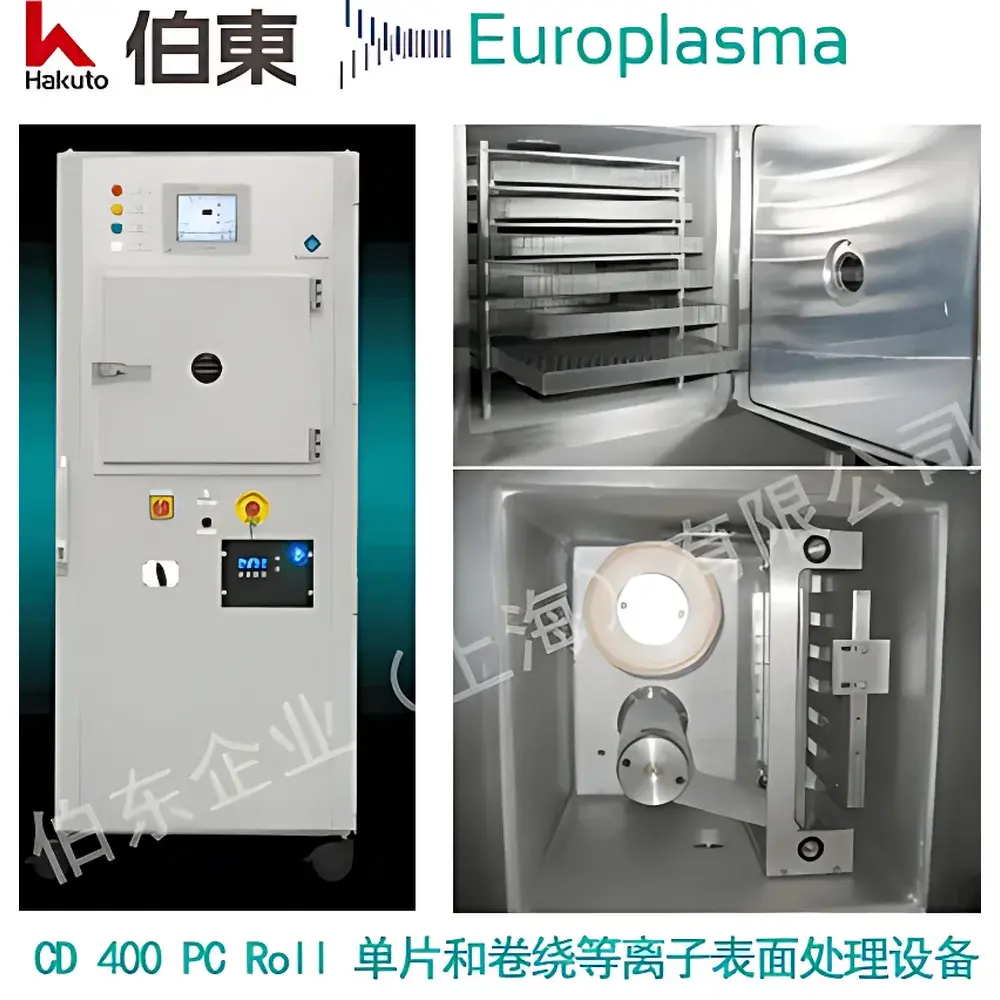
Europlasma CD 400 PC Roll Plasma Surface Treater for Polypropylene (PP) Film Hydrophilization
| Brand | Europlasma |
|---|---|
| Origin | Belgium |
| Model | CD 400 PC Roll |
| Sample Handling | Roll-to-Roll (R2R) |
| Chamber Material | Anodized Aluminum |
| Process Gases | O₂ or N₂O (with optional hydrocarbon co-gas) |
| Control System | Fully Automated PLC-Based Interface |
| Equipment Type | Imported Plasma Surface Treatment System |
| Application Focus | Permanent Hydrophilic Modification of PP and PBT Films |
Overview
The Europlasma CD 400 PC Roll is a laboratory- and pilot-scale roll-to-roll (R2R) atmospheric-pressure plasma surface treatment system engineered for the controlled, dry, and solvent-free functionalization of polymeric films—particularly polypropylene (PP) and polybutylene terephthalate (PBT). Unlike conventional corona or low-pressure plasma systems that induce only transient surface oxidation, the CD 400 PC Roll utilizes precisely tuned reactive gas mixtures—including oxygen (O₂) or nitrous oxide (N₂O) combined with trace hydrocarbon precursors—to graft stable polar functional groups (e.g., –OH, –COOH, C=O) covalently onto the polymer backbone. This results in durable hydrophilicity with measured wettability retention exceeding 60 days under ambient storage conditions—critical for demanding applications such as blood filtration membranes and lithium-ion battery separators where long-term interfacial stability directly impacts device performance and safety.
Key Features
- Roll-to-roll architecture enabling continuous treatment of flexible substrates up to 400 mm web width, compatible with standard film handling infrastructure
- Modular plasma head design with uniform dielectric barrier discharge (DBD) electrode configuration ensuring ±3% process homogeneity across full web width
- Automated PLC-based control system with recipe management, real-time power monitoring, and gas flow regulation (mass flow controllers for O₂/N₂O and auxiliary hydrocarbon injection)
- Anodized aluminum process chamber offering high corrosion resistance, thermal stability, and electromagnetic shielding for repeatable discharge characteristics
- Integrated exhaust and abatement interface compliant with ISO 14644-1 Class 8 cleanroom requirements; no liquid effluents or VOC emissions generated during operation
- Process scalability validated from lab R2R trials to pre-production validation runs—serving as a direct technical bridge to industrial-scale Europlasma production lines
Sample Compatibility & Compliance
The CD 400 PC Roll is optimized for thermoplastic polymer films with melting points above 130 °C, including isotactic PP, random copolymer PP, and PBT. Substrate thickness range: 12–150 µm. Surface energy enhancement from ≤30 mN/m (pristine PP) to ≥72 mN/m post-treatment, verified per ASTM D2578 (dyne solution test) and ISO 8296. All plasma chemistry protocols are fully documented for GLP-compliant process validation. The system meets CE machinery directive 2006/42/EC and electromagnetic compatibility standards EN 61000-6-2/-4. Optional IQ/OQ documentation packages support FDA-regulated environments requiring 21 CFR Part 11–compliant audit trails for critical process parameters.
Software & Data Management
The embedded HMI supports multi-user access levels (operator, engineer, administrator) and stores all treatment logs—including RF power (W), gas composition (%), line speed (m/min), and cumulative exposure time—in timestamped CSV files. Historical data export enables correlation of surface energy metrics (measured offline via contact angle goniometry) with plasma parameters. For regulated labs, optional software add-ons provide electronic signature capability, change control tracking, and automated report generation aligned with ISO/IEC 17025 quality management frameworks.
Applications
- Lithium-ion battery separator functionalization: permanent hydrophilicity improves electrolyte uptake kinetics and reduces interfacial resistance at the anode/cathode interface
- Hemofiltration membrane activation: enhances protein adsorption uniformity and reduces thrombogenic potential in extracorporeal circuits
- Medical packaging film pretreatment: enables reliable ink adhesion and sterilization indicator responsiveness without solvent primers
- Lab-on-film microfluidic substrate preparation: creates patterned hydrophilic/hydrophobic domains via mask-assisted plasma exposure
- Recyclable packaging development: replaces fluorinated wet-chemical coatings in sustainable mono-material laminates
FAQ
What distinguishes Europlasma’s plasma treatment from standard corona systems for PP film?
Corona treatment relies on surface oxidation alone, yielding unstable peroxide species that decay within hours. Europlasma’s multi-gas DBD process incorporates carbon-containing precursors that enable covalent grafting of oxygen-rich functionalities—verified by XPS analysis showing >15 at.% O/C ratio retention after 60-day aging.
Can the CD 400 PC Roll treat non-woven PP substrates?
Yes—provided basis weight remains within 20–120 g/m² and fiber melt point exceeds 140 °C. Porosity and caliper variation must be characterized prior to process optimization.
Is nitrogen (N₂) usable as a process gas?
N₂ is not recommended as a primary gas due to insufficient dissociation energy for effective PP chain scission. O₂ and N₂O are validated for hydrophilic functionalization; N₂ may be used as a carrier or purge gas only.
How is process reproducibility ensured across different operator shifts?
All recipes are locked to user-defined parameter sets with hardware-enforced limits. Full audit logs record operator ID, start/stop timestamps, and deviation alerts for any parameter outside ±5% tolerance band.
Does Europlasma provide application-specific protocol development support?
Yes—Europlasma’s Application Lab in Leuven offers collaborative feasibility studies, including surface characterization (XPS, AFM, contact angle), accelerated aging testing, and wetting dynamics analysis using standardized KOH wicking assays per IEC 62621 Annex B.



