
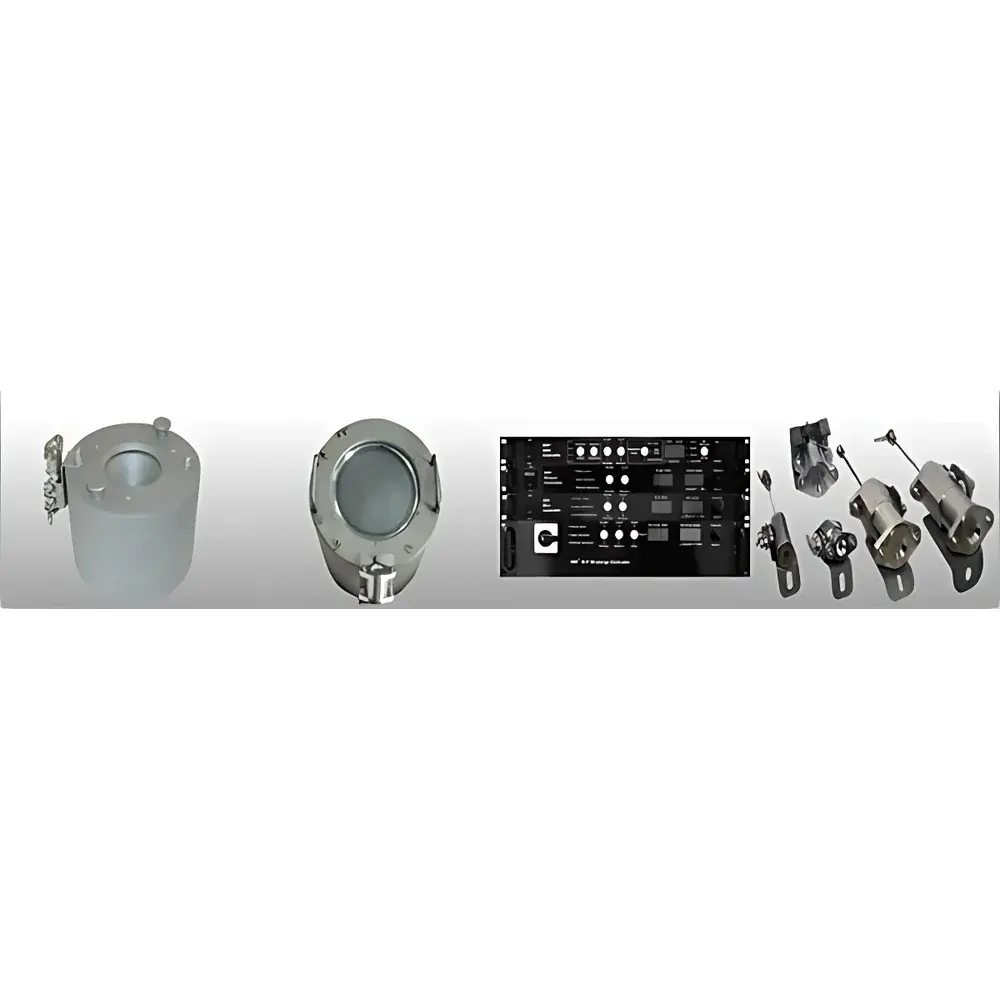
Kaufman & Robinson eH Series Ungridded End-Hall Ion Source
| Brand | Kaufman & Robinson (KRi) |
|---|---|
| Origin | USA |
| Model | eH Series |
| Type | Ungridded End-Hall Ion Source |
| Operating Principle | Magnetron-sustained plasma discharge with axial magnetic field and radial electric field |
| Typical Ion Energy Range | 20–150 eV |
| Max. Beam Current | Up to 2.5 A (dependent on gas, pressure, and geometry) |
| Gas Compatibility | Ar, Xe, O₂, N₂, CF₄, and other process gases |
| Cooling | Water-cooled anode and cathode assembly |
| Mounting Flange | Conflat (CF) 63 or CF 100 standard |
| Compliance | Designed for integration into UHV and HV vacuum systems per ISO 3529-2, ASTM F1875, and SEMI S2/S8 safety guidelines |
Overview
The Kaufman & Robinson eH Series Ungridded End-Hall Ion Source is a robust, magnetically confined plasma-based ion generation system engineered for precision surface modification, thin-film sputter deposition, in-situ substrate cleaning, and low-energy ion-assisted etching in high-vacuum and ultra-high-vacuum environments. Unlike gridded ion sources that rely on electrostatic extraction through perforated electrodes, the eH design employs a self-contained end-Hall configuration: a ring-shaped anode and central thermionic cathode generate a crossed-field (E × B) discharge, sustaining a dense, quasi-neutral plasma plume at the source exit. Ions are accelerated radially outward by the inherent sheath potential—without grid-induced beam divergence or grid erosion—enabling stable, long-lifetime operation with minimal maintenance. The eH source delivers high-current, low-energy ion beams (typically 20–150 eV) ideal for gentle surface activation, stoichiometric control during reactive sputtering, and minimizing subsurface damage in sensitive optical or semiconductor substrates.
Key Features
- Ungridded architecture eliminates grid sputtering, thermal warping, and lifetime-limiting voltage breakdown—ensuring >10,000 hours of continuous operation under optimized conditions
- End-Hall plasma confinement enables stable, uniform ion flux across beam diameters up to 150 mm (with appropriate collimation optics)
- Water-cooled anode and cathode assembly supports sustained power input up to 1.2 kW, maintaining thermal equilibrium during extended duty cycles
- Modular flange interface (standard CF-63 or CF-100) allows direct integration into existing vacuum chambers without custom adapters
- Compatible with dual-gas operation (e.g., Ar/O₂ mixtures) for tunable ion chemistry in reactive ion beam processes
- Low divergence beam profile (< ±8° full angle) facilitates efficient coupling with PTIBeam™ multi-aperture ion lenses for beam shaping and current density homogenization
Sample Compatibility & Compliance
The eH ion source operates effectively with substrates ranging from silicon wafers and fused silica optics to flexible polymer films and metallic foils. Its low-energy beam minimizes atomic displacement and lattice disorder in crystalline materials while enabling controllable surface stoichiometry in oxides and nitrides. All eH variants comply with vacuum compatibility standards per ISO 3529-2 (vacuum system cleanliness), ASTM F1875 (specification for ion sources in thin-film processing), and SEMI S2/S8 (safety guidelines for semiconductor manufacturing equipment). Materials of construction—including oxygen-free copper anodes, thoriated tungsten cathodes, and alumina insulators—are certified for bake-out temperatures up to 150 °C and outgassing rates <1×10⁻⁹ Pa·m³/s·cm² per ASTM E595.
Software & Data Management
KRi’s integrated power supply and controller (Model PS-4000 series) provides closed-loop regulation of discharge current, anode voltage, and cathode heater power via analog and digital I/O (RS-485, Ethernet/IP). Firmware supports time-stamped operational logging compliant with FDA 21 CFR Part 11 requirements when deployed in GMP-regulated environments. Beam current and voltage parameters are traceable to NIST-calibrated shunts and high-voltage dividers, with audit trails retained for ≥12 months. Optional LabVIEW™ and Python SDKs enable synchronization with chamber pressure controllers, mass flow meters, and deposition rate monitors for fully automated process recipes.
Applications
- In-situ pre-deposition substrate cleaning prior to PVD or ALD—removing native oxides and hydrocarbon contamination without substrate heating
- Ion-assisted electron-beam evaporation for enhanced film density and adhesion in optical coatings (e.g., TiO₂/SiO₂ multilayers)
- Low-damage ion milling of TEM cross-sections and MEMS structures
- Surface functionalization of biomedical polymers (e.g., PET, PU) for improved cell adhesion
- Controlled oxidation/nitridation of III–V semiconductor surfaces prior to epitaxial growth
- Spacecraft component testing under simulated LEO atomic oxygen exposure using hyperthermal O⁺ beams
FAQ
What vacuum pressure range is required for stable eH operation?
Optimal performance is achieved between 5×10⁻⁴ and 2×10⁻³ Pa (3.8×10⁻⁶ to 1.5×10⁻⁵ Torr) with argon; lower pressures require increased discharge current to sustain plasma density.
Can the eH source operate with reactive gases such as O₂ or CF₄?
Yes—O₂, N₂, and CF₄ are routinely used; however, extended operation with oxidizing gases requires periodic cathode inspection and optional lanthanum hexaboride (LaB₆) cathode upgrade for enhanced lifetime.
Is beam energy tunable in real time?
Beam energy is primarily determined by the anode-to-cathode potential difference and is adjustable via the power supply’s voltage setpoint; fine tuning within ±5 eV is achievable with active feedback on discharge current stability.
How does the eH source compare to RFICP or KDC gridded sources in terms of beam uniformity?
eH offers superior angular uniformity over large areas (>100 mm diameter) due to its divergent plasma plume geometry, whereas RFICP and KDC sources deliver higher current density but narrower usable beam profiles requiring external collimation.
Does KRi provide OEM integration support for custom vacuum systems?
Yes—KRi offers mechanical interface drawings, electrical schematics, cooling loop specifications, and vacuum compatibility test reports under NDA for qualified OEM partners.






