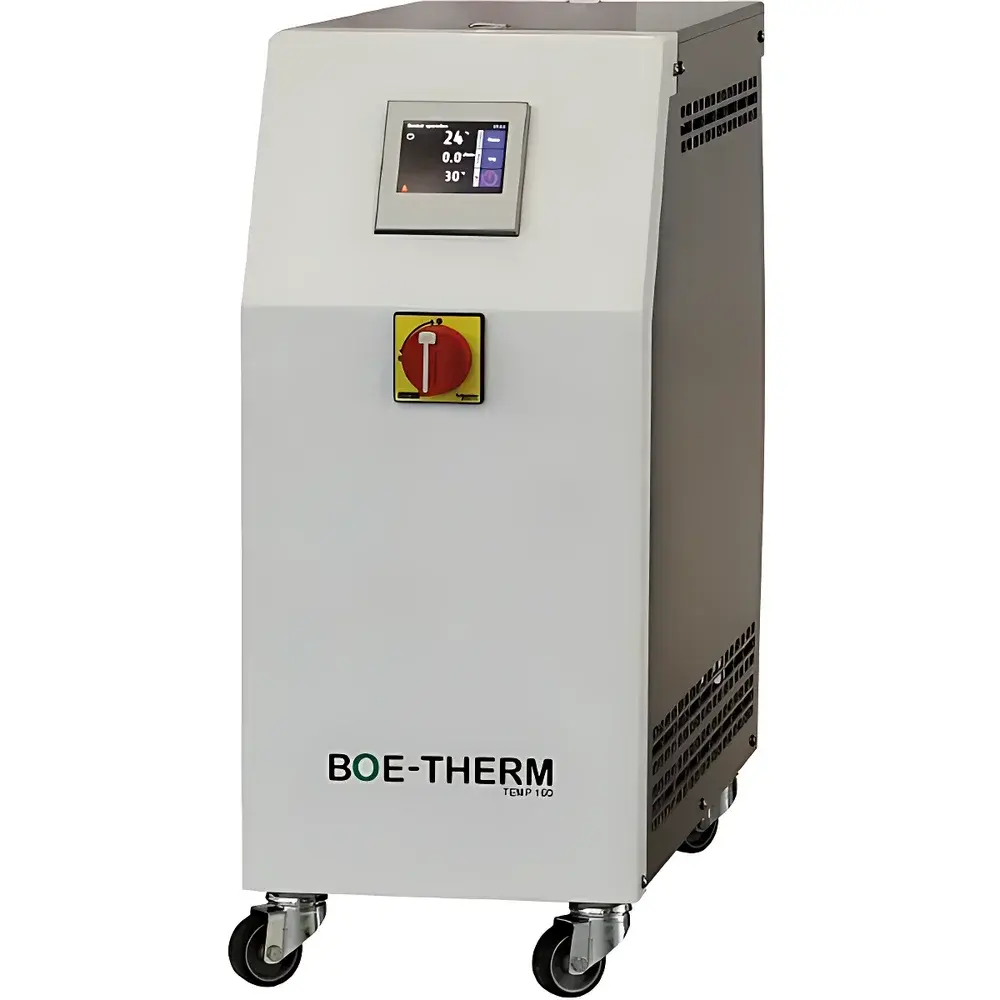
BOE-THERM Temp 150 Industrial Thermal Oil Circulator
| Brand | BOE-THERM |
|---|---|
| Origin | Denmark |
| Model | Temp 150 |
| Max Operating Temperature | 150°C (±0.8°C) |
| Heating Power | 3 kW (expandable to 6 kW / 9 kW) |
| Oil Tank Capacity | 14 L (3 kW) / 19 L (6–9 kW) |
| Pump Pressure | 3.8–4.4 bar (up to 6.0 bar with TM8 pump) |
| Flow Rate | 60–80 L/min |
| Cooling Capacity | 23 kW (standard) / 35 kW (enhanced heat exchanger) |
| Control Interface | 4–20 mA analog input/output, MODBUS RTU, Profibus-DP V1, Ethernet/IP, PROFINET with IRT |
| Safety Certifications | CE (EN 60204-1:2018), ISO 9001:2015, optional ATEX Ex d IIB T4 |
| IP Rating | IP54 (standard control cabinet), IP65 (optional) |
| Noise Level | ≤60 dB(A) |
| Thermal Loss | <5% |
| Power Supply | 3-phase 400 V / 50 Hz or 480 V / 60 Hz (customizable) |
Overview
The BOE-THERM Temp 150 Industrial Thermal Oil Circulator is a precision-engineered temperature control system designed for stable, high-temperature thermal management in demanding industrial and pilot-scale process environments. Utilizing synthetic or mineral-based heat transfer fluids—such as YD-325 (synthetic) or YD-300 (mineral)—the unit maintains tight thermal regulation across a continuous operating range up to 150°C with ±0.8°C stability. Its core architecture integrates a high-efficiency heating module (3 kW base, scalable to 6 kW or 9 kW), a low-noise high-pressure gear pump (TM6/TM7/TM8 series), and a dual-stage cooling system featuring either a standard 12-type or enhanced 16-type heat exchanger. The circulator operates under low-system pressure (<5 bar nominal), minimizing mechanical stress and enhancing long-term reliability while complying with EN 60204-1:2018 safety standards for electrical equipment of machines.
Key Features
- High-precision temperature control: ±0.8°C accuracy at 150°C, enabled by dual PT100 sensor inputs with redundant measurement capability
- Thermally optimized enclosure design achieving <5% thermal loss under steady-state operation
- Low-noise operation (≤60 dB[A]) via vibration-damped mounting and acoustically shielded pump housing
- Modular heating architecture supporting field-upgradable power modules (3 → 6 → 9 kW)
- Intelligent cooling logic: programmable ramp-down profiles with real-time thermal load compensation
- Integrated auto-restart function with configurable delay and safety interlock verification post-power interruption
- Comprehensive alarm system including adjustable temperature deviation threshold (±1°C default), low-oil-level detection with automatic top-up compensation, and pump failure monitoring
- Robust industrial connectivity: native support for MODBUS RTU, Profibus-DP V1, Ethernet/IP, and PROFINET with IRT synchronization for deterministic cycle times
Sample Compatibility & Compliance
The Temp 150 is compatible with a wide range of heat transfer media approved for continuous service up to 150°C, including DIN 51522-compliant synthetic oils (e.g., YD-325) and ISO 6743-12-classified mineral oils (e.g., YD-300). Its fluid circuitry meets ASME B31.1 and PED 2014/68/EU requirements for pressurized thermal systems. All electrical components carry CE marking per EN 60204-1:2018, and the system adheres to ISO 9001:2015 quality management protocols throughout manufacturing and calibration. Optional ATEX-certified variants (Ex d IIB T4) are available for Zone 1 hazardous area deployment. The control cabinet conforms to IP54 ingress protection; IP65-rated enclosures are offered for washdown or high-humidity environments.
Software & Data Management
The onboard controller provides a localized HMI with intuitive navigation and real-time parameter visualization—including temperature setpoint, actual bath temperature, flow rate, pump pressure, and cumulative runtime (recorded to 0.1-hour resolution). All operational events—including alarms, manual overrides, and mode transitions—are timestamped and stored in non-volatile memory for GLP/GMP-aligned audit trails. Analog 4–20 mA interfaces allow seamless integration into DCS or SCADA platforms for centralized supervision. Digital communication protocols support full parameter read/write access, alarm acknowledgment, and firmware update capabilities via secure industrial networks. Data export is supported via USB or Ethernet for CSV-formatted logs compliant with FDA 21 CFR Part 11 requirements when paired with validated software environments.
Applications
The Temp 150 serves critical roles in chemical synthesis reactors, polymerization pilot lines, pharmaceutical drying ovens, composite material curing presses, and analytical instrument thermal baths (e.g., HPLC column ovens, rheometer temperature jackets). Its stable thermal output supports ASTM D341 viscosity-temperature correlation studies, ISO 2555 thermal conductivity validation, and USP thermal stability testing protocols. The system’s low-pressure, high-flow performance makes it especially suitable for jacketed vessel temperature control where rapid thermal response and minimal thermal lag are essential—such as in batch reaction calorimetry or crystallization process development.
FAQ
What is the maximum allowable operating temperature and associated accuracy specification?
The Temp 150 is rated for continuous operation up to 150°C with a typical temperature stability of ±0.8°C under steady-state conditions.
Can the unit be integrated into an existing PLC-controlled production line?
Yes—native support for MODBUS RTU, Profibus-DP V1, Ethernet/IP, and PROFINET with IRT ensures deterministic, low-latency integration into major industrial automation architectures.
Is remote diagnostics and firmware updates supported?
Firmware updates and diagnostic data retrieval are supported via Ethernet interface using vendor-provided configuration tools compliant with IEC 62443 cybersecurity guidelines.
What certifications are included as standard, and which are optional?
CE (EN 60204-1:2018) and ISO 9001:2015 are standard; ATEX Ex d IIB T4 certification and IP65 enclosure rating are optional configurations.
How does the intelligent cooling function operate during process shutdown?
The system executes user-defined cooling curves based on real-time thermal mass estimation, dynamically adjusting coolant flow and heater duty to prevent thermal shock and ensure uniform cooldown rates across connected equipment.