
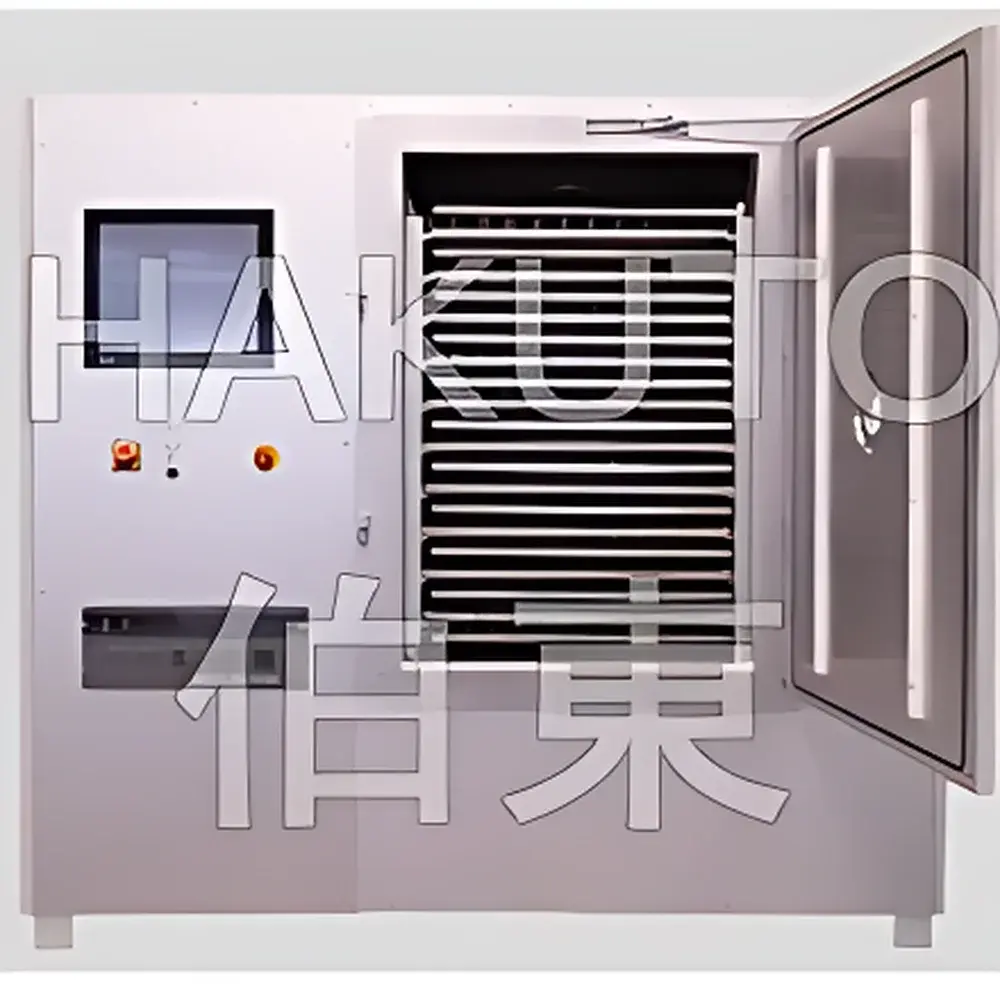
Europlasma CD1000 Low-Pressure Plasma Surface Treater
| Brand | Europlasma |
|---|---|
| Origin | Belgium |
| Model | CD1000 |
| RF Frequency | 3.7 MHz |
| Power | 3.7 kW |
| Chamber Dimensions | 1000 × 700 × 700 mm |
| Chamber Volume | 490 L |
| Chamber Material | Anodized Aluminum |
| Operating Gases | Multi-gas capability (O₂, Ar, N₂, CF₄, NH₃, etc.) |
| Control System | PLC-based with 17″ HMI touchscreen |
| Vacuum System | Dry scroll pump assembly with Pirani gauge |
| Gas Delivery | Up to 5 MFC-controlled inlets (¼″ SS tubing, 1 bar inlet pressure) |
| Exhaust | 28 mm port with optional VOC abatement |
| Safety Compliance | CE-marked, emergency stop, overtemperature lockout, vacuum interlock |
Overview
The Europlasma CD1000 is a low-pressure, radio-frequency (RF) plasma surface treatment system engineered for high-reproducibility functionalization of industrial and laboratory-scale substrates. Operating at 3.7 MHz under controlled vacuum conditions (typically 0.1–10 Pa), the system generates non-thermal plasma via capacitive coupling between parallel aluminum electrodes. This enables precise, solvent-free surface modification—without bulk heating—through physical sputtering, ion bombardment, and reactive species generation (e.g., atomic oxygen, nitrogen radicals, or fluorocarbon fragments). Unlike atmospheric plasma systems, the CD1000’s vacuum environment ensures uniform energy distribution, eliminates ambient contamination, and supports multi-step gas-switching protocols critical for sequential cleaning, activation, and coating. Its 490 L anodized aluminum chamber accommodates large-format assemblies—including fully populated PCBs, medical catheters, wearable electronics housings, and textile rolls—making it suitable for both R&D validation and pre-production process qualification.
Key Features
- Robust anodized aluminum chamber (1000 × 700 × 700 mm) with integrated viewport and pneumatic door sealing for rapid cycle times and long-term vacuum integrity.
- Modular RF generator (3.7 kW, 3.7 MHz) with impedance matching network optimized for stable plasma ignition across variable load geometries and gas compositions.
- PLC-based control architecture featuring a 17″ industrial touchscreen HMI, supporting recipe-driven operation, real-time parameter logging, and password-protected user access levels.
- Multi-gas delivery system with up to five mass flow controllers (MFCs), enabling precise blending of O₂, Ar, N₂, CF₄, NH₃, or custom mixtures for tailored surface chemistry.
- Integrated dry scroll vacuum pump train with Pirani pressure monitoring, automatic pressure ramping, and programmable venting sequences to minimize process variability.
- Comprehensive safety subsystems: hardware-enforced emergency stop, temperature-sensing interlocks on chamber walls and RF components, vacuum-loss shutdown, and CE-compliant electrical architecture.
Sample Compatibility & Compliance
The CD1000 treats substrates ranging from silicon wafers and polymer films to assembled PCBs, biomedical devices, and nonwoven textiles. Its large chamber volume and standard 3–5 tray configuration (858 × 672 mm per tray) support batch processing of heterogeneous parts without repositioning. Surface outcomes are traceable and repeatable per ISO 13485 and IEC 61000-4-2 guidelines. For regulated environments, the system supports audit-ready data export (CSV/Excel), timestamped event logs, and optional 21 CFR Part 11–compliant electronic signatures when interfaced with validated ERP or MES platforms (e.g., SAP QM, Siemens Opcenter). All plasma processes—whether Nanofics® hydrophilic activation (WCA 120°)—are documented with full parameter traceability, including RF power, pressure history, gas composition, exposure duration, and chamber temperature profiles.
Software & Data Management
The embedded PLC firmware records all operational parameters at 1 Hz resolution: chamber pressure, RF forward/reflected power, gas flow rates, stage temperature, and vacuum pump status. Data is stored locally on an industrial SSD and exportable via USB or Ethernet to external LIMS or quality management systems. The HMI allows creation and versioning of process recipes—including multi-stage sequences (e.g., O₂ clean → Ar sputter → NH₃ functionalization), conditional logic (e.g., “hold pressure at 2.5 Pa until RF ignition confirmed”), and alarm thresholds. Optional OPC UA integration enables bidirectional communication with SCADA or factory automation layers. Audit trails include operator ID, timestamp, parameter deviations, and manual override events—fully aligned with GLP and GMP documentation requirements.
Applications
- PCB Manufacturing: Pre-lamination cleaning of inner layers; activation of high-aspect-ratio microvias and laser-drilled blind/buried vias; surface conditioning of PTFE-based flex circuits where chemical etching is ineffective; halogen-free moisture barrier deposition using PlasmaGuard® technology.
- Biomedical Devices: Hydrophilic activation of silicone catheters and polyurethane tubing (WCA < 10°); covalent immobilization of bioactive peptides on cell culture flasks; removal of mold-release agents from injection-molded housings for wearables.
- Energy Materials: Surface oxidation of lithium-ion battery separator films to enhance electrolyte wettability; functionalization of graphene-coated current collectors for improved adhesion.
- Functional Textiles: Durable water repellency (DWR) on outdoor apparel fabrics; antimicrobial surface grafting on surgical gowns via nitrogen-plasma-initiated polymerization.
FAQ
What vacuum level does the CD1000 achieve, and how is it monitored?
The system uses a calibrated Pirani gauge to measure pressure continuously across the 0.1–100 Pa range, with closed-loop control ensuring stable operation at user-defined setpoints during plasma ignition and processing.
Can the CD1000 perform both cleaning and coating in a single run?
Yes—by sequencing gas inlets and RF power modulation, the system executes multi-step processes such as O₂-based decontamination followed by C₄F₈-based fluorocarbon deposition without breaking vacuum.
Is remote diagnostics supported?
Standard Ethernet connectivity enables secure remote monitoring via VNC or proprietary diagnostic tools; firmware updates and log retrieval are performed over TLS-encrypted channels.
What materials are incompatible with low-pressure plasma treatment?
Highly volatile organics (e.g., uncured resins, certain plasticizers), low-melting-point thermoplastics (< 80°C), and some elastomers may undergo unintended mass loss or crosslinking—preliminary compatibility testing is recommended.
How is process validation performed for regulated industries?
Validation packages include IQ/OQ documentation templates, mapping reports (temperature, plasma density), and protocol templates aligned with ASTM F2624 (for medical device surface modification) and IPC-CC-830B (for conformal coating adhesion enhancement).



