
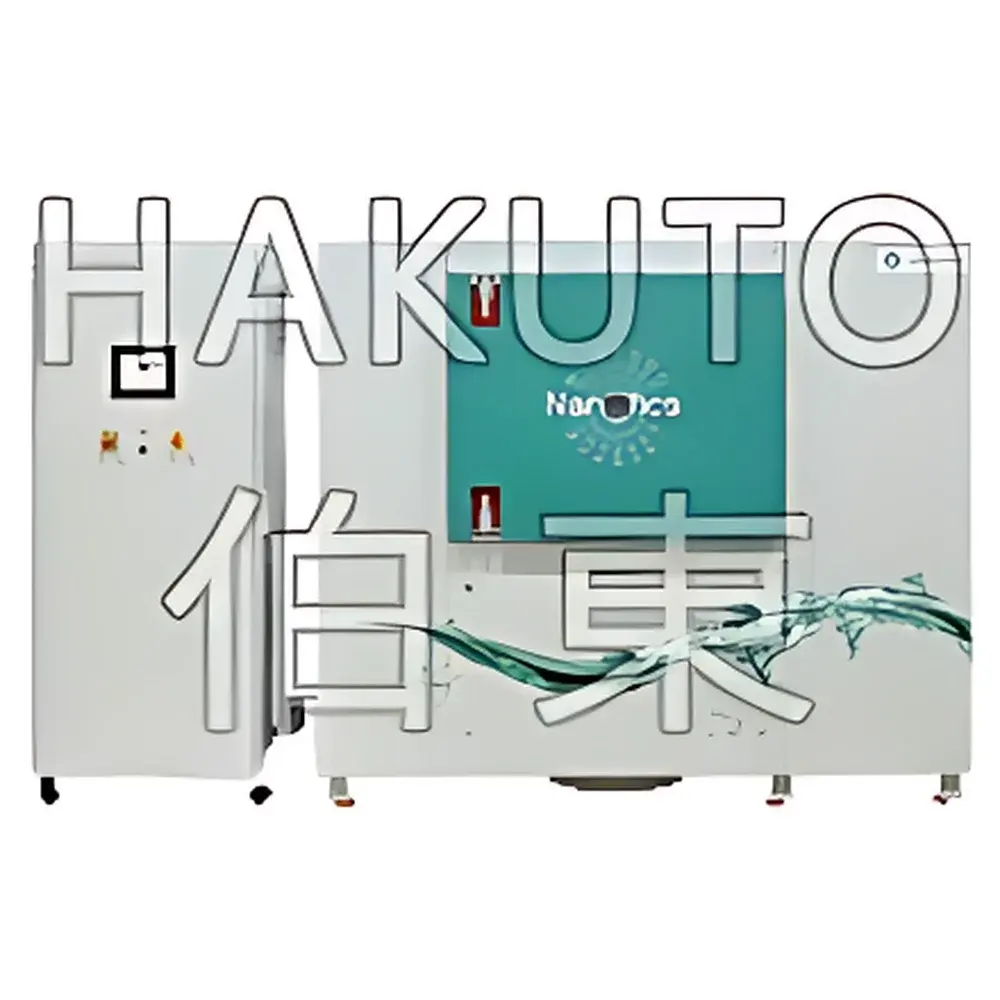
Europlasma CD 600 PLC Low-Pressure Plasma Surface Treater
| Brand | Europlasma |
|---|---|
| Origin | Belgium |
| Model | CD 600 PLC |
| RF Frequency | 50 Hz |
| Power Supply | 380 V AC, 3-phase, 40 A |
| Chamber Dimensions | 600 × 600 × 600 mm |
| Chamber Volume | 216 L |
| Chamber Material | Anodized Aluminum |
| Control System | PLC-based with 17″ Touchscreen HMI |
| Vacuum System | Dry Scroll Pump, 480 m³/h Pumping Speed |
| Vacuum Measurement | Dual Pirani Gauges |
| Gas Inlet | 1/4″ (6.45 mm) port with Mass Flow Controller (MFC), 1 bar max inlet pressure |
| Exhaust Port | 28 mm diameter |
| Safety Features | Emergency Stop, Vacuum Interlock, Overtemperature Protection, CE Certified |
| Compliance | Fully CE-marked for industrial laboratory use under EU Machinery Directive 2006/42/EC and EMC Directive 2014/30/EU |
Overview
The Europlasma CD 600 PLC is a fully integrated low-pressure plasma surface treatment system engineered for precision surface functionalization in R&D and pilot-scale production environments. Operating under controlled vacuum conditions (typically 0.1–10 Pa), the system utilizes radiofrequency (RF) energy at 50 Hz to generate stable, non-thermal plasma discharges within an aluminum process chamber. This enables reproducible, solvent-free surface modification—including cleaning, activation, etching, and thin-film deposition—without thermal damage to heat-sensitive substrates. Unlike atmospheric plasma systems, low-pressure operation ensures uniform plasma distribution, high process repeatability, and compatibility with complex 3D geometries and porous materials. The CD 600 PLC is designed for integration into GLP-compliant laboratories and ISO 13485-certified medical device manufacturing workflows, where traceable, validated surface treatments are required for adhesion promotion, biocompatibility enhancement, or barrier layer formation.
Key Features
- 216-liter anodized aluminum chamber with internal dimensions of 600 × 600 × 600 mm—optimized for batch processing of medium-to-large components including wearable electronics housings, PCB assemblies, and medical tubing bundles.
- PLC-based control architecture with a 17-inch industrial touchscreen HMI, supporting full automation of vacuum sequencing, gas dosing, RF power ramping, and process timing.
- Dual Pirani vacuum gauges provide real-time pressure monitoring across roughing and process phases; integrated vacuum interlocks prevent RF ignition outside safe pressure windows.
- Dry scroll vacuum pump system (480 m³/h pumping speed) eliminates oil contamination risks and supports rapid chamber cycling—typical pump-down time to operating pressure is < 90 seconds.
- Single-gas MFC inlet (1/4″ BSP, max 1 bar) enables precise delivery of argon, oxygen, nitrogen, or custom gas mixtures; exhaust path includes passive venting via 28 mm port.
- Comprehensive safety suite: hardware-triggered emergency stop, temperature-sensing thermal cutoffs, vacuum-loss lockout, and password-protected operator access levels.
- CE-certified per Machinery Directive 2006/42/EC and EMC Directive 2014/30/EU—documentation package includes Declaration of Conformity, risk assessment, and wiring schematics for audit readiness.
Sample Compatibility & Compliance
The CD 600 PLC accommodates diverse substrate classes without requiring fixturing modifications: rigid plastics (PC, ABS, PEEK), elastomers (silicone, TPE), metals (aluminum, stainless steel), ceramics, glass, and nonwovens. Standard sample trays (552 × 522 × 40 mm, five included) support stacked or nested loading. For regulated applications—including ISO 10993 biocompatibility testing and FDA-registered device manufacturing—the system supports full process validation (IQ/OQ/PQ) and can be configured with optional audit-trail logging compliant with 21 CFR Part 11 requirements. All plasma chemistries (e.g., O₂ for hydrophilization, CF₄ for fluorination, or Nanofics®/PlasmaGuard® formulations) are documented per ASTM D726-18 (surface energy measurement) and IEC 61000-4-3 (EMC immunity).
Software & Data Management
Process parameters—including chamber pressure, RF forward/reflected power, gas flow rate, treatment duration, and stage temperature—are logged at 1 Hz resolution and stored locally on the embedded controller. Data export is supported via USB or Ethernet (Modbus TCP) for integration with LIMS or MES platforms. The HMI interface allows creation and recall of up to 99 user-defined recipes, each with independent setpoints, safety limits, and alarm thresholds. Optional software add-ons provide CSV report generation, SPC charting, and electronic signature capability for GMP-aligned documentation.
Applications
- Medical device manufacturing: surface activation of silicone catheters prior to adhesive bonding; hydrophilic coating of diagnostic microfluidic chips; plasma cleaning of surgical instrument housings.
- Electronics assembly: removal of organic residues from flexible PCBs; enhancement of solder mask wettability; pre-treatment of Bluetooth earbud enclosures for conformal coating adhesion.
- Energy storage: functionalization of lithium-ion battery separator films to improve electrolyte uptake and interfacial stability.
- Textiles & filtration: durable hydrophobic finishing of outdoor apparel membranes; plasma grafting of antimicrobial agents onto melt-blown nonwovens.
- Automotive sensors: cleaning and activation of plastic lens housings prior to AR coating deposition.
FAQ
What vacuum level is required for stable plasma ignition?
Stable plasma discharge is achieved between 0.1 and 10 Pa; the dual Pirani gauges maintain closed-loop control within ±0.2 Pa during active treatment.
Can the system operate with reactive gas mixtures (e.g., O₂ + CF₄)?
Yes—though the standard configuration includes one MFC, optional dual-MFC retrofit kits support two independent gas lines for binary chemistry processes.
Is remote monitoring supported?
Ethernet connectivity enables real-time parameter viewing and recipe upload via standard web browser; no proprietary client software is required.
What maintenance intervals are recommended?
Dry pump oil change every 3,000 operating hours; RF matching network inspection annually; chamber cleaning after every 200 cycles or when visual residue accumulation exceeds 5 µm.
Does Europlasma provide installation qualification (IQ) documentation?
Yes—factory-issued IQ templates, utility specifications, and site preparation checklists are supplied with each unit; on-site IQ support available upon request.



