
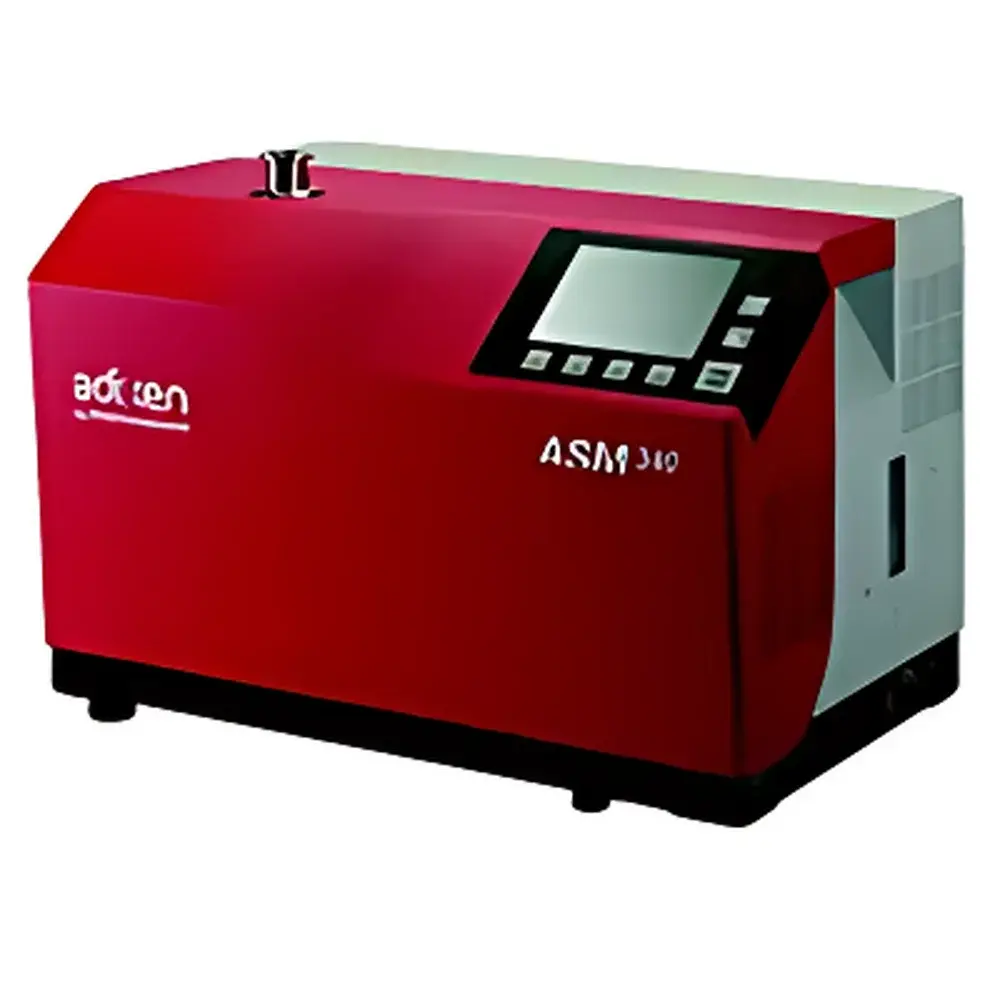
Pfeiffer ASM 340 D Helium Mass Spectrometer Leak Detector
| Brand | Pfeiffer Vacuum |
|---|---|
| Origin | Germany |
| Model | ASM 340 D |
| Minimum Detectable Leak Rate (Vacuum Mode) | 5 × 10⁻¹³ Pa·m³/s |
| Minimum Detectable Leak Rate (Sniffer Mode) | 5 × 10⁻¹⁰ Pa·m³/s |
| Helium Pumping Speed | 2.5 L/s |
| Forepump Type | Oil-Free Dry Scroll Pump |
| Forepump Speed | 3.4 m³/h |
| Max Inlet Pressure | 25 hPa |
| Detection Gases | ⁴He, ³He, H₂ |
| Warm-up Time | ~3 min |
| Dimensions & Weight | 45 kg |
| Data Storage | Integrated SD Card |
| User Interface | Modular, Removable and Customizable |
Overview
The Pfeiffer ASM 340 D Helium Mass Spectrometer Leak Detector is a high-sensitivity, oil-free analytical instrument engineered for quantitative leak detection in ultra-high vacuum (UHV) systems, semiconductor fabrication tools, aerospace components, medical device packaging, and research-grade vacuum chambers. Operating on the principle of magnetic sector mass spectrometry, the ASM 340 D selectively ionizes and separates helium atoms (mass-to-charge ratio m/z = 4) from background gas species using a stable 90° magnetic field. Its quadrupole-free design ensures long-term mass resolution stability and minimal drift over extended operation cycles. Unlike conventional thermal conductivity or pressure-rise methods, helium mass spectrometry provides absolute quantification of leak rates in SI units (Pa·m³/s), enabling trace-level integrity verification compliant with ISO 10648-2, ASTM E493, and SEMI F27 standards.
Key Features
- Oil-free dry scroll forepump (3.4 m³/h) eliminates hydrocarbon contamination risks—critical for cleanroom environments and UHV applications requiring residual gas analysis.
- Helium-specific pumping speed of 2.5 L/s at the analyzer inlet ensures rapid response and high signal-to-noise ratio during dynamic testing.
- Dual-mode operation: vacuum mode (sensitivity down to 5 × 10⁻¹³ Pa·m³/s) for chamber-integrated testing; sniffer (probe) mode (5 × 10⁻¹⁰ Pa·m³/s) for localized leak localization on pressurized components.
- Modular, removable front-panel interface supports configuration flexibility—ideal for integration into automated test stations or glovebox-mounted setups.
- Integrated SD card slot enables standalone data logging with timestamped leak rate records, operator ID tagging, and CSV export for audit-ready reporting.
- Support for multiple detection gases (⁴He, ³He, H₂) allows method validation cross-checking and compatibility with hydrogen-based tracer gas protocols per ISO 9934-3.
Sample Compatibility & Compliance
The ASM 340 D is designed for use with metallic, ceramic, and glass vacuum vessels operating from atmospheric pressure up to 10⁻⁹ mbar base pressure. It accommodates standard CF, KF, and ISO-F flanged connections and interfaces seamlessly with Pfeiffer’s HiPace turbomolecular pumps and VACUUUBRAND dry backing pumps. All firmware and calibration routines comply with GLP/GMP documentation requirements. The instrument supports 21 CFR Part 11–compliant electronic signatures when paired with validated laboratory information management systems (LIMS). Calibration traceability follows DIN EN ISO/IEC 17025 via factory-certified reference leaks (NIST-traceable), and routine performance verification adheres to ASTM E1512 Annex A1 procedures.
Software & Data Management
The ASM 340 D operates without external PC dependency but supports optional USB or Ethernet connectivity for remote control via Pfeiffer’s TPG300-compatible software suite. Logged data includes real-time leak rate curves, spectral background profiles, pump-down timelines, and alarm-triggered snapshots. SD card exports retain full metadata—including system temperature, ion source emission current, and filament usage hours—for retrospective root-cause analysis. Audit trails record all parameter changes, user logins, and calibration events with immutable timestamps. Export formats include .csv and .xml for direct import into statistical process control (SPC) platforms or enterprise quality management systems (QMS).
Applications
- Leak integrity validation of hermetically sealed MEMS sensors, implantable medical devices, and lithium-ion battery enclosures.
- In-line leak testing of semiconductor process chambers prior to installation in cleanroom fabs.
- Commissioning and maintenance of synchrotron beamline vacuum systems and cryogenic transfer lines.
- Qualification of fusion reactor first-wall components under simulated operational thermal cycling.
- Verification of weld integrity in pharmaceutical lyophilizer chambers per USP guidelines.
- Research applications requiring isotopic discrimination—e.g., deuterium/helium co-detection in plasma-facing material studies.
FAQ
What is the warm-up time required before achieving full sensitivity?
The ASM 340 D achieves operational readiness in approximately 3 minutes after power-on, with full specified sensitivity attained within 5 minutes under ambient conditions (20–25 °C, <60% RH).
Can the instrument detect gases other than helium?
Yes—it supports detection of ⁴He, ³He, and H₂ through configurable mass filter settings; however, helium remains the primary tracer due to its inertness, low atmospheric concentration (~5 ppm), and optimal mass separation characteristics.
Is the SD card data export compatible with FDA 21 CFR Part 11 requirements?
Raw data files are exportable in unalterable formats; full Part 11 compliance requires integration with a validated QMS platform that enforces electronic signature workflows, audit trail retention, and role-based access controls.
Does the ASM 340 D require annual recalibration?
While no mandatory annual recalibration is stipulated, Pfeiffer recommends biannual verification using certified reference leaks and quarterly functional checks per ISO 17025-accredited internal procedures.
How is oil-free operation maintained across the entire vacuum path?
The system employs a dry scroll forepump and a metal-sealed turbomolecular pump—eliminating all elastomer seals and hydrocarbon-bearing components upstream of the mass analyzer.






