
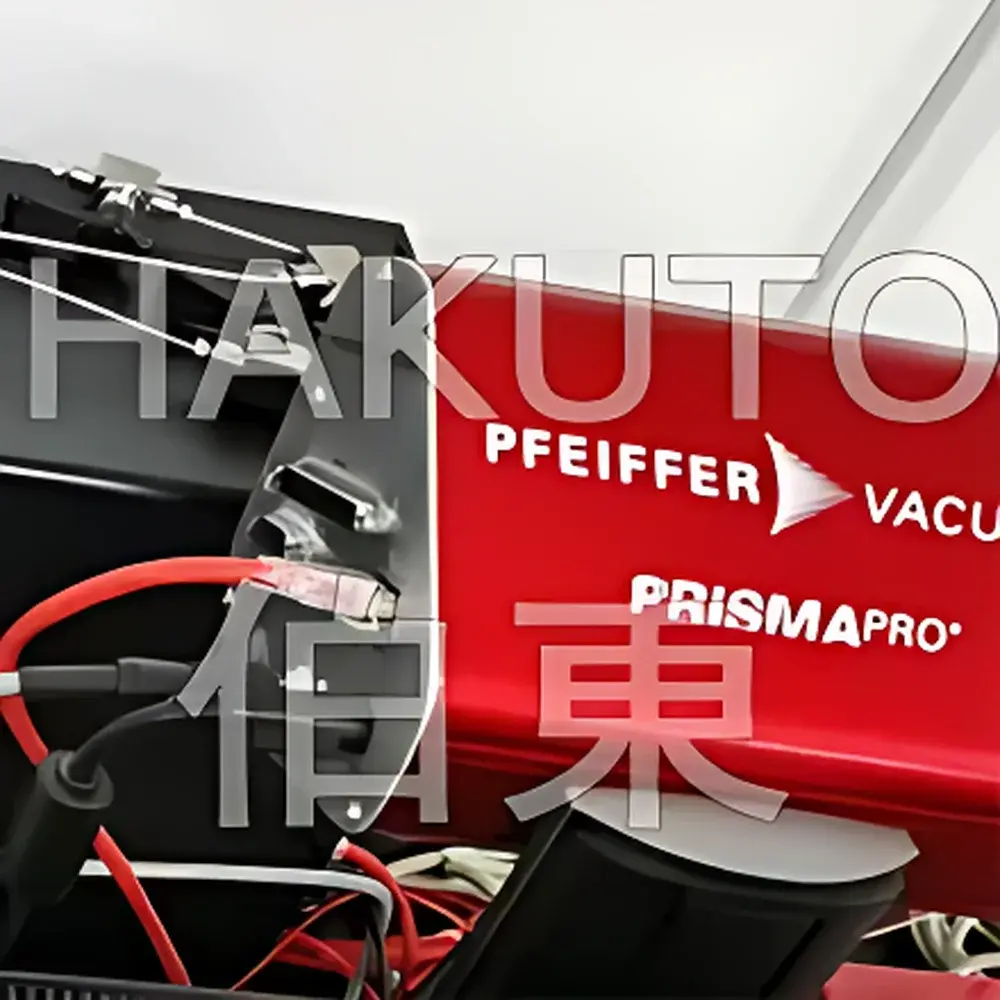
Pfeiffer Vacuum QMG 250 M1 Residual Gas Analyzer for In Situ Electrochemical Reaction Monitoring
| Brand | Pfeiffer Vacuum |
|---|---|
| Origin | Germany |
| Model | QMG 250 M1 |
| Detection Principle | Quadrupole Mass Spectrometry (QMS) |
| Configuration Type | Benchtop Modular System |
| Mass Range | 1–300 u |
| Detection Limit | <1×10⁻¹⁴ mbar (typical for H₂) |
| Response Time | ≤1 s (for major species under optimized inlet conditions) |
| Repeatability | ±0.5% RSD for H₂, O₂, CO₂ at stable vacuum and temperature |
| Operating Vacuum Range | 1×10⁻⁹ – 1×10⁻³ mbar (with turbomolecular pumping) |
| Interface | Capillary Inlet (standard), optional heated transfer line |
| Compliance | CE, RoHS, ISO 9001 manufacturing environment |
| Software | PV MassSpec v3.x (supports ASTM E1946-22 data reporting templates, GLP-compliant audit trail, 21 CFR Part 11 optional module) |
Overview
The Pfeiffer Vacuum QMG 250 M1 Residual Gas Analyzer is a high-sensitivity, benchtop quadrupole mass spectrometer engineered for real-time, in situ monitoring of gaseous species evolved during electrochemical processes—particularly lithium-ion battery cycling. Unlike electrochemical gas sensors based on amperometric or catalytic principles, the QMG 250 employs mass-resolved detection via ion separation in a radiofrequency (RF) quadrupole field, enabling unambiguous identification and quantification of multiple volatile species—including H₂, CO, CO₂, O₂, N₂, C₂H₄, CH₄, and HF—within a single acquisition cycle. Its operational vacuum range (1×10⁻⁹ to 1×10⁻³ mbar) ensures compatibility with ultra-high-vacuum (UHV) sample chambers used in controlled-environment battery testing cells. The system is not an electrochemical sensor per se; rather, it functions as a vacuum-compatible analytical endpoint that interfaces directly with sealed or differential-pumping-equipped electrochemical reactors, delivering time-resolved compositional data essential for mechanistic studies of SEI formation, electrolyte decomposition, and cathode gas evolution.
Key Features
- Quadrupole mass analyzer with 1–300 u mass range and <1×10⁻¹⁴ mbar partial pressure detection limit for light gases (e.g., H₂)
- Modular architecture: integrates seamlessly with Pfeiffer’s HiCube 80 turbomolecular pump, PKR 251 full-range vacuum gauge, and custom four-way cross chamber
- Capillary direct-inlet configuration with bakeable stainless-steel path; optional heated transfer line (up to 200 °C) minimizes condensation of polar volatiles
- Real-time response ≤1 second for dominant species under stable vacuum and thermal equilibrium conditions
- Repeatability of ±0.5% RSD for H₂, O₂, and CO₂—validated across >100 consecutive injections at constant pressure and temperature
- Robust RF electronics with digital signal processing, eliminating analog drift and enabling long-term baseline stability
Sample Compatibility & Compliance
The QMG 250 M1 is compatible with both static and dynamic gas sampling from electrochemical half-cells, pouch-type battery test fixtures, and glovebox-integrated reaction chambers. It supports quantitative analysis of gases evolved during charge/discharge cycles of NMC, LFP, LCO, and silicon-anode systems—without interference from background water vapor or hydrocarbon contamination when operated under UHV conditions (<1×10⁻⁴ mbar). The system complies with CE marking requirements and is manufactured under ISO 9001-certified quality management protocols. Data acquisition and reporting align with ASTM E1946-22 (“Standard Guide for Mass Spectrometry Data Reporting in Materials Research”) and supports optional 21 CFR Part 11 compliance modules for regulated battery development labs operating under GLP/GMP frameworks.
Software & Data Management
PV MassSpec v3.x provides intuitive instrument control, spectral acquisition, peak integration, and multi-component quantification using calibrated sensitivity factors. The software includes built-in libraries for common battery-related gases (including isotopic variants of CO₂ and H₂O), customizable time-segmented acquisition profiles, and export formats compatible with MATLAB, Python (via .csv/.txt), and commercial battery modeling platforms (e.g., COMSOL Multiphysics® coupling via ASCII output). Audit trails record all parameter changes, calibration events, and user logins—essential for traceability in academic publications and industrial R&D documentation.
Applications
- In situ tracking of H₂ evolution during overcharge or low-voltage discharge in silicon-dominant anodes
- Quantifying CO₂ and CO release associated with carbonate solvent oxidation at high-voltage cathodes (>4.3 V vs. Li/Li⁺)
- Distinguishing thermal runaway precursors (e.g., C₂H₄ onset) from normal cycling byproducts
- Correlating gas evolution kinetics with differential voltage-capacity (dV/dQ) fingerprints to identify degradation modes
- Validating solid-electrolyte interphase (SEI) stability under varying electrolyte formulations and current densities
FAQ
Is the QMG 250 M1 suitable for online, continuous monitoring during battery cycling?
Yes—when integrated with a capillary inlet and stabilized vacuum environment (<1×10⁻⁴ mbar), it delivers sub-second temporal resolution for major gases, enabling synchronization with potentiostat data streams.
Does the system require carrier gas or calibration standards for quantification?
Quantitative analysis relies on pre-installed sensitivity factors derived from certified gas mixtures; absolute calibration is recommended annually or after major maintenance.
Can it detect hydrogen fluoride (HF) and other corrosive electrolyte decomposition products?
Yes—HF (m/z = 20) is reliably detected above 5×10⁻¹³ mbar partial pressure; nickel-alloy ion source and detector components ensure extended service life under corrosive exposure.
What vacuum integrity safeguards prevent damage to the quadrupole during operation?
The PV MassSpec software enforces interlock logic: QMS operation is disabled if PKR 251 reads pressure >1×10⁻⁴ mbar, protecting the filament and mass filter from ion-source contamination and arcing.
How does modular configuration reduce total cost of ownership compared to turnkey systems?
By selecting only required components (e.g., HiCube 80 + PKR 251 + QMG 250 M1), labs avoid over-specification—achieving ~45% lower capital expenditure while retaining full analytical capability for battery gas profiling.
Related Products







