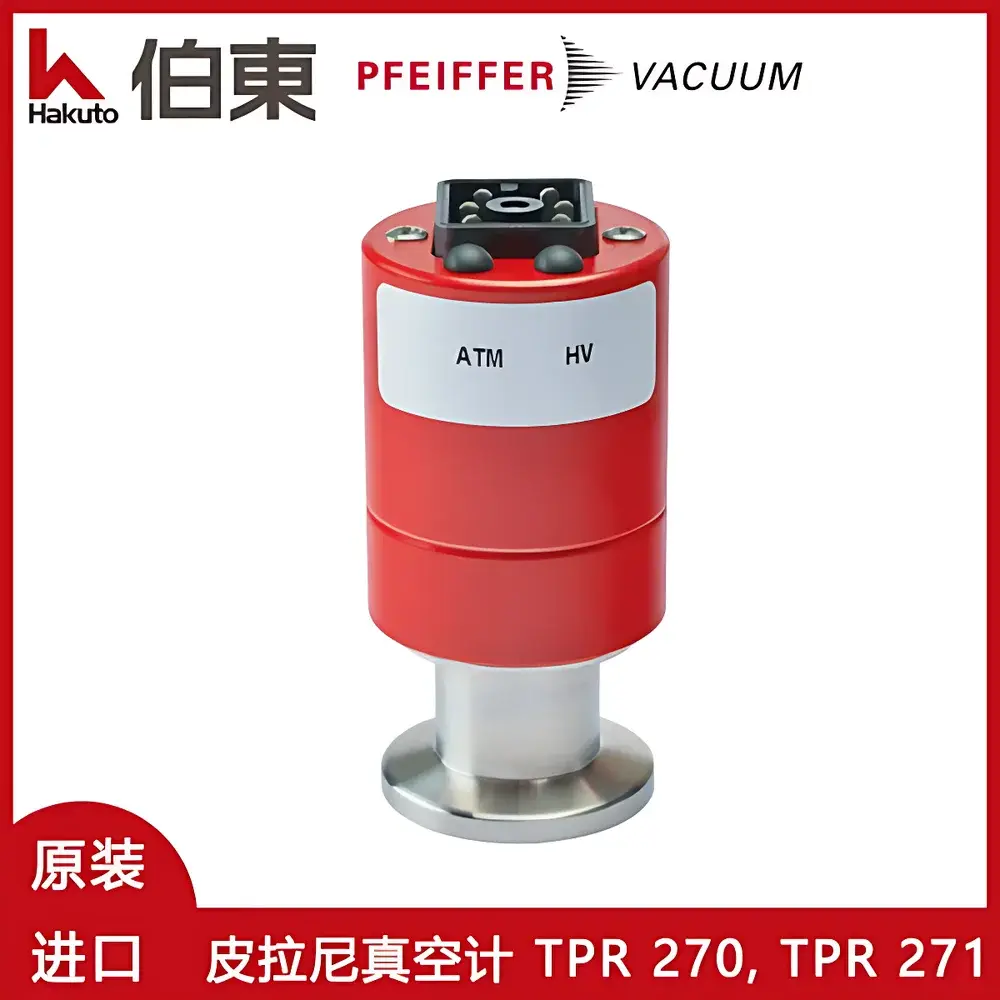
Pfeiffer Vacuum TPR 270 & TPR 271 Pirani Vacuum Gauges
| Brand | Pfeiffer Vacuum |
|---|---|
| Origin | Germany |
| Model | TPR 270, TPR 271 |
| Measurement Principle | Thermal Conductivity (Pirani) |
| Measured Medium | Gases |
| Range | 1×10⁻⁴ to 1000 hPa (TPR 270) |
| Accuracy | ±10 % to ±30 % of reading |
| Repeatability | ±2 % |
| Operating Temperature | 5 to 60 °C |
| Bakeout Temperature | Up to 80 °C (standard), up to 250 °C (with optional high-temp flange variants) |
| Output Signal | TPR 270: 1.5–8.5 V |
| TPR 271 | 2.2–8.5 V |
| Filament Material | TPR 270: Tungsten |
| TPR 271 | Platinum or Rhodium |
| Flange Options | DN 16 ISO-KF, DN 16 CF-F, 1/8" NPT, 8-VCR |
Overview
The Pfeiffer Vacuum TPR 270 and TPR 271 are compact, robust thermal conductivity (Pirani) vacuum gauges engineered for reliable pressure measurement in the medium- and low-vacuum range (1×10⁻⁴ to 1000 hPa). Based on the well-established Pirani principle—where gas thermal conductivity modulates the electrical resistance of a heated filament—the TPR series delivers stable, pulse-modulated operation that minimizes filament oxidation and extends service life. Unlike thermocouple gauges, the TPR’s active temperature control and digital pulse modulation ensure superior long-term stability and reduced drift, particularly under dynamic process conditions. These gauges are not absolute pressure standards but serve as cost-effective, field-serviceable sensors for routine monitoring in vacuum systems where traceable calibration is maintained via periodic verification against reference standards. Their design complies with fundamental electromagnetic compatibility (EMC) requirements per EN 61326-1 and mechanical safety per EN 61000-6-2, making them suitable for integration into industrial vacuum equipment, laboratory chambers, freeze dryers, and R&D setups operating under non-aggressive or mildly corrosive environments.
Key Features
- Two model variants optimized for distinct operational demands: TPR 270 (tungsten filament) for general-purpose inert-gas applications; TPR 271 (platinum or rhodium filament) for enhanced chemical resistance in processes involving water vapor, solvents, or mild corrosives—especially validated for lyophilization (freeze-drying) cycles.
- Pulse-modulated Pirani sensing architecture ensures consistent thermal management, minimizing filament aging and improving measurement reproducibility over extended service intervals.
- Standard analog voltage output (TPR 270: 1.5–8.5 V; TPR 271: 2.2–8.5 V) enables direct integration with PLCs, vacuum controllers, and SCADA systems without external signal conditioning.
- Multiple flange configurations available—including DN 16 ISO-KF, DN 16 CF-F, 1/8″ NPT, and 8-VCR—to support diverse chamber geometries and UHV-compatible installations.
- Optional high-temperature variants rated for bakeout up to 250 °C (with specific flange and sealing configurations), enabling use in systems requiring periodic in-situ cleaning or outgassing protocols.
- Compact housing (≤ 70 mm length) and IP40-rated enclosure facilitate mounting in space-constrained locations while maintaining mechanical resilience against vibration and thermal cycling.
Sample Compatibility & Compliance
The TPR 270 and TPR 271 are intended for gaseous media only and are not suitable for vapors condensing at operating temperatures or for reactive species such as halogens, strong oxidizers (e.g., O₃, Cl₂), or unsaturated hydrocarbons at elevated partial pressures. The TPR 271’s noble-metal filament significantly improves tolerance to moisture-laden atmospheres and organic solvent vapors common in pharmaceutical freeze-drying, though continuous exposure to aggressive chemistries requires evaluation per ISO 20483 (vacuum metrology) and consultation with application engineering. Both models meet CE marking requirements under the EU Machinery Directive 2006/42/EC and EMC Directive 2014/30/EU. While not certified to SIL or ATEX standards, their intrinsic design supports integration into safety instrumented systems (SIS) when paired with externally validated logic solvers and redundancy schemes compliant with IEC 61511.
Software & Data Management
These gauges operate as standalone analog sensors and do not include embedded firmware or digital communication interfaces (e.g., RS-485, Modbus, or Ethernet/IP). However, their linearized voltage output is fully compatible with third-party data acquisition systems supporting 0–10 V or 4–20 mA (via optional converter). When integrated into vacuum control platforms such as Pfeiffer’s HiCube or FlexiPump series, the TPR signals feed into centralized logging architectures that support audit-trail generation, timestamped trend storage, and export in CSV or XML formats—facilitating compliance with GLP and FDA 21 CFR Part 11 requirements when deployed with validated software layers and user-access controls. Calibration certificates (traceable to PTB or NIST standards) are provided upon request and include uncertainty budgets aligned with ISO/IEC 17025 guidelines.
Applications
- Monitoring chamber pressure during pharmaceutical freeze-drying (lyophilization), where TPR 271’s corrosion-resistant filament maintains accuracy across repeated water vapor load cycles.
- Process control in vacuum ovens, coating systems (PVD, CVD pre-pump stages), and leak detection stations operating between 10⁻³ and 10³ hPa.
- Education and training labs requiring durable, entry-level vacuum instrumentation with clear physical principles and straightforward signal interpretation.
- Backup or redundant pressure sensing in semiconductor tool foreline lines, where cost-effective redundancy complements capacitance manometers or cold cathode gauges.
- R&D vacuum systems integrating multiple gauge types—e.g., pairing TPR 270 with a Bayard-Alpert gauge for cross-range validation between 10⁻⁴ and 10² hPa.
FAQ
What gases can the TPR 270 and TPR 271 accurately measure?
They are calibrated for nitrogen and air; measurements in other gases require correction factors based on thermal conductivity ratios relative to N₂, as specified in Pfeiffer’s technical documentation (e.g., Bulletin TPR-EN-02).
Can these gauges be used in ultra-high vacuum (UHV) systems?
No—they are not designed for pressures below 1×10⁻⁴ hPa and lack UHV-compatible materials or bakeout-rated internal components unless explicitly ordered with the 250 °C flange option and verified seal configuration.
Is field recalibration possible?
Field recalibration is not supported; however, zero-point adjustment and span verification can be performed using certified reference gauges and documented procedures compliant with ISO 27874.
Do TPR 270/271 comply with FDA 21 CFR Part 11?
The gauges themselves are hardware-only devices with no electronic memory or user authentication—compliance depends entirely on the host system’s software architecture, audit trail implementation, and procedural controls.
What is the typical service life under continuous operation?
Under nominal conditions (≤ 50 °C ambient, non-condensing gases), mean time between failures exceeds 30,000 hours; filament replacement kits and OEM service support are available through authorized Pfeiffer distributors.