
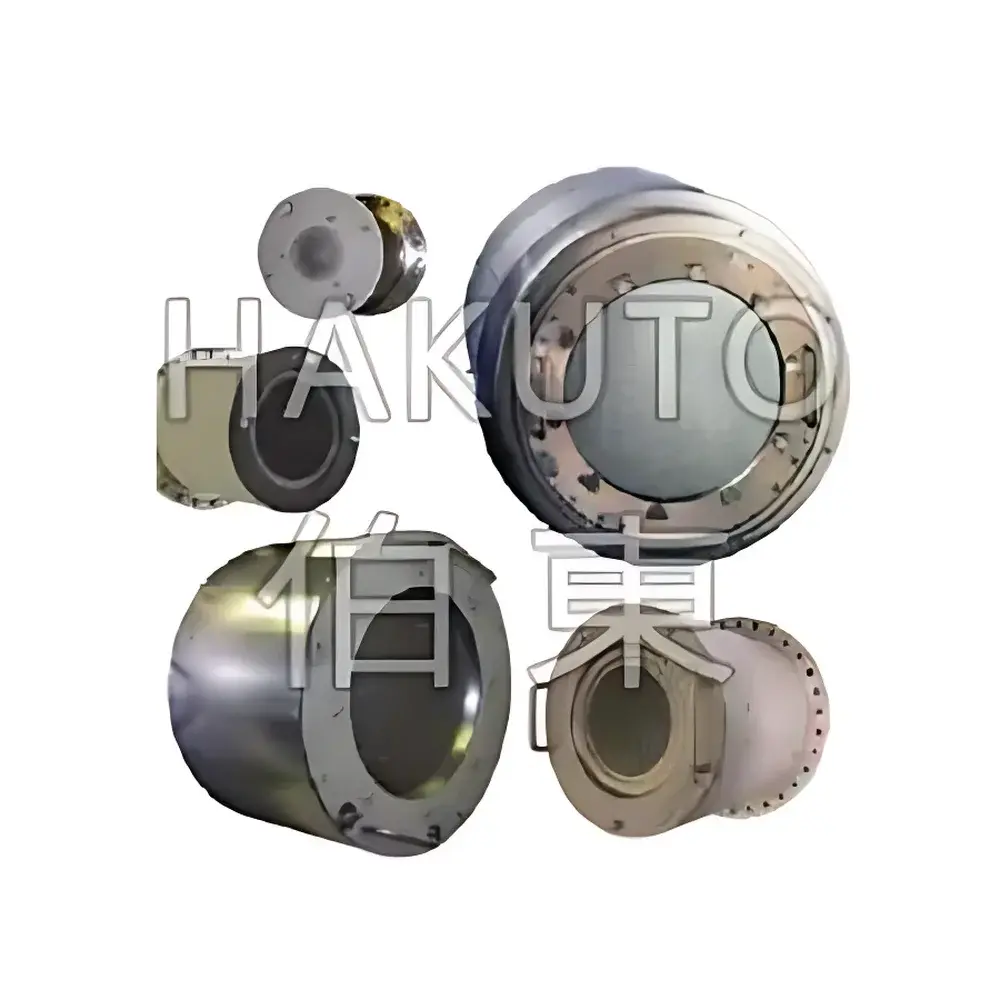
KRI Kaufman Gridded Ion Source KDC Series
| Brand | KRI (Kaufman & Robinson, Inc.) |
|---|---|
| Origin | USA |
| Model | KDC Series (KDC-10, KDC-40, KDC-75, KDC-100, KDC-160) |
| Beam Current | >10–650 mA |
| Beam Energy | 100–1200 V |
| Grid Diameter | 1–16 cm Φ |
| Operating Pressure | < 0.5 mTorr |
| Compatible Gases | Ar, Kr, Xe, O₂, N₂, H₂ |
| Gas Flow Rate | 1–30 sccm |
| Length | 11.5–25.2 cm |
| Diameter | 4–23.2 cm |
| Neutralizer | Thermionic Filament Type |
Overview
The KRI Kaufman Gridded Ion Source KDC Series is a precision-engineered, thermionically driven broad-beam ion source designed for integration into ultra-high vacuum (UHV) and high-vacuum systems used in thin-film research, surface engineering, and advanced materials processing. Based on the classical Kaufman-type discharge architecture—first pioneered by Dr. Robert L. Kaufman in 1978—the KDC series employs a heated tungsten or thoriated tungsten filament cathode to generate electrons, which ionize process gases within a cylindrical anode chamber. Ions are then extracted and accelerated through a multi-grid electrostatic optics system (typically two- or three-grid configuration), enabling precise control over beam energy, current density, and divergence. Unlike RF or microwave ion sources, the KDC’s DC-discharge design delivers exceptional stability, reproducibility, and low-noise operation—critical for applications requiring long-duration, uniform ion bombardment such as ion-beam-assisted deposition (IBAD), in-situ ion cleaning, and controlled sputter etching. The series is fully compatible with standard CF, ISO-K, and ConFlat vacuum flanges and engineered for modular integration into laboratory-scale coating systems, load-lock chambers, magnetron sputtering platforms, roll-to-roll web coaters, and linear deposition tools.
Key Features
- Gridded electrostatic ion optics with self-aligning grid assembly—minimizes beam steering drift and ensures long-term optical stability
- Switch-mode high-voltage power supply with independent control of discharge voltage, acceleration voltage, and neutralizer bias—enabling real-time optimization of beam profile and energy distribution
- Modular architecture: each KDC system includes the ion source body, thermionic electron neutralizer (with replaceable filament), dedicated DC power supplies, and interlock-compatible cabling
- Five scalable models (KDC-10 to KDC-160) covering grid diameters from 1 cm to 16 cm and beam currents from >10 mA to >650 mA—supporting both small-area R&D and large-area industrial processing
- Optimized for low-pressure operation (< 0.5 mTorr), ensuring minimal gas-phase collisions and high ion transmission efficiency
- Compatible with inert (Ar, Kr, Xe) and reactive (O₂, N₂, H₂) process gases—enabling both physical sputtering and reactive ion beam synthesis
Sample Compatibility & Compliance
The KDC series supports substrates ranging from silicon wafers and optical lenses to flexible polymer films and metallic foils. Its broad, collimated beam enables uniform treatment across flat, curved, or textured surfaces without raster scanning. All models comply with international vacuum safety standards (ISO 2788, ANSI Z88.2) and electromagnetic compatibility requirements (CE, FCC Class A). When integrated into GLP- or GMP-regulated environments—including optical coating lines for aerospace or medical-grade thin-film devices—the KDC’s stable output and repeatable beam parameters support audit-ready process documentation. While not intrinsically FDA 21 CFR Part 11 compliant, its analog/digital interface options allow integration with validated SCADA or MES systems supporting electronic signature and audit trail functionality.
Software & Data Management
KDC systems operate via front-panel analog controls or optional RS-232/RS-485 digital interfaces compatible with LabVIEW™, Python-based control suites, and PLC-driven automation frameworks. Real-time monitoring of discharge current, acceleration voltage, neutralizer emission current, and gas flow is supported through standardized 0–10 V analog outputs. Optional data-logging firmware enables timestamped parameter capture at 10 Hz resolution, facilitating correlation between ion beam conditions and film properties (e.g., stress, refractive index, stoichiometry). For traceability in regulated labs, third-party software packages can map KDC operational logs to ISO/IEC 17025-compliant calibration records and preventive maintenance schedules.
Applications
- Ion Beam Assisted Deposition (IBAD): Simultaneous evaporation/sputtering with concurrent ion bombardment to enhance adhesion, density, and crystallinity of optical coatings (e.g., TiO₂, SiO₂, Ta₂O₅)
- Ion Beam Sputter Deposition (IBSD): High-purity, low-defect thin-film growth on temperature-sensitive substrates using noble-gas ions
- Ion Beam Etching (IBE): Anisotropic, maskless material removal with sub-nanometer depth control for semiconductor metrology and MEMS fabrication
- Surface Activation & Cleaning: Removal of hydrocarbon contamination and native oxides prior to bonding or ALD nucleation—especially critical for III-V semiconductors and biofunctionalized surfaces
- Plasma-Enhanced Surface Modification: Cross-linking, functionalization, or hydrophilicity tuning of polymers (e.g., PET, PC, PI) for biomedical device manufacturing
FAQ
What vacuum level is required for optimal KDC operation?
The KDC series is designed for operation at pressures ≤ 0.5 mTorr. Stable plasma ignition and beam extraction require base pressures below 5×10⁻⁶ Torr; higher pressures may cause arcing or reduced beam current reproducibility.
Can the KDC be operated with reactive gases like oxygen or nitrogen?
Yes—KDC sources are routinely used with O₂, N₂, and H₂ for reactive sputtering and surface oxidation/nitridation. However, extended exposure to oxidizing gases may reduce filament lifetime; thoriated tungsten filaments are recommended for such applications.
Is neutralizer operation mandatory during beam extraction?
Yes. Electron neutralization of the positive ion beam is essential to prevent spacecraft-like charging of insulating substrates and maintain beam focus. All KDC systems include a thermionic neutralizer with independently adjustable bias.
How is beam uniformity characterized across the target area?
Beam uniformity is verified via Faraday cup mapping per ASTM F1193-22. Typical KDC-100 and KDC-160 models achieve ±5% current density variation over 90% of the nominal beam diameter at 10 cm working distance.
Does KRI provide calibration certificates or factory acceptance testing reports?
Upon request, KRI issues NIST-traceable calibration reports for discharge and acceleration power supplies, along with beam current/energy validation data generated under ISO 17025-accredited internal test protocols.



