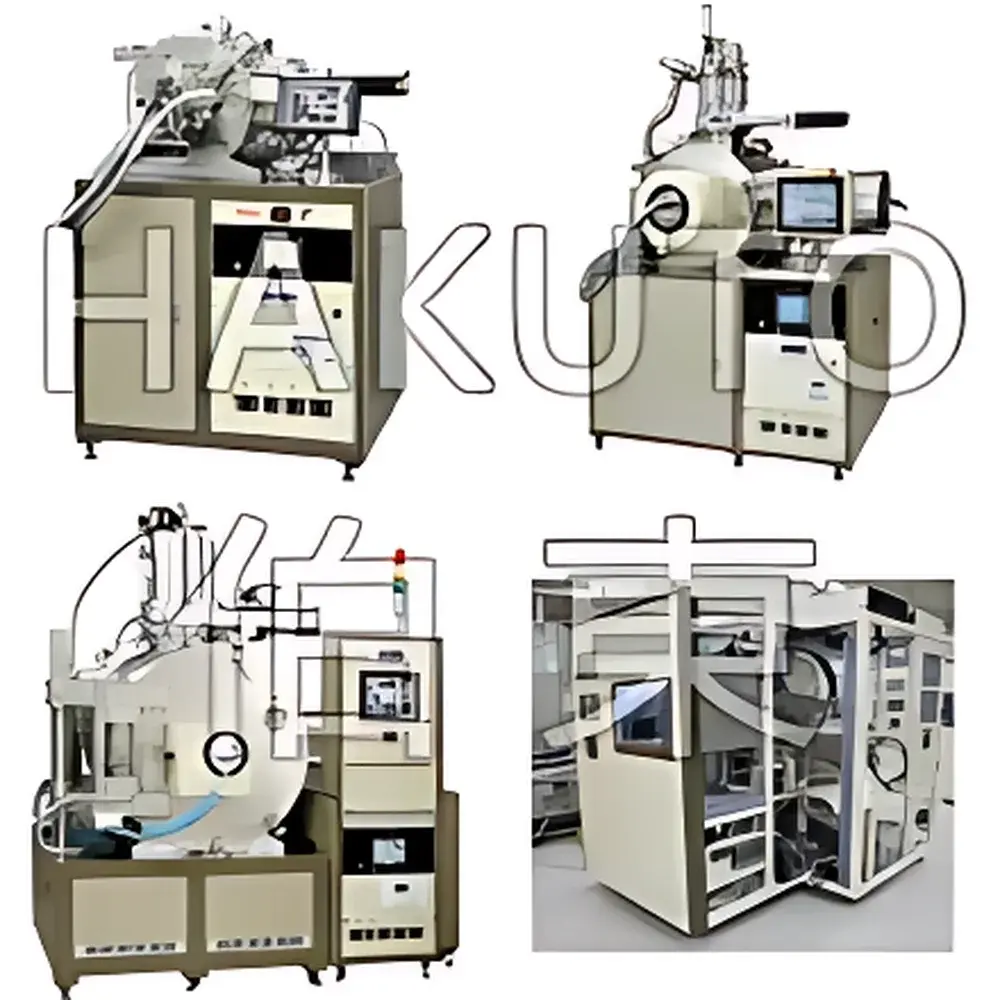
NS 4 IBE Kaufman-Type Ion Beam Etcher
| Brand | NS |
|---|---|
| Origin | Japan |
| Model | 4 IBE |
| Sample Holder | 4" φ, single wafer |
| Ion Incidence Angle | 0° to ±90° |
| Ion Source | KDC-40 Kaufman-type (KRI, USA) |
| Base Pressure | ≤1×10⁻⁴ Pa |
| Turbomolecular Pump | Pfeiffer, 350 L/s |
| Etch Uniformity | ≤±5% |
| Cooling | Direct substrate cooling |
| Motion Control | Planetary rotation (rotation + revolution) |
| Gas Compatibility | Ar, O₂, N₂, CF₄, Xe, and mixed process gases |
Overview
The NS 4 IBE is a compact, high-precision Kaufman-type ion beam etcher engineered for advanced dry-etching applications in academic research laboratories, R&D centers, and pilot-line semiconductor fabrication. Unlike reactive ion etching (RIE) or plasma-based systems, the 4 IBE employs a physically sputtering-dominated mechanism—accelerating inert or reactive ions (typically Ar⁺, but extendable to O₂⁺, N₂⁺, or CF₄⁺) through electrostatic grids to achieve highly directional, low-damage material removal. Its collimated ion beam enables sub-micron feature definition with exceptional anisotropy and minimal sidewall redeposition, making it uniquely suited for materials resistant to chemical etching—including magnetic alloys (NiFe, CoFeB), noble metals (Au, Pt), refractory metals (W, Mo), and compound semiconductors (GaAs, InP, SiC). The system operates under ultra-high vacuum (UHV) conditions (<1×10⁻⁴ Pa), ensuring contamination-free processing and stable beam current density over extended runs.
Key Features
- Kaufman-type ion source (KDC-40, KRI, USA): Delivers stable, long-lifetime ion beams with adjustable extraction voltage (up to 1.5 kV) and broad current density control (0.1–2 mA/cm²).
- Full angular flexibility: Ion incidence angle continuously adjustable from –90° to +90° relative to the sample normal, enabling vertical, tilted, or glancing-angle etching for controlled profile engineering.
- Direct substrate cooling: Integrated copper chuck with liquid nitrogen or chilled water interface maintains sample temperature below –50°C during prolonged etching—critical for thermally sensitive films and stress management.
- Planetary motion stage: Combines synchronized rotation and revolution to ensure uniform ion flux distribution across 4-inch wafers, achieving ≤±5% etch rate uniformity without requiring complex beam scanning.
- UHV-compatible architecture: Equipped with a Pfeiffer turbomolecular pump (350 L/s) and all-metal sealed chambers; base pressure <1×10⁻⁴ Pa ensures low residual gas partial pressures and repeatable process reproducibility.
- Modular gas delivery: Dual-channel mass flow controllers support inert (Ar, Xe) and reactive (O₂, N₂, CF₄) gases—enabling both physical sputtering and ion-assisted chemical etching modes.
Sample Compatibility & Compliance
The NS 4 IBE accommodates standard 4-inch (100 mm) substrates—including Si, quartz, sapphire, glass, and flexible polymer foils—with optional custom fixtures for non-planar or irregular samples. It supports mask-based patterning using metal (Cr, Ni) or dielectric (SiO₂, SiNₓ) hard masks deposited via sputtering or evaporation. The system conforms to ISO 14644-1 Class 5 cleanroom compatibility when installed in appropriate enclosures. All vacuum components meet ASTM F2780 standards for UHV integrity, and electrical subsystems comply with IEC 61000-6-3 (EMC) and IEC 61010-1 (safety). Process documentation supports GLP/GMP traceability requirements, including timestamped log files, parameter archiving, and user-accessible audit trails.
Software & Data Management
Control is executed via a real-time Windows-based HMI with deterministic PLC logic, supporting recipe-driven operation, multi-step sequential processes (e.g., pre-sputter cleaning → main etch → endpoint monitoring), and interlocked safety protocols. Software logs include beam current/voltage, chamber pressure, gas flows, stage position, and substrate temperature at 100 ms intervals. Export formats include CSV and HDF5 for integration with MATLAB, Python (Pandas), or LabVIEW-based analysis pipelines. Optional FDA 21 CFR Part 11-compliant configuration provides electronic signatures, role-based access control, and immutable audit trails for regulated environments.
Applications
- Development of spintronic devices: Precise milling of MTJ stacks (CoFeB/MgO/CoFeB) without interfacial oxidation or magnetic dead layers.
- Microfabrication of RF/microwave components: Low-loss patterning of superconducting Nb thin films and high-Q resonator structures.
- TEM sample preparation: Site-specific thinning of cross-sectional specimens with minimal amorphization or ion implantation artifacts.
- Nanoimprint mold repair: Sub-10 nm defect correction on Ni or Si templates used in NIL lithography.
- Surface functionalization studies: Controlled surface roughening or stoichiometric modification of oxides (e.g., TiO₂, ZnO) for catalysis or sensing research.
FAQ
What materials can be etched with the NS 4 IBE?
It processes virtually all solid-state materials—including elemental metals (Au, Pt, Cu), magnetic alloys (Permalloy, CoPt), ceramics (Al₂O₃, SiC), and compound semiconductors—without requiring material-specific chemistry optimization.
Is endpoint detection integrated?
The base configuration does not include optical emission spectroscopy (OES) or laser interferometry; however, the system provides analog/digital I/O ports for third-party endpoint sensor integration (e.g., residual gas analyzers or reflectance monitors).
Can the system be upgraded for larger substrates?
The 4 IBE platform is optimized for 4-inch wafers; scaling to 6-inch requires structural redesign of the chamber, stage, and beam optics—available as a factory-engineered customization under NS’s OEM program.
What maintenance intervals are recommended for the KDC-40 ion source?
Typical service life exceeds 5,000 operating hours; routine maintenance includes quarterly filament inspection and annual grid cleaning—detailed in the NS Technical Service Manual (Rev. 4.2).
Does the system support remote diagnostics?
Yes—via encrypted Ethernet connection, authorized engineers can perform real-time performance diagnostics, firmware updates, and calibration verification under customer-defined security policies.