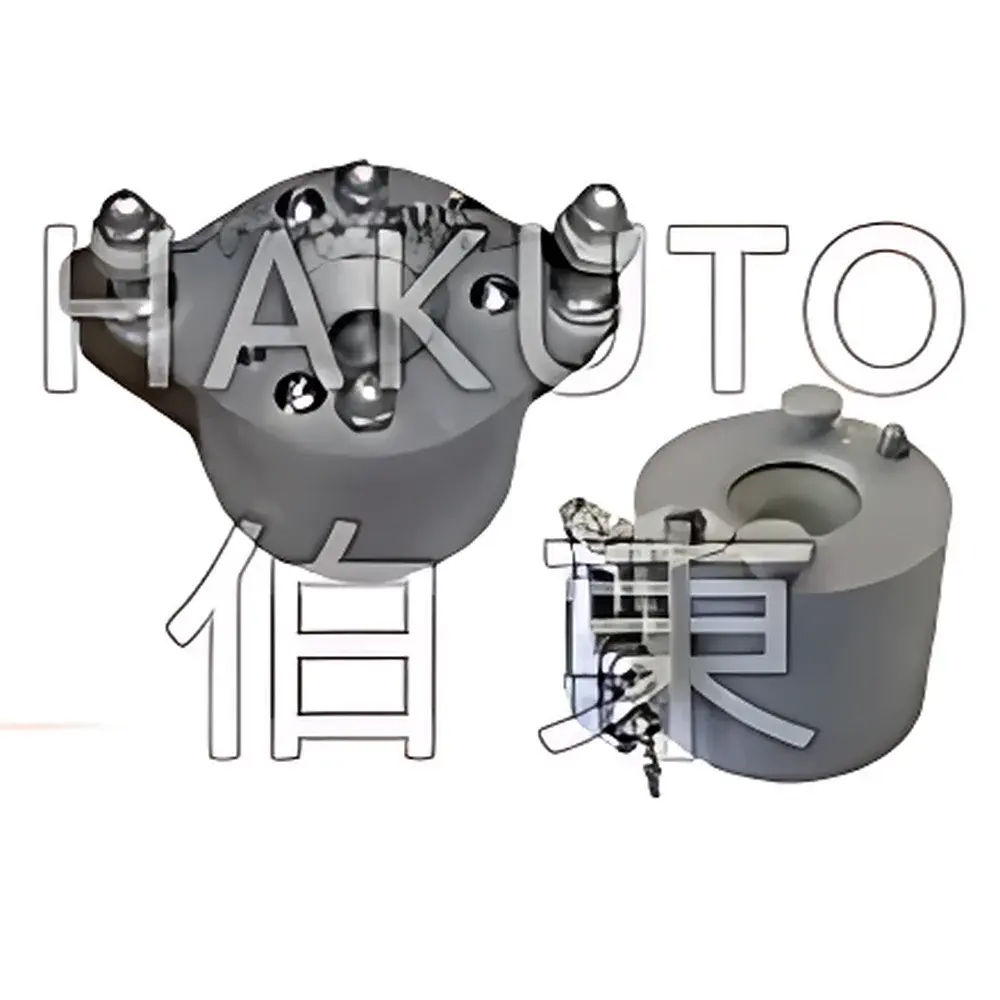
KRI EH 3000 HC Hall-Effect Ion Source for Ion Beam Assisted Deposition (IBAD)
| Brand | Kaufman & Robinson, Inc. (KRI) |
|---|---|
| Origin | USA |
| Model | EH 3000 HC |
| Discharge Voltage/Current | 50–300 V / up to 20 A |
| Beam Divergence (HWHM) | >45° |
| Cooling | Water-cooled |
| Compatible Gases | Ar, Xe, Kr, O₂, N₂ |
| Dimensions | Ø9.7" × H6" |
| Application | IBAD for high-density, uniform optical thin-film deposition |
Overview
The KRI EH 3000 HC Hall-effect ion source is a high-current, gridless ion beam generator engineered for precision ion beam assisted deposition (IBAD) in demanding optical and semiconductor thin-film applications. Unlike gridded Kaufman-type sources, the EH 3000 HC employs a magnetically confined plasma discharge within a ceramic discharge chamber, enabling stable, long-lifetime operation without grid erosion or thermal distortion. Its hall-effect acceleration mechanism produces a highly collimated yet broadly divergent ion beam (>45° half-width at half-maximum), delivering exceptional spatial uniformity and flux density across large-area substrates—critical for fabricating low-absorption, high-reflectivity coatings on meter-class optics. Designed for integration into high-vacuum (≤1×10⁻⁶ Torr) PVD systems, the EH 3000 HC operates with inert and reactive gases—including Ar, O₂, and N₂—to support both sputter cleaning, reactive IBAD, and stoichiometric oxide formation (e.g., SiO₂ capping layers). Its water-cooled mechanical architecture ensures thermal stability during extended duty cycles, making it suitable for production-scale astronomical mirror coating, automotive reflector manufacturing, and advanced photonic device fabrication.
Key Features
- High-current capability: Sustained ion beam currents up to 20 A at adjustable discharge voltages (50–300 V), enabling precise control over ion energy and flux density.
- Gridless Hall-effect design: Eliminates grid degradation mechanisms, ensuring >10,000 hours of operational lifetime and consistent beam profile stability across multiple process runs.
- Wide angular coverage: Beam divergence exceeding 45° (HWHM) provides uniform ion bombardment over substrates up to Ø1.5 m without mechanical scanning or multiple source configurations.
- Reactive gas compatibility: Fully validated for O₂, N₂, Ar, Xe, and Kr—enabling in-situ oxidation during Al-based reflective stack deposition (e.g., Al/SiO₂ broadband mirrors).
- Integrated neutralization: Equipped with a dedicated hollow cathode neutralizer to prevent substrate charging and ensure charge-balanced beam delivery under high-current conditions.
- Modular vacuum interface: Standard CF-63 or CF-100 flange mounting; compatible with ISO-K and ConFlat vacuum architectures common in industrial coating platforms.
Sample Compatibility & Compliance
The EH 3000 HC supports planar and moderately curved substrates ranging from 100 mm to 1500 mm in diameter, including fused silica, ULE®, and Zerodur® astronomical mirror blanks. It has been successfully deployed in Class 100 cleanroom-integrated 2.2 m-diameter planetary-scale evaporation chambers for NASA- and ESO-aligned telescope programs. The system complies with SEMI S2-0215 safety guidelines for plasma-based vacuum equipment and meets CE marking requirements for electromagnetic compatibility (EMC Directive 2014/30/EU) and low-voltage operation (LVD Directive 2014/35/EU). All control electronics are designed to support GLP/GMP audit trails when integrated with compliant SCADA or PLC-based process controllers.
Software & Data Management
The EH 3000 HC operates via a dedicated analog/digital hybrid controller (included), providing real-time monitoring of discharge voltage, anode current, neutralizer emission current, gas flow (via optional mass flow controller integration), and coolant temperature. Optional RS-485 or Ethernet-enabled programmable logic modules allow synchronization with main chamber PLCs for recipe-driven IBAD sequencing—supporting full traceability per batch in accordance with FDA 21 CFR Part 11 requirements when paired with validated data acquisition software. Process logs include timestamped parameters, interlock status, and fault diagnostics—facilitating root-cause analysis during qualification and routine maintenance.
Applications
- Astronomical optics: Fabrication of ultra-low-loss Al/SiO₂ and Ag/SiO₂ broadband reflective coatings for segmented primary mirrors (e.g., 1.5 m telescope elements), where <0.1% absorption loss is required across 300–1200 nm.
- Automotive lighting: High-efficiency reflector coatings for LED headlamp modules, improving luminous efficacy through enhanced specular reflectance and reduced scattering.
- Semiconductor metrology optics: Dense, pinhole-free anti-reflective and high-reflection stacks for EUV lithography mask inspection systems and interferometric sensor components.
- Space-qualified thin films: Radiation-hardened optical coatings requiring high packing density, low columnar microstructure, and minimal residual stress—validated per MIL-STD-883 Method 1015.8.
FAQ
What vacuum level is required for stable EH 3000 HC operation?
Optimal performance requires base pressure ≤5×10⁻⁷ Torr, with operating pressure maintained between 1×10⁻⁴ and 5×10⁻⁴ Torr during gas introduction.
Can the EH 3000 HC be used for ion etching (IBE) as well as IBAD?
Yes—the source delivers sufficient ion energy and current density for shallow-angle IBE of optical coatings and surface pre-cleaning prior to deposition, though dwell time and angle must be optimized per material system.
Is remote diagnostics supported?
Standard analog outputs (0–10 V) enable integration with third-party DAQ systems; optional digital communication modules provide Modbus TCP or EtherCAT protocol support for predictive maintenance logging.
What cooling infrastructure is required?
A closed-loop deionized water system with flow rate ≥4 L/min and temperature stability ±1°C is recommended; inlet pressure must remain between 30–100 psi.
How is beam uniformity verified and qualified?
KRI provides Faraday cup mapping protocols and certified beam profile reports; users may perform in-situ uniformity validation using calibrated quartz crystal microbalances (QCMs) arranged in radial arrays across the substrate plane.