
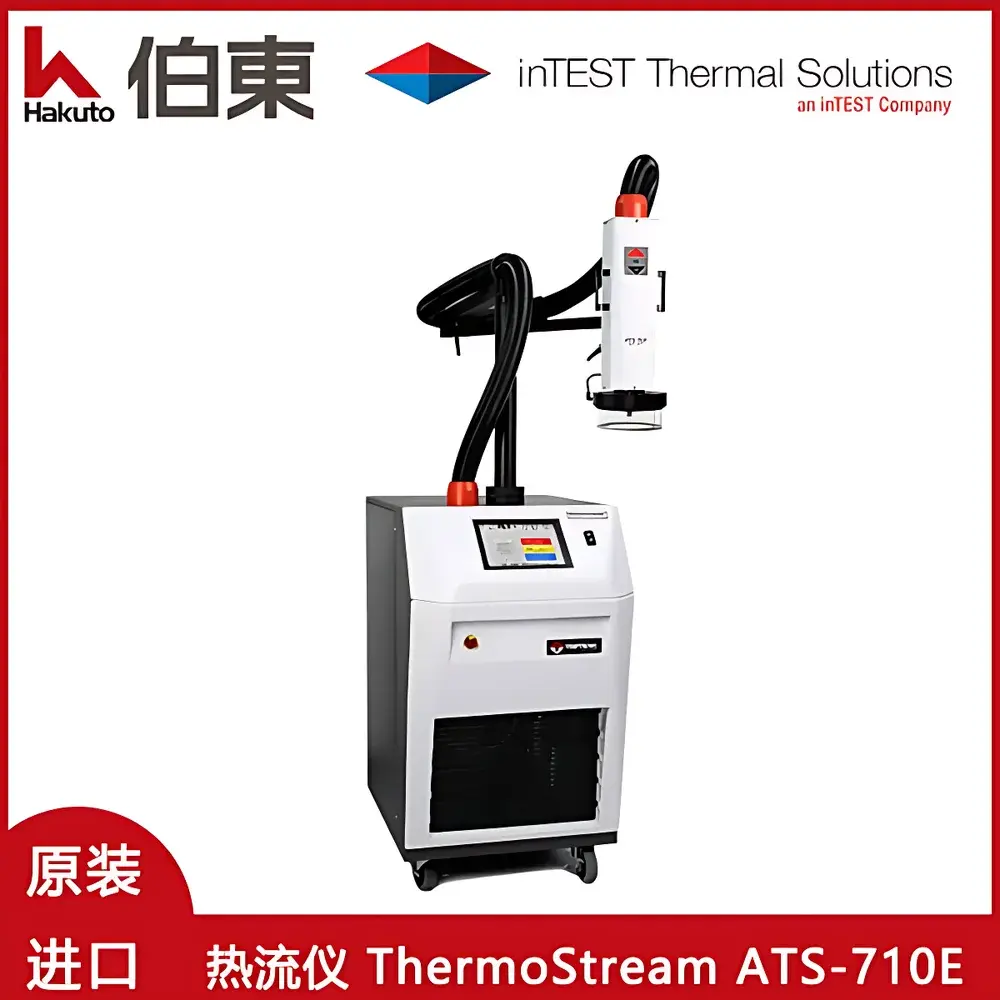
inTEST ATS-710E ThermoStream® High-Speed Thermal Shock Test System
| Brand | inTEST–Temptronic |
|---|---|
| Origin | USA |
| Manufacturer Type | Authorized Distributor |
| Origin Category | Imported |
| Model | inTEST ATS-710E |
| Quotation | Upon Request |
| High-Temperature Range (°C) | +225 |
| Low-Temperature Range (°C) | −75 |
| Thermal Shock Range (°C) | −75 to +225 (50 Hz) |
| Temperature Stability (°C) | ±0.1 °C |
| Heating Rate (°C/min) | −55 to +125 °C in ~10 s |
| Cooling Rate (°C/min) | +125 to −55 °C in ~10 s |
| Airflow Output | 4–18 scfm (1.8–8.5 L/s) |
| Temperature Accuracy | ±1 °C (NIST-traceable calibration) |
| Temperature Display Resolution | 0.1 °C |
| Sensor Type | T-type or K-type thermocouple |
| Remote Interfaces | Ethernet, IEEE-488 (GPIB), RS-232 |
| Control Interface | Touchscreen HMI with embedded real-time OS (Windows-free architecture) |
Overview
The inTEST ATS-710E ThermoStream® is a high-speed, closed-loop thermal shock test system engineered for precision temperature transient testing of electronic components and assemblies under dynamic thermal stress conditions. Unlike conventional environmental chambers, the ATS-710E employs forced convective heat transfer via precisely conditioned, dry nitrogen-enriched airflow directed through a localized thermal shroud—enabling rapid, repeatable, and spatially selective thermal excursions directly onto the device under test (DUT). Its core architecture leverages inTEST’s proprietary OCM (Optimized Control Module) platform, delivering sub-10-second transitions between −55 °C and +125 °C while maintaining ±0.1 °C stability at setpoint. Designed for integration into automated test environments—including ATE load boards, burn-in systems, and reliability qualification labs—the ATS-710E supports full traceability, audit-ready operation, and deterministic thermal profiling without reliance on legacy Windows-based controllers.
Key Features
- High-fidelity thermal shock capability: Achieves −75 °C to +225 °C operational range (50 Hz), with extended −80 °C to +225 °C support at 60 Hz power supply
- Ultra-fast thermal transients: ≤10 seconds for both heating (−55 °C → +125 °C) and cooling (+125 °C → −55 °C) cycles
- NIST-traceable temperature accuracy of ±1 °C and display resolution of 0.1 °C, verified per ASTM E220 and ISO/IEC 17025 guidelines
- Dry-air purge system (0.5–3 scfm) prevents condensation on DUT surfaces during low-temperature exposure
- Fluorocarbon-free refrigeration circuit compliant with EPA SNAP and EU F-Gas Regulation (Regulation (EU) No 517/2014)
- Embedded touchscreen HMI with deterministic real-time operating system—eliminates Windows dependency and associated obsolescence risks
- Programmable overtemperature protection (factory default: +230 °C), user-configurable upper/lower thermal limits
- Auto-standby mode reduces power consumption during idle or hold states without compromising thermal readiness
Sample Compatibility & Compliance
The ATS-710E accommodates a broad spectrum of DUT geometries—from bare die and packaged ICs (QFN, BGA, CSP) to populated PCBs up to 5.5-inch shroud diameter. Its localized thermal delivery avoids thermal crosstalk, enabling single-component stress testing on multi-device boards—a critical requirement for JEDEC JESD22-A104 (Temperature Cycling) and JESD22-A106 (Thermal Shock) qualification. The system meets IEC 60068-2-14 (Test N: Change of Temperature) and supports GLP/GMP-aligned workflows through configurable audit trails, electronic signatures, and 21 CFR Part 11–compliant data logging when paired with inTEST’s optional SecureLog™ software module. All thermal sensors are calibrated against NIST-traceable standards; calibration certificates include uncertainty budgets per ISO/IEC 17025.
Software & Data Management
Control and monitoring are executed via an embedded web-enabled HMI supporting Ethernet, IEEE-488 (GPIB), and RS-232 interfaces—enabling seamless integration with LabVIEW, Python-based test sequencers, or enterprise MES platforms. Real-time temperature telemetry, airflow status, compressor diagnostics, and alarm logs are timestamped and exportable in CSV or XML format. Optional SecureLog™ adds role-based access control, immutable audit logs, electronic signature capture, and encrypted local storage—fully aligned with FDA 21 CFR Part 11 and EU Annex 11 requirements. USB ports support keyboard/mouse input and printer output; no external PC is required for basic operation.
Applications
- Qualification testing of power management ICs, automotive ADAS SoCs, and aerospace-grade ASICs per AEC-Q200, MIL-STD-883, and ECSS-Q-ST-60-13C
- Failure analysis root-cause isolation via targeted thermal stressing of suspect nodes on high-density PCBs
- Thermal design validation of thermal interface materials (TIMs), heatsink attachment efficacy, and package-level CTE mismatch
- Accelerated life testing (ALT) protocols requiring controlled ramp-hold-shock profiles with <5 s dwell repeatability
- In-line thermal screening during wafer sort and final test, integrated with handler interfaces and parametric test equipment
FAQ
What distinguishes the ATS-710E from conventional thermal shock chambers?
Unlike large-volume air- or liquid-immersion chambers, the ATS-710E applies thermal energy directionally via focused airflow—reducing thermal mass effects, eliminating long soak times, and enabling component-level rather than board-level stress.
Is NIST-traceable calibration included with shipment?
Yes—each unit ships with a factory calibration certificate documenting as-found/as-left data, measurement uncertainty, and traceability to NIST Standard Reference Materials (SRMs).
Can the system operate without a Windows host PC?
Yes—the embedded controller runs a deterministic real-time OS; all functions—including profile editing, data logging, and remote command execution—are accessible via the touchscreen or network interfaces.
Does the ATS-710E comply with environmental refrigerant regulations?
Yes—it uses R-513A (a low-GWP, non-ozone-depleting refrigerant approved under EPA SNAP and EU F-Gas Regulation) and contains zero CFCs, HCFCs, or flammable hydrocarbons.
What safety protections are built into the thermal shroud interface?
The shroud includes interlocked thermal cutoff switches, airflow obstruction detection, and automatic shutdown upon loss of sensor feedback or excessive surface temperature deviation (>±5 °C from setpoint).
Related Products



