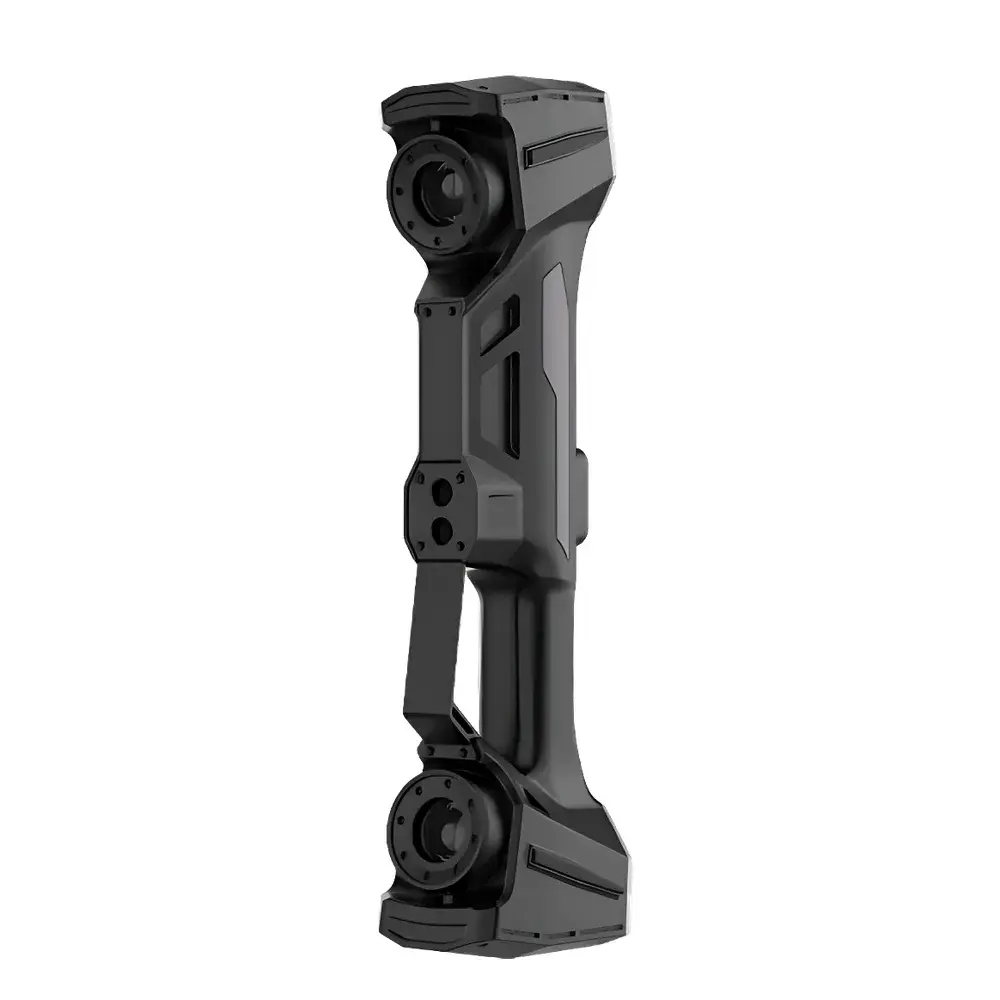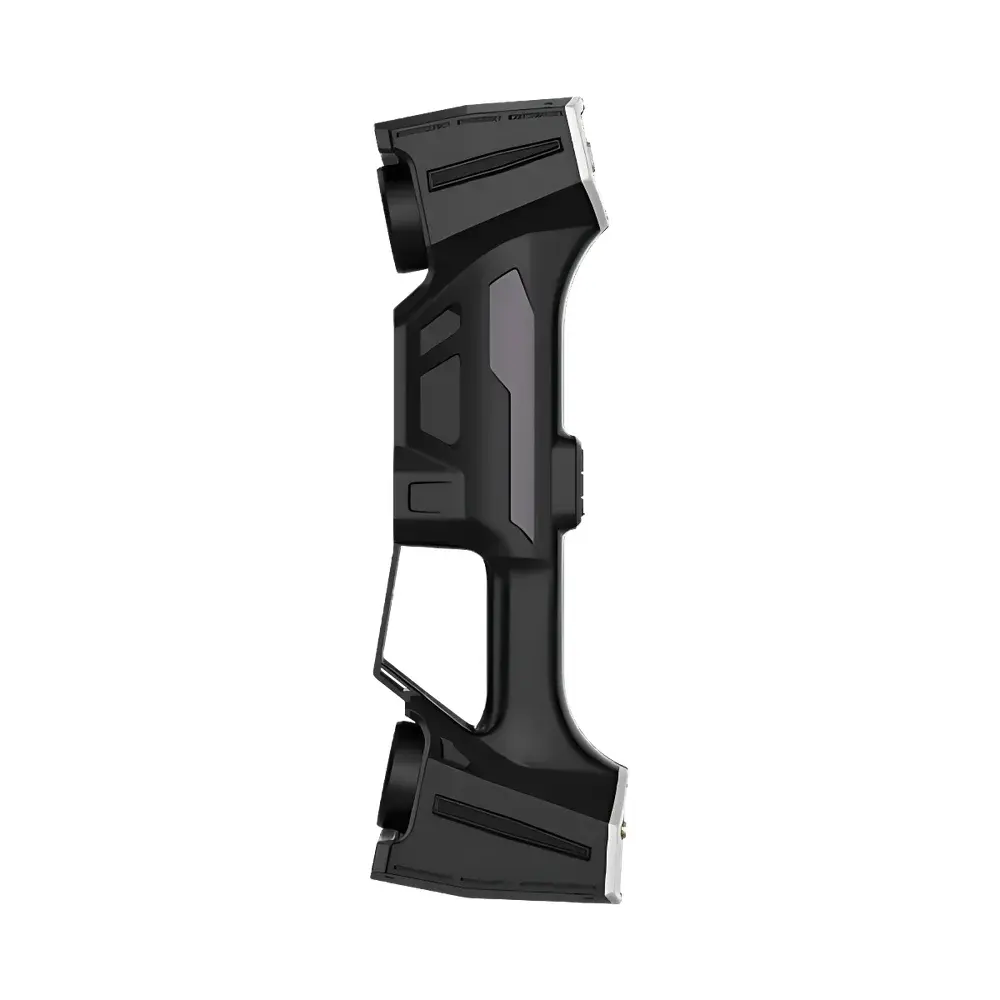
Hexagon HyperScan Intelligent Optical Tracking 3D Scanner
| Brand | Hexagon |
|---|---|
| Origin | Shandong, China |
| Manufacturer Type | Authorized Distributor |
| Product Category | Domestic |
| Model | HyperScan |
| Instrument Type | Laser-Based 3D Scanner |
| Measurement Speed | 8.3 million measurements per second |
Overview
The Hexagon HyperScan Intelligent Optical Tracking 3D Scanner is a high-performance, metrology-grade laser triangulation system engineered for dynamic, high-accuracy 3D digitization of large-scale industrial components. Unlike conventional structured-light or photogrammetry-based scanners, HyperScan integrates real-time optical tracking via an external metrological tracker—eliminating the need for adhesive reference targets or rigid fixture setups. Its core architecture leverages synchronized spatial coordinate fusion between the tracker’s six-degree-of-freedom (6DoF) pose estimation and the scanner’s high-density blue laser line projection. This enables robust, vibration-insensitive measurement in uncontrolled production environments—including aerospace assembly floors, automotive body-in-white stations, heavy machinery fabrication bays, and foundry mold inspection zones—where thermal drift, floor vibrations, and acoustic noise would otherwise compromise data integrity.
Key Features
- Optical Tracking–Enabled Targetless Operation: Real-time 6DoF tracking of the scanner head by an external metrological optical tracker ensures sub-millimeter positional repeatability without surface-mounted targets—reducing setup time by up to 70% compared to traditional photogrammetric alignment workflows.
- Ultra-High-Density Blue Laser Array: Equipped with an upgraded 7-in-1 laser engine projecting 116 parallel blue laser lines, HyperScan achieves a sustained acquisition rate of 8.3 million 3D points per second—enabling full-field capture of complex freeform surfaces on parts exceeding 5 m in length within minutes.
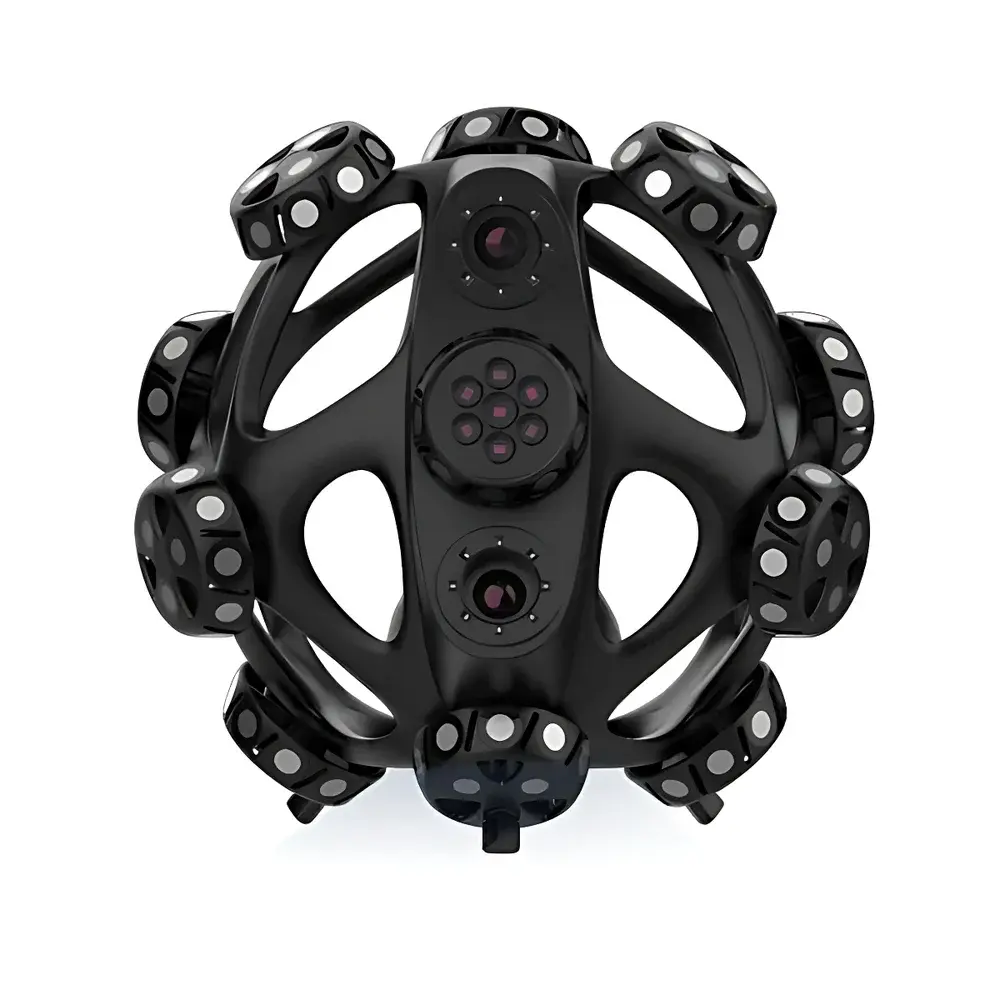
- Carbon-Fiber Integrated Spherical Cage: A monolithic carbon-fiber mechanical housing encloses the optical core and integrated fiducial sphere array. The redesigned spherical targets feature omnidirectional retroreflective geometry optimized for consistent detection across ±90° angular incidence—improving tracker lock reliability and reducing occlusion-related repositioning cycles.
- Voice-Controlled Metrology Interface: Supports multilingual voice command execution (English, German, Mandarin, Japanese) for mode selection, scan initiation/pause, software navigation, and calibration trigger—all compliant with ISO/IEC 17025-accredited lab environment protocols where hands-free operation enhances procedural consistency.
- Adaptive Resolution Scanning: Dynamically modulates point density in real time based on local surface curvature, reflectivity, and geometric discontinuity—preserving micron-level detail on critical features (e.g., turbine blade leading edges) while suppressing redundant sampling on planar regions to optimize point cloud size and post-processing latency.
Sample Compatibility & Compliance
HyperScan accommodates metallic, composite, painted, and thermally coated surfaces without pre-treatment—leveraging stabilized blue laser wavelength (450 nm) for reduced specular interference and improved signal-to-noise ratio on high-gloss or anodized finishes. It complies with ISO 10360-8:2020 for articulated arm and optical tracker–based coordinate measuring systems, and supports traceable calibration using NIST-traceable artifact sets (e.g., ceramic step gauges, sphere plates). All firmware and embedded control logic are validated under IEC 61508 SIL2 for functional safety in industrial automation contexts. Data provenance—including timestamped tracker pose logs, laser power monitoring, and environmental temperature compensation records—is maintained in accordance with FDA 21 CFR Part 11 and EU Annex 11 requirements for regulated manufacturing environments.
Software & Data Management
The HyperScan Control Suite (v5.2+) provides native integration with Hexagon’s Metrology Software Platform (MSP), supporting bidirectional workflow synchronization with PC-DMIS, QUINDOS, and OpenDXF-compliant CAD comparison engines. Raw point clouds are stored in vendor-neutral ASAM MCD-2 MC format, enabling interoperability with third-party meshing (MeshLab, Geomagic Wrap), GD&T evaluation (PolyWorks Inspector), and digital twin ingestion pipelines (PTC ThingWorx, Siemens Teamcenter). Audit trails record every user action, parameter change, and hardware event with SHA-256 hashing and immutable timestamps—fully auditable for GLP/GMP internal audits and regulatory submissions.
Applications
- Aerospace: In-situ wing spar deformation monitoring during load testing; tooling verification for composite layup molds.
- Automotive: Body-in-white dimensional stability assessment across thermal cycles; stamping die wear analysis using time-series deviation mapping.
- Heavy Industry: As-built validation of cast turbine housings prior to machining; alignment verification of multi-axis gantry structures.
- Energy: Geometry fidelity checks of wind turbine blade root sections after transport-induced flexure.
- Education & Research: Teaching labs utilizing open API access for custom trajectory planning and real-time point cloud streaming via ROS 2 middleware.
FAQ
Does HyperScan require physical target placement on the part surface?
No. HyperScan operates in a targetless mode by continuously tracking its own position and orientation via an external optical metrology tracker—eliminating the need for adhesive or magnetic targets.
What environmental conditions affect measurement stability?
The system maintains metrological performance under ambient temperature fluctuations of ±5 °C/hour and floor vibration spectra up to 15 Hz RMS acceleration—validated per ISO 230-2 Annex D test protocols.
Is the voice control functionality certified for use in Class 1 Div 1 hazardous locations?
Voice interface hardware meets IP54 ingress protection but is not intrinsically safe rated; it must be deployed outside classified zones or housed in explosion-proof enclosures per NEC Article 500.
Can HyperScan data be directly imported into CATIA or NX for GD&T analysis?
Yes—via native STEP AP242 export or direct MSP-to-CATIA/NX connector modules supporting PMI-rich model exchange and tolerance stack-up simulation.
How is traceability ensured during multi-station scanning campaigns?
Each scan station is registered to a common global coordinate frame using tracker-measured fiducial sphere positions, with uncertainty propagation calculated per GUM Supplement 2 and reported in the final inspection report.